Showing posts sorted by relevance for query airglow. Sort by date Show all posts

Saturday, June 28, 2014

Airglow Over The Canyon!

There are many glows in the night time sky.  In towns and cities, the normally dark sky is diffusely lit by the scattering of man-made light sources from dust, humidity and aerosols.  This "light pollution" limits many types of observing from urban areas.  But from the Grand Canyon and other dark sites, even mountaintop sites here in Arizona, there are other types of natural airglow.  Aurora, or Northern (or Southern) lights are from energetic particles from the sun coming down the magnetic field lines of the Earth, interacting with the upper atmosphere, mostly at northern (or southern) latitudes, very rare in Arizona.  But the topic of this post, which I've covered before, is of airglow, fainter, but generally more visible from anywhere on the Earth's surface.  Shown at left is the view from the International Space Station, with airglow seen as a diffuse greenish glow in the atmosphere.   An excellent discussion of various properties of airglow is presented in the archives of Atmospheric Optics and Optics Picture of the Day, maintained by Les Cowley.


While obvious from orbit, where you see a stronger glow because of the long path length an observer at altitude would look through, it is harder to spot from the ground.  The last few years we've had good displays from the Grand Canyon Star Party, perhaps because of the dark northern sky, and also perhaps because they are generally held near the summer solstice.  Airglow is caused by excitation of molecules in the upper atmosphere by ultraviolet light of the sun, and the light of the glow is discharged at night after the sun sets.  At the Summer solstice, my thinking is that with the long days, and the sun not being very far below the northern horizon, the airglow display from Northern Arizona might be enhanced.  While the green glow is caused by the excitation and discharge from oxygen molecules, in the near-infrared, the sky is aglow from OH emission caused by the same effect.  The IR emission was discovered by Aden Meinel in the 1950s, a well known astronomer of the middle of the last century that all Arizonans likely know (and I had occasion to meet several times).   Fortunately, I brought my IR-modified Canon 20D, which captures near-IR redward of 720nm.  At left is shown a fisheye view showing this OH emission - it looks like clouds, but the sky is just aglow from a multitude of emission lines.  There was no moonlight, no city lights to illuminate these "clouds" from below...  Looking North towards Polaris, just above center, the fisheye view shows the Big Dipper at left to Cassiopeia at right.


Comparing the above view to a visible-light image, the first thing that I noticed is that besides the change in airglow, even the constellations look different!  Check out the comparison at left, showing the view of the Big Dipper from the picture above, to the visible-light view.  With the lines I've drawn showing the dipper outline, there seem to be "extra" stars on the near-IR view.  Of course, it would look different with different wavelength coverage!  The three stars pointed out in the IR view are red variable stars or otherwise cooler spectral types that appear brighter in the IR view than they do in visible light...  As seen in the right image taken a few minutes later than the IR shot, the visible-light image is dominated by the greenish glow of oxygen emission, though since we're not in the ISS looking across at it, it appears brighter near the horizon where you are looking through a larger cross-section of the emission...


So here are the full-size frames from the fisheye
view in visible light at left, and at right is a frame from an 80mm lens shooting across the Canyon to the North Rim Lodge and stars and airglow to the horizon.  Certainly if there were clouds (as it appears in the IR view above, but it was perfectly clear), there would be obscuration of the rising stars.  You can also see from these images that the airglow is not uniform in intensity nor static.  "Gravity Waves" propagate from the lower atmosphere, affecting the density and chemical abundance, changing the appearance of the airglow pattern.


And while single frames are of interest, many frames taken over time show the change in airglow illumination.  While I didn't invest a lot of time in taking frames (a cold wife, waiting in the car tends to shorten the imaging session), taking frames over a 15 minute period, and cycled several times will have to do for now...  Enjoy the view, and keep looking up!


Friday, July 8, 2016

Last Weekend - Part 2!

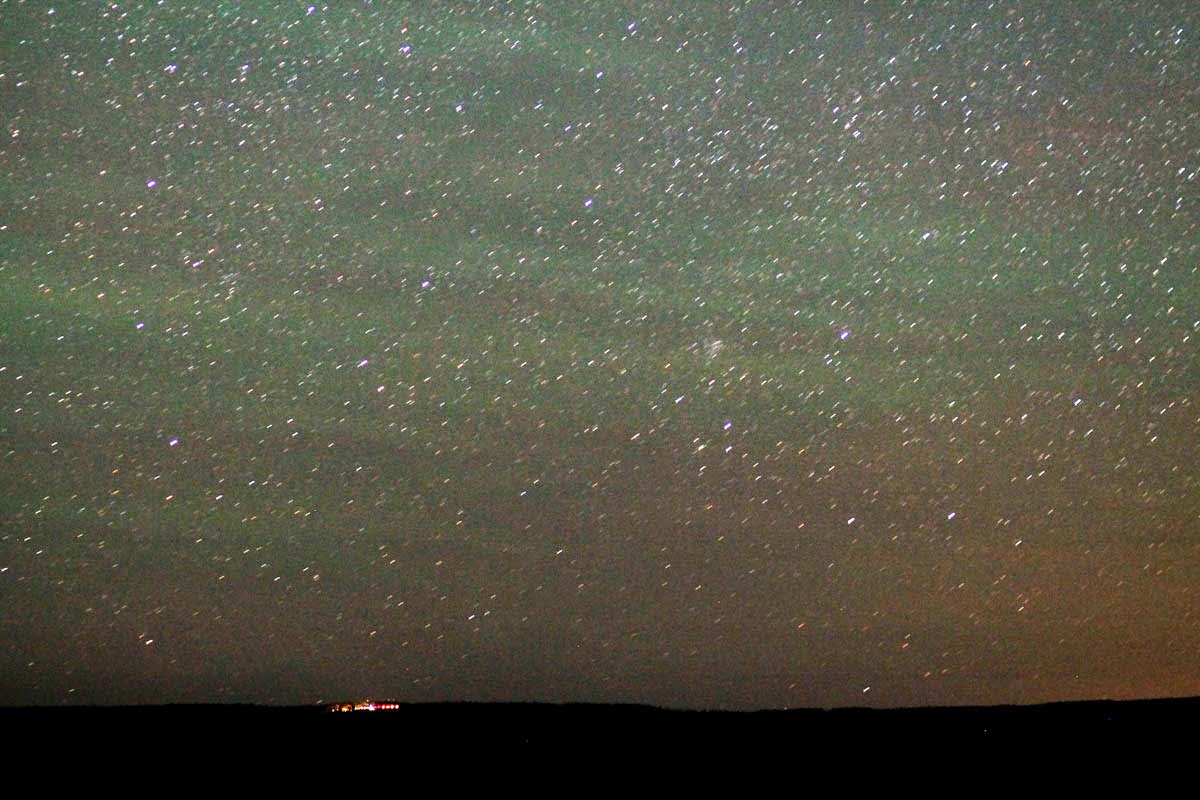
In the last post, I showed some of the first results with the new-to-me 6D. While taking the wide shots of the transiting Milky Way, with the lower edge of the field near the horizon, I noticed the strong green cast of an airglow display. The last image of that set, shown at left, shows the airglow at its highest extent that I caught. While it has the greenish glow of aurora (558nm), airglow is completely different from the northern lights they can resemble. First, they can appear in any direction - due south in this exposure. Airglow (the green kind) is caused by the recombination of oxygen atoms that were photo-ionized during the daytime.


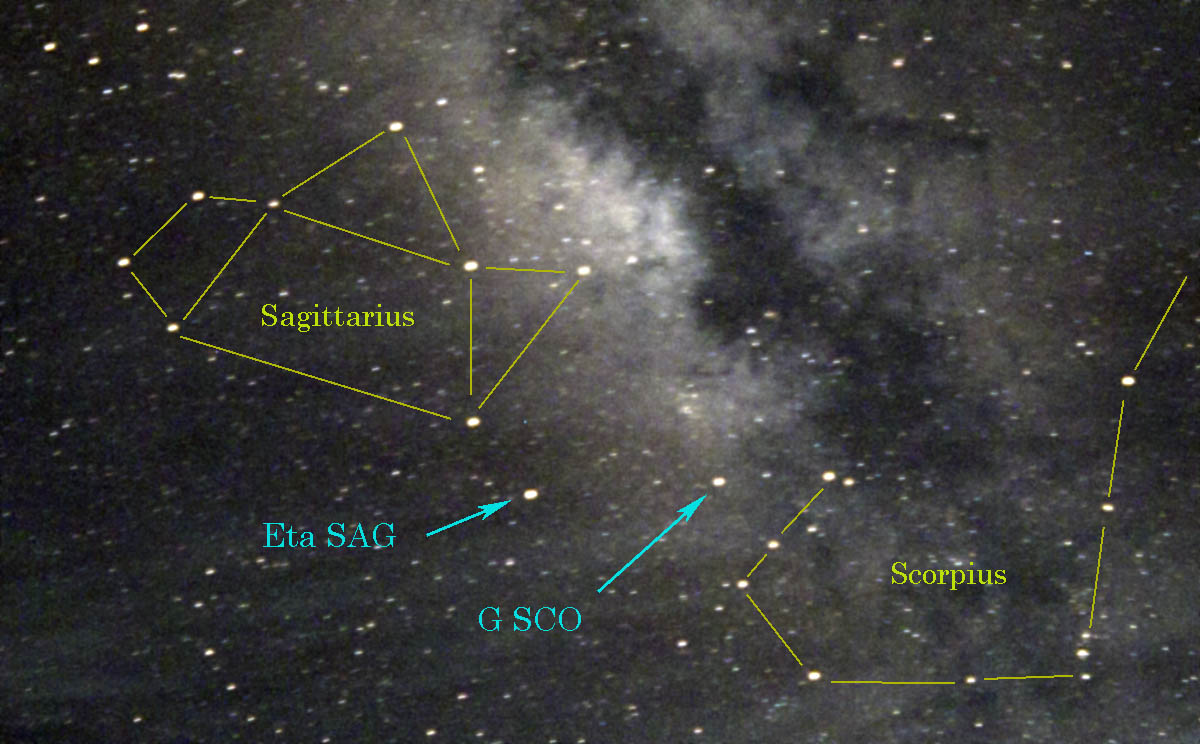
But when airglow is visible as green in the camera or faintly visible to the eye as a glowing white cloud (too faint to trigger eye's color sensors), chances are there is a good display in the near infrared as well. I've got an IR-modified camera that replaces the IR blocking filter with an IR-pass for some cool landscape effectsI've also posted some airglow images and time-lapse clips here before. Of course, being duly prepared for anything, I had packed the camera for the outing Sunday nite, so set up the modified Canon 20D with the Nikon 16mm fisheye on a tripod to shoot a clip. There was indeed a nice display that filled the field of the fisheye lens. In addition, the structure showed good motion, so was great for a time-lapse clip. Interestingly, while the green airglow showed very faintly to the eye, this IR stuff, that looks so much like bands of cirrus moving through the field, was totally undetectable! Oh, and just to show the subtle changes that shooting in the near-IR (NIR) shows, at right is a close-up of the Milky Way center.  While the Teapot asterism of Sagittarius and the end of Scorpius are readily visible, there are some bright stars that seem out-of-place. Eta SAG and G SCO seem brighter - as bright as any of the other stars in the constellations (compare to color image above!). Sure enough, checking their Wikipedia entries, both are spectral class K or M supergiants that would appear brighter in the red...

The IR airglow emissions, interestingly enough, are known as OH Meinel Airglow, named for the scientist, Aden Meinel, who identified the source of the infrared glow from OH emissions in the upper atmosphere. And if you don't know Aden Meinel, shame on you! A Lick Observatory astronomer when he was hired by the NSF to establish a National Observatory (eventually located on Kitt Peak), he served as its first director before moving across the street to serve as director of Steward Observatory, and then went on to found the Optical Sciences Center! He is really the reason the Tucson area is a major center of astronomy and optics, even now 50 years after his efforts! I blogged about one of his last appearances in Tucson 6 years ago (he passed in October, 2011)...

In his first paper (1950) where he presents his evidence the spectral lines were due to OH+, he talked about the "short exposures" of 4 hours at Yerkes Observatory, compared to the 32 hour exposures required (over several nights!) with older instrumentation at Lick Observatory! Of course, this was due to the extremely slow IR photographic plates of the day. Imagine what he would think of the 60-second exposures shown here! So about 80 minutes of monitoring are included in the clip here, after some minor stretching. The banding structures are known as "gravity waves" - not the newly found electromagnetic waves from merging black holes, but bands in the upper atmosphere caused by upper winds and the restoring force of gravity...

Here is the clip - enjoy!

Thursday, June 21, 2012

Airglow, Not Aurora!

Last night's post evidently stimulated some interest, but some were perhaps mislead from my title of the post, "Arizona Aurora?".  At the time I observed it, the northern location of the brightest sections, and the pinkish color seen in some images had me thinking it might have been aurora.  In addition, there were auroral displays seen as far south as Northern Utah on Saturday night, 16 June, the night AFTER my first observation.

So what I saw and the photos posted are airglow - the brightest airglow displays I've ever seen!.  While resembling the greenish color of aurora, and occupying nearly the same part of our atmosphere at about 90km altitude, they are different phenomenon.  Aurora are caused by energetic particles spiraling down the earth's magnetic field, while airglow is caused by excitation of atoms in the upper atmosphere by daytime solar UV radiation.

There is an excellent site on atmospheric optics called "Optics Picture of the Day".  They maintain a gallery on a wide range of optical effects, including the above topics, with very well-written explanations of what the images illustrate.  My favorite image of airglow from the site is from an all-sky image at local midnight from Nebraska a half-dozen years ago.  There are also examples of similar banded airglow to my image and an image from space showing airglow from above.  They also have several examples and explanations of gravity waves.  I highly recommend bookmarking the site and returning frequently to learn about many of the sights we can see in the sky, both day and night.

Friday, September 14, 2012

A Summer Favorite!

With Summertime rapidly drawing to a close, I was thinking of some of our experiences that we've not had the opportunity to post about.  Certainly one of the highlights was a visit to A Shooting Star Inn, a combination Bed & Breakfast and sound recording and portrait studios.  We've known the proprietor, Tom Taylor for many years - he has made semi-regular appearances to the Grand Canyon Star Party, and we've seen him down in Tucson a time or two also.  This last June he invited us to stop by at his B&B on the way to the 2012 Star Party and experience a night at his place.  He had also invited our friends Mike and Elvira, so the chance to experience the Inn and catch up with friends at the same time was too good to pass up!  This year we had two friends joining us at the Canyon and Tom didn't bat an eye, inviting them to join us too.

Located about a third of the way to the Canyon from Flagstaff at Kendrick Park, it is quite a spectacular location - in a broad valley surrounded by a few cinder cones.  It has a spectacular view of the extinct volcano Mount Humphrey - the highest point in Arizona, to the Southeast.  In the panorama picture at left, the last rays of the setting sun illuminate the highest peak of the San Francisco Peaks.

It is quite the incredible place!  Built from a "log cabin kit" that Tom designed from scratch, it arrived by a trio of semi trucks and was put together over a considerable length of time by him and a group of local friends.  The inside is remarkably large and roomy, with a recording studio loft tucked into the west side, and a large photographic studio on the ground floor.  I've heard there is a chemical darkroom, but I think most of his current work is digital.  Aided by girlfriend Amy, they have 3 guest rooms, commercial kitchen, large office area and their own living quarters.  Amazingly enough, they do all this "off grid", surviving solely on solar power, since they are some little distance from civilization...  They've even been experimenting with their own little brewery operation, producing a very nice ale that we were able to sample.  Their walls were covered by keepsakes of the area and Tom's own photography, which set a very nice tone for a place specializing in astronomy and local attractions.
 
After a tour and getting settled into our room, I took a walk around the structure, taking the panorama above and some of the other exterior sights.  I didn't get (or have forgotten) the story of the flamingos gracing the back yard, but they somehow did not seem out of place in the high desert of Northern Arizona.  Just a few steps from the entrance is the main telescope - a Meade 14" Schmidt Cass on a beefy Astro-Physics AP1200 mount.  Not shown in this view is a smaller refractor that a paying guest was using with a CCD camera for some very deep wide-field imaging later in the night.  Note that in this picture and panorama above that it doesn't have a roof, removable or not...  Tom says the walls block the wind to improve imaging performance, but a roof generally isn't needed - when bad weather is expected, he has a few tarps to protect sensitive equipment.
 
As darkness descended, dinner approached.  Tom and Amy cooked a gourmet meal for us, and it was great to gather 'round them preparing and cooking, hearing stories of the Inns construction and the experiences they've had.  And once served, I can't recall having more enjoyable dinner conversation that we had that night.
 
After a bit of digesting, I grabbed the camera and tripod to check out the observing conditions outside.  A good 15 air miles from Flagstaff there was a little bit of sky glow sneaking over the San Francisco Peaks, but generally the night sky was spectacular!  The Summer Milky Way was rising brilliantly, stretching over the horizon to the Northeast.  It seemed to me that there were some thin clouds moving into the area - strange, it looked perfectly clear at sunset...  A short exposure with the camera revealed the greenish secret - there was a substantial airglow display!  I wrote a blog post about it in June, which happened on a few subsequent nights at the Canyon.  If you look carefully under the Milky Way image at left, you can see the greenish layer near the horizon - it often appears at about those levels, even in the southern sky as here.  Panning around towards the Northeast under the Cygnus area of the Milky Way it is easy to see the green glow of the natural airglow that was visible to the naked eye appearing as thin clouds. 
 
Further on to the North is not only the greenish airglow, but perhaps even some purplish colors as well that I've not heard mentioned before.  Airglow is a natural phenomenon caused by oxygen in the upper atmosphere.  Atoms absorb solar ultraviolet light during the daytime and re-emit them in the evening at characteristic greenish colors.  I think that the fact it happened so close to Summer solstice when the days are longest and the sun is closest to our Northern horizon at night helps to explain these displays in my mind...  In this picture, the "W" of Cassiopeia is at extreme lower right with the Double Cluster of Perseus below it on the horizon.  At upper left, the dipper of the Big Dipper is just descending into the frame at top.  All these pictures, by the way, are with a 16mm fisheye lens at F/2.8, with 60 second exposures at ISO 1600.  I checked with the observer at the telescope who was unaware of the sky display - he was doing some amazing imaging of very faint nebulae in the Milky way and was little effected by the small amount of airglow display.  I turned into bed shortly afterwards...
 
The next morning we needed to leave early for the Star Party at the Canyon - we ended up leaving at the ungodly hour of 11am!  As a post pancake treat, Tom pulled out his Coronado SolarMax 90 for some exquisite views of some solar storms on the sun.  I don't think I've ever seen solar prominences so clearly as through that scope - it was very nice!  Shown in this picture is our buddy Mike, and our friend Rob, seated, who was joining us for the Star Party that week.  Our visit to A Shooting Star Inn was a great stop on what is normally a very long hectic drive to the Canyon.  It was so nice to unwind on a quiet evening before "roughing it" in the campground for days at the Star Party.  Many thanks to Tom and Amy for hosting us for the night - we'd love to come back!

Saturday, June 28, 2014

In Search of Scenery at the Grand Canyon!

From the title of this post, you would think it would be a no-brainer - every view of the Canyon is scenic!  But you know me - I don't like to make life too easy - I'm thinking of night-time scenics!  How about a night exposure that says "Grand Canyon" with stars and Milky Way stretching overhead...  The problem, of course, is that the Canyon is awfully dark at night.  Unless there is a little moon to provide some ambient light, it is literally a black hole!  Take, for example the image at left, taken while imaging for the previous post on airglow observations at rimside.  The minute-long exposure with a fisheye lens at F/2.8 if anything overexposes the sky (minor levels adjustments), but other than the lights of Phantom Ranch at the bottom of the Canyon, almost no Canyon details are seen, even though the Double Cluster and Andromeda Galaxy are seen at right central and far right.  The small orange sky glow is from Page, about 70 air miles distant.

But it must be possible, since it has been done!  I'm a big fan of Wally Pacholka, who makes a living shooting scenics, particularly night scenics at National Parks.  While he has few of the Canyon at night (he must have noticed the same "black hole" effect I mentioned above), the one classic Canyon image he has is of the Desert View Watchtower under the Milky Way.  The Watchtower is probably the one manmade emblem of the Canyon recognized by most.  Built in 1932, designed by noted architect Mary Jane Coulter, it is based on ancient pueblo watchtowers.  I've blogged about it before, but I was interested in improving on Wally's shot - one reason I've been practicing my Milky Way Panoramas the last month or two.  It is also one of the reasons we went up to the star party at the Canyon a day early - to have a night off to attempt the shot.  Unfortunately, it clouded up on our early arrival, so I sneaked away one night after the peak of the public had passed our telescope to make the 30 mile trip.  But fate conspired against me - not only was the Watchtower brightly lit by a couple spotlights, but the viewing angle was wrong to get the tower under the arch of the Milky Way...  I would have had to walk 50 meters out into the canyon to get the shot I wanted!  The issue is illustrated at left - a brightly lit tower, Milky Way barely visible and decentered from where I wanted it...

But since I was there, I took some photo sets.  Looking back on it now, I should have gone to the van for a pair of towels to help shutter the spotlights - oh well, next time.  As a result, I needed to keep exposures brief to keep from blowing out the tower, and would have to try to stretch the Milky way back into visibility.   Shown here is the result - a 4-frame mosaic of the tower and Milky Way, stretching to the Big Dipper on the far left to almost the center of our galaxy at right.  The brilliant lights on the right side were another problem - the little cafĂ©, though long-closed for the day remained lit up at night...  At least the brilliantly lit gas station (also closed) wasn't a factor off the far right side of the frame.  Besides the tower and Milky Way, a low-level display of airglow was going on (greenish glow near horizons), and the distant glow of Page, and perhaps the marina at Lake Powell.

A night later, while imaging for the most recent airglow post, I finally thought about and took a couple exposures that tried to show the "native" Canyon at night.  Shown here is a view from Yavapai point, looking east towards the Desert View Watchtower, about 15 air miles distant.  Yes, the spotlights are easily visible from that distance, as well as the snack bar, and also the brilliant gas station, visible from over the horizon from scattering.  But Canyon details are finally visible in the 4 minute (!) exposure, lit up by starlight and the light of the Milky Way passing high overhead.

Well, practice makes perfect - I'll keep practicing and seeing if I can improve my technique.  What I've learned so far - high ISOs help to shorten exposures, as do fast lenses (kit lenses at F/3.5 or slower just won't do!).  Short exposures are needed to minimize star trailing caused by Earth's rotation.  It is likely my post-processing that needs tuning - I'll post my mistakes here as I learn!

Saturday, June 15, 2013

The Unseen Canyon

More stuff from our recent trip to the Grand Canyon...  Since I'm getting into the time-lapse stuff now, I took something in excess of 4,000 pictures, mostly with my XSi, some with Melinda's too.  What has been interesting through the decades is that most people look in from the edge and see the macroscopic view of the Canyon.  Since it is mostly hidden in an inner gorge, most likely don't even realize it was carved by the mighty Colorado river.  Even fewer know that the length and breadth of the Canyon has a network of trails that are popular with hikers and trod by mule trains to haul supplies and visitors alike.  I made a point of bringing my William Optics 11cm refractor to the rim for some real telephoto views.  It is amazing what I was able to catch in an hour or two of imaging!

The South Kaibab Trail is a popular route for those going down to Phantom Ranch.  It is a shorter hike, about 7 miles to the River, with some spectacular views along the way.  This time of year, the inner canyon suffers hellish temperatures and most hikers headed down leave early to avoid the worst heat.  After first focusing the scope, I pointed to the "Tipoff" and right away caught some hikers going down meeting up with a mule train of riders coming up.  A mule train travels amazingly quickly, so trail etiquette  has hikers yielding to the mules.  Clicking the image will load the nearly full-resolution image.  Note that while obvious here, the mule train was barely visible to the unaided eye, and of course, the hikers could not be seen at all.

Similarly, a few miles up-trail above Skeleton Point,
I looked for and caught a couple hikers also headed down the trail.  Note that all these images were taken from Yavapai Overlook, a couple miles west of the Kaibab trailhead, so these mules and hikers are easily a number of miles downrange.  I thought the 770mm focal length scope performed pretty well!  The picture at right shows the same image of the hikers on the South Kaibab, but at the full camera resolution, showing all the details the system was able to capture.


Glancing down to the Bright Angel Trail just below Yavapai Overlook was a spot of greenery where I spotted some hikers headed up that trail.  I started taking a set of pictures for a time-lapse, and without even realizing it, caught another mule train headed down!  While it seemed pretty busy, I think it was a matter of the early-morning traffic a good part of the way down avoiding the heat...


And speaking of Phantom Ranch, the destination of most of the mule riders and hikers, another group of Canyon explorers also visits - river rafters!  There is a beach a few hundred yards upstream where expeditions can eat meals and take advantage of other services available there.  At left is shown some small inflatable rafts that were paddling away from shore to catch the river currents to continue downstream.


A few miles downstream is another spot of river visible (only these two spots of the river are visible from Yavapai).  I was looking for the above inflatables to cross across this view, but instead these big banana boats came drifting through!  The boats are just visible to the unaided eye, but again, if you didn't know there was a river there, you likely wouldn't detect the boats either!  I've been told the solar panels are for the emergency telephone for use on the lower Bright Angel trail...


A couple days later, I went out to the eastern part of the Park, to Lippan Point, to try to get better views of the rafts going down the rapids.  From that vantage point there is a much better view of the Colorado river, including Unkar Rapids and part of Hance Rapids.  I caught a pair of big rafts going down Unkar, one of which is shown here.  Click on the image to see it clearly in the midst of the rapids...


And just to return to an astronomical theme, I'll close out with a couple of wide shots of the northern sky from adjacent to the Canyon.  We didn't quite stay late enough into the week to take advantage of the moon lighting up the Canyon - it was pretty black when imaging the sky over it at night.  On night one, shown at left, we had a very nice display of banded airglow from the observing field at the Star Party.  Like last year's display, I'm thinking it is because we're close to Summer Solstice and the airglow, caused by solar excitation, is discharged over the hours of darkness.  A few nights later I headed to the rim for more pictures.  Though we had a few clouds, lots of details were still seen.  On the northern horizon at center, the North Rim lodge lights can be seen at center, and to the right of the lights, the small light dome of Page, Arizona can be spotted.  Above the lights of the lodge is a satellite appearing to track through the Double Cluster and below Cassiopeia Constellation.  The Space Station had passed in a very similar orbit about an hour before, so I'm thinking it is likely a supply ship that I know was headed to a rendezvous with ISS.  Above the trail of the satellite is an airplane that appears to be flying in formation...  If there was any airglow on this later night, it was just marginally detected, if at all.

It was fun to use the scope to reveal some of the goings-on in the Canyon that few know about.  In the past 23 years of attendance, I've used my big binocs to show people some of these scenes, but I've never tried capturing them, but it is neat stuff!

Thursday, June 21, 2012

Arizona Aurora?

We are just back from a spectacular 5 day break from reality in Northern Arizona, mostly at the Grand Canyon for the annual star party there.  We've many previous posts regarding some of our time there on previous trips, so check here for a link to some of those exploits

On our way there last Friday (15 June), we stopped at the Bed and Breakfast of buddy Tom Taylor, proprietor of A Shooting Star Inn.  We'll write a separate post about our evening there, but what I'd like to cover tonight is a display of sky lights.  What looked like a thin layer of clouds moving in showed structure I've seen before from dark sky locations - airglow with gravity wave structures.  The main clue was the green color from oxygen emission. Shown here is a frame of several taken with a 16mm fisheye with a 1 minute duration, with only minor levels adjustments.  The bowl of the big dipper is coming into the upper left, Cassiopeia at lower right and Polaris, the North Star is upper right center.  It was a cool display, and like I said, the casual observers there thought they were thin clouds,  but the exposures show the green emission.

Then again just last night (19 June), on our last night of observing, showed a very similar glow and structure.  Again, the observers thought clouds were moving in, but again the exposures showed the telltale green emission.  I thought hard about it being aurora, but didn't see any characteristic rays, even though the display was very strongly centered due north.  Peaking right at about midnight as we were putting telescopes away from the night's public observing, after dropping Melinda and another observer off at the campground, I went back out to Yavapai Point and shot more frames from rim side for about a half hour.  I thought I could detect some pinkish or red color in some of the frames, but the structure and motion is consistent with airglow and gravity waves. 

I collected the 30 or so frames into a time-lapse and uploaded them into YouTube so you can see the structure and motion of the glow.  Interestingly, the structure was moving north on both nights, and the wind, which was very strong while taking the frames, was also towards the north.  In case the YouTube viewer doesn't load, go to this link to view on their website. Anyway, really cool stuff, but not aurora, which is pretty rare, even in Northern Arizona.  More posts about the events of the last week to come!

Tuesday, December 31, 2013

The Best, The Worst, The Memorable!

In an idea spawned by bloggin' buddy Andrew Cooper, as the year ends, it is time to look back on the memorable images of the year appearing on these pages.  While not presented in chronological order, dates referenced will allow you to search out the original posts for more information if needed.


The major jolt to our normal-way-of-life was Melinda's diagnosis of small-cell lung cancer in August.  She went from biopsy on Tuesday, meeting the oncologist Thursday, and admitted to UMC for chemo that night!  Posts from 24 August show her as an inpatient at UMC getting her first round of chemo.  Since she works a couple floors above at the NICU, she had a constant queue of visitors, especially at shift change!

The news has been good.  She made it through 6
cycles of 3 week duration, finishing on 11 December. They make a big deal of small steps - on the completion of her last chemo, the nurses all gathered at bedside for an emotional bubble-blowing salute!


Even with all the seriousness of the medical
news, it seems like we travelled a lot!  A springtime trip to speak at the Southern Star astronomy event in North Carolina allowed us to visit family in South Carolina.  At right, niece Shannon wrestles with a tree on the grounds of the Biltmore Estate (18 April), and on a walk along the Congaree River in Columbia (27 April) revealed a multitude of minnows evidently beloved by egrets fishing in the shallows...


The Grand Canyon Star Party, which I organized
for 18 years before retiring, is still a must-do event on our annual calendar.  Showing pristine skies to summer tourists just can't be beat.  This year I carried a scope to the edge of the Canyon a few times, recording a mule train on the South Kaibab Trail at left (15 June).  The same post also showed a nice display of banded airglow visible in a wide shot to the north.


I'm always looking for the best way to show the
star of the Grand Canyon Star Party show - the rising Summer Milky Way.  The dark skies show it off to best advantage - we've had some folks mistake it for incoming rain clouds!  The shot at left is a 1 minute exposure with an 8mm fisheye shot showing the arch of our galaxy's profile over the red lights of the star party's parking lot.  At right, walking back from the rim, I paused to catch the center of the galaxy over the scrub trees growing at Canyon's edge (12 June).


While we waited for the "Comet of the Century",
comet ISON, which became a non-event when it disintegrated in its close pass to the sun on Thanksgiving, we got lots of practice on comet PanSTARRS (C/2011 L4).  We heard good reports of its visibility from the southern hemisphere before it popped above our horizon in March.  My first spotting was on 10 March, but 2 days later, appeared in conjunction with a crescent moon over Kitt Peak (posted 13 March).  Besides the 3-way alignment of comet, moon and Observatory, a 4th object is little reported - gas giant planet Uranus is just below the comet in the left shot.  The right image makes the green-tinged planet pop out a little better in the closeup.


And PanSTARRS wasn't done with the show!  While never a visual spectacle, it was a nice binocular and telescopic comet.  A couple months after the above appearance, the Earth passed through the comet's orbital plane, making another feature visible - an anti-tail!  Normally the tail is pushed outwards by solar wind, but when crossing the orbital plane, dust and gas trailing behind can sometimes appear by perspective to point towards the sun - thus the anti-tail.  At left on 19 May, on the C-14 plus Hyperstar the anti-tail appears as a spike towards the left, the real tail points to upper right.  On 30 May, as it passed Polaris, as a proof-of-concept, I used a tripod-mounted (untracking)camera to stack 15 one-minute exposures as it passed the Little Dipper.  Amazingly, it is almost all anti-tail!

Sad news reached us as Melinda was finishing her cycle 5 of chemo on 20 November.  Her older sister Susan died of an apparent heart attack overnight.  Ironically, she had been diagnosed with non-small-cell lung cancer within days of Melinda's diagnosis and had been responding well to treatments.  The image at right was taken during happier times at our wedding in June of 2008, Susan at right.


With the green of Illinois revealed in the last
image, we continue to trek to our place there every couple months.  While we generally don't do any astronomy there, an entertaining alternate activity is searching for prey with the macro lens.  On 2 August I posted about the bizarre insect at left, a two-spot tree-hopper, which have apparently evolved to resemble dead leaf stems to avoid being eaten!  On 19 October, I loved the raindrops on the oak leaf acting as little magnifying glasses...


On 14 May were some closeups of the wild flowers in our "native" lawn.  At right is a stereo image of the trillium flower.  This is a "cross-eyed" view - cross your eyes slightly to look at the right image with your left eye and vice-versa.  You should see 3 images, the center one showing depth.  And on 30 October, I was out on a frosty morning with the macro to observe some tubular frost crystals that morning...


In our frequent flights to the Midwest, we just recently started taking the early-morning flight that gets us in at noon instead of much later, usually after dark.  Of course, with full sun the whole time, and now that cameras are "approved electronic devices" that can stay on the entire flight, pictures of flights are more fun to take.  On 30 November, one of my favorites of the year was a newly-frozen slough off the Illinois River.  The wind had blown ice or snow to create interesting clear spots on the surface.  A few minutes later, as we banked to turn around, a bird's eye view of the Chicago skyline presented itself.

Kitt Peak National Observatory was featured in a
lot of posts.  A job there is what originally brought me to Tucson, and I still work there on a part-time basis in their public programs, but my love of astronomy and observing makes it a destination for me.  We bookended the entire year with sunset alignments involving the Observatory.  On 18 December, from the Mount Lemmon highway, we watched the sun silhouette the observatory, then the clouds provided a spectacular sunset for desert!


And way back on 16 January, while watching yet another sunset over the Observatory, we marveled at an amazing display of observatory domes casting shadows on the hazy air just after the sun dipped below the horizon.  Other times during the year, Kitt Peak featured prominently.  On 20 September, we trekked up the road to take time-lapse of datura flowers opening in the twilight almost in the shadow of the moon-lit domes.


On 25 April, on a night when it was almost too
windy for the domes to be open, camera and I survived buffeting to make a time-lapse of Omega Centauri and a pair of bright galaxies rising past the "vintage" 2.1 meter telescope.  A few months later, on a rare clear night during the monsoon rainy season, we again shot the 2.1 meter against the Summer Milky Way as the last rays of the setting moon died out.


A few nights previously (9 August) I had also
gone up to shoot some star fields as well as capturing an Iridium flare cross a Milky Way field with a telephoto lens.  Flat shiny antennae briefly shine the sun down to your location, and this "flare" also passed some deep-sky objects.  A month and a half later (30 September) at an astronomy club "Star-B-Que", I shot a 9-frame mosaic of the Milky Way center with diffuse airglow, mostly as a test for the Microsoft "ICE" mosaic assembling software, which it excels at!


While not astronomical, at the same Star-B-Que (posted 29 September) we saved a little lizard that had managed to get stuck in a short length of hose.  How many engineers does it take to free a lizard?  In the remote location, the one with a variety of tools won...  This is the before picture...


At another observatory about 100 air miles away,
we snagged invites to the LBT employee's picnic on Mount Graham (11 October).  Working at the Mirror Lab, we polished the nearly 30 foot (8.4 meter) twin mirrors for this telescope.  At left is a mosaic of just one of the pair of scopes, in this case, the Gregorian secondary and tertiary are swung out of the way, and a prime-focus camera installed.  A month later (9 November), from the valley floor below, we watched the first run of ARGOS, the laser beams help correct for atmospheric turbulence.


More recently we reconnected with our niece and nephew Kathy and Rick (9 December).  They had been estranged from Melinda's sister Susan (their mother) and as a result, our family.  Between Melinda's cancer diagnosis and Susan's death, we've reconnected with them, which is about the highlight of the Fall!


In the potpourri section, I talked a little about my
"little" binoculars that are fun for both daytime and night time viewing (2 February).  Made by Nikko during WWII, they are spectacular in use at the edge of the Canyon... And interestingly, there was a BHS meeting in Tucson (Binocular History Society), where we had a couple days of talks and a tour of the optics museum at the Optical Sciences Center.  Shown here are 19th century opera glasses, mostly French and European (22 February).


In the "strange" categories, there was the image
of moirĂ© fringes at a McDonald's in Omaha (1 August).  The screen patterns of non-uniform hole spacing created the  pattern seen from inside the restaurant.  And I checked out the operation of my IR modified camera before sending it off for a friend to use for the summer on 1 June.


We made a couple trips to Whitewater Draw to observe cranes and whatever else was wintering there.  On 7 February I lugged my William Optics APO to get some closeup portraits of sandhill cranes.  The depth of field is so shallow that the rear one a couple feet back is out of focus.  On another trip with our visiting friend Carolyn, I used the on-camera flash to capture a great blue heron fishing in near-total darkness.  I was after the cats-eye reflection from its eyes, but also got focused lines of light across its body - waves in the water concentrating the flash.

Finally, from one of our last posts (28 December) an "omega" sunrise from our Christmas visit to Puerto Penasco.  The omega shape (named for the Greek letter Ω which resembles the outline of the disk) is caused by an inferior mirage (warm air near the water next to cooler air above).  The lower section next to the sea is a squashed, inverted image of the lower disk of the sun.  The apparent waves on the water are also a magnified aspect of the mirage...


It was a great year, one of contrasts certainly.  As this one draws to a close, we have optimism regarding Melinda's health, and look forward to getting back to something resembling a normal life!  All we can do is do what we can, and hope the best to all of our readers, wherever you may be.  Do keep in touch, and hopefully I'll be able to continue to entertain you with some aspects of our lives here on the blog.  Happy New Year!