Showing posts sorted by relevance for query Meinel. Sort by date Show all posts

Wednesday, October 26, 2016

October TAAA Meeting!

A little late with this post - almost 3 weeks! Well, I've been busy... I was able to make the Tucson Amateur Astronomy Association monthly meeting on 7 October, and brought my camera along to take some shots of the slides - both for my own memory, and document on the blog for those who might have missed it to see some of it too.

I had an out-of-town visitor, so missed the beginner's lecture, but really wanted to attend the main lecture - Katy Garmany, Emeritus Scientist talking about the history of Kitt Peak National Observatory and the Tohono O'odham Nation, on whose land it resides! Now I'm a sucker for that sort of thing after 5 years on staff back in the early '80s, docent in the early '90s, and until recently a guide on the night time public observing sessions the last 5 years. It is what brought me to AZ in the first place and is my absolute favorite place in Southern Arizona. A talk on the history and the O'odham homeland - naturally I wouldn't miss it! At left is Katy awaiting the start of the lecture, and at right is her title slide showing the view of Kitt Peak from "the wrong side", from near Sells, capital of the reservation.

She started from the very beginning, back to the National Science Foundation's mandate for a national observatory, and the search by Aden Meinel and Helmut Abt to find a location. At left is shown the sites that were eventually identified and investigated through Arizona. She also showed the note from Helmut Abt's notebook indicating that Kitt Peak appeared to be a good site (from his airplane over-flights) and deserved further exploration. For the first time I learned the astronomers asked permission to climb Kitt Peak twice and were refused both times!

Then, as the legend tells us, tribe representatives visited the 36" telescope on the UA campus to examine the sky and learn a little about what astronomers do. It was after that visit that Meinel was granted permission to climb the mountain. And as the illustration at right shows, Katy's husband John Glaspey located the original movie reels in the NOAO basement a few years back!

After a failed attempt by Meinel and Abt to climb the mountain on 6 January, 1956, accompanying Meinel and Harold Thompson on 14 March were O'odham guides Al Martinez and Raymond Lopez, along with newspaper reporter Clifford Abbott. NOAO also supports a page of images from the first ascent. A night-time view from that first ascent is shown at left. I'm not sure any of the film images from the movie appear there, or if they were taken with other cameras or from the newspaper reporter than accompanied them. The movie is a true AZ time capsule from 60 years ago! The introductory scenes show the trip out Ajo Way, little more than a 2-lane road in those days. Road signs for 7-up and Old Tucson mark the last place to fill up for fuel before heading across the desert! John Glaspey has allowed me to upload it to Youtube for you to watch it. Note that there is no sound, just images from the original 16mm film taken on that first ascent up the mountaintop that eventually became the home to Kitt Peak National Observatory...

!


While the short movie was the highlight
for me, Katy went on to explain the interactions of the Observatory and the tribe, including employment, lease agreements, craft sales and continuing education utilizing observatory staff on the reservation. Also presented were some of the cultural beliefs of the O'odham and some of the sky stories she knew about. Over the decades, the relationship of the Observatory and tribe has not always been smooth - she relates the story of the failed attempt to locate the VERITAS gamma ray telescope array on the mountain as example. In recent years though, former Kitt Peak director Buell Jannuzi has worked to strengthen relations. She noted also that Kitt Peak is no longer a true National Observatory as NSF has pulled money away for other projects and many of the telescopes are now operated by consortiums.  It appears though that while no longer available to astronomers on a competitive basis (how the National Observatory was run for 50 years), it will continue to be a front-edge research facility.


She closed by informing us how we can become educated in the ways of the Tohono O'odham, and suggests the visits in the slide at left. It is a shame that a visit to Kitt Peak, on the eastern edge of the reservation, doesn't expose us to more of the culture and facilities located 20 miles beyond Kitt Peak in Sells and beyond...

After questions the meeting was concluded by a planet report from Erich Karchoshka (at right)- always interesting because he indicates alignments, occultations and appearances that we might not be aware of.

 And that was the October, 2016 TAAA meeting!

Tuesday, March 23, 2010

"The Great Man" - Aden Meinel

I was wondering how to title this post, and it came to me this afternoon while taking a photograph of 3 real pioneers in astronomy and optics in Arizona. After taking the photo at left of Helmut Abt, Aden Meinel, and Roger Angel (from left to right) as they toured the Steward Observatory Mirror Lab, Roger offered to take a picture of me with "The Great Man", and that title seems appropriate given all his accomplishments in just a couple square blocks on the University of Arizona campus. By the way, here they were examining one of the 11 foot slumpings that Roger is researching to make inexpensive high power solar voltaic collectors.


Aden's early days in Arizona was the topic of a lecture last night as part of the public lecture series at Steward Observatory. Titled, "Why Kitt Peak? -- The History of Iolkam Du'ag and the Birth of Kitt Peak National Observatory", he addressed how Kitt Peak was selected as the site of the National Observatory. Reading his biographical highlights, Helmut Abt took nearly 10 minutes to cover the basics! The essentials, as relates here, is that Aden was in charge of selecting the location of the National Observatory, narrowed it down to a list of 4 possible locations in Arizona, Kitt Peak being the final choice, which required negotiations with the Tohono O'odham Nation for a lease arrangement. Aden served as the founding director of Kitt Peak and oversaw the site surveys, construction of the first 36" telescope and design of the 84" and 60" solar telescope. He then served as the third director of Steward Observatory at the University of Arizona, including the relocation of their 36" telescope to Kitt Peak, and the design of the University's 90" and Multiple Mirror Telescopes. Aden then went on to be the founding director of the Optical Sciences Center - one of only 2 optical centers in the country specializing in optical research and education. Realize that the headquarters of all 3 institutions are pretty much adjacent to each other on the University of Arizona campus, with OSC located in the Meinel Building. The photo at left shows Leo Goldberg (KPNO director), Nicholas Mayall, and Aden Meinel (former KPNO directors) at the 4-meter telescope dedication in 1973 (named for Mayall).

The lecture was filled to capacity with attendees spotted from all three centers on campus where he served as director. Interestingly, I've worked at all 3 institutions, from Kitt Peak and Optical Sciences through the '80s, and Steward Observatory since then. It was great seeing all the "old timers" there, some of which I've not seen in well over a decade!

The highlights for me are always the pictures and stories of the old days. Kitt Peak was "discovered" by Helmut Abt as he criss-crossed the desert southwest from the air. One of it's advantages was a large developable area, though it was on reservation land, and the only access was on horseback. After arranging permission for a visit with Tohono guides, Aden showed the resultant home movies and photos from that first ascent in February of 1956. He related the story of how the precious water (there was none at the mountaintop) they brought first went to the horses, then into the bucket next to the fire to which was added coffee for the group. That first overnight visit showed great promise, and the location has gone on to be one of the largest concentrations of astronomical telescopes in the world. Aden related the story of the trip down when his horse slipped on the rocks, and while it was fine, Aden broke his arm... It was some time before a road was built to the site, and the first routine access for observers and the first 16" telescopes was a bulldozer road straight up the east side where slopes approached 100% at times (45 degrees!).

Another highlight for me was the second part of the lecture, given by Bernard Siquieros, Education Curator of the Tohono O’odham Nation’s Cultural Center and Museum. He told the native's historical and religious perspectives of Iolkam Du’ag (the Tohono name for Kitt Peak, which ironically roughly translates to "home of the clouds"!). Most moving for me was the slide show of past and current life on the reservation with his wife, children and grandson providing musical accompaniment in the native tongue it was great!

Kitt Peak has always been a special place for me to live, work and visit. It was a wonderful evening to learn some of it's early history and get the native perspective as well.

Friday, July 8, 2016

Last Weekend - Part 2!

In the last post, I showed some of the first results with the new-to-me 6D. While taking the wide shots of the transiting Milky Way, with the lower edge of the field near the horizon, I noticed the strong green cast of an airglow display. The last image of that set, shown at left, shows the airglow at its highest extent that I caught. While it has the greenish glow of aurora (558nm), airglow is completely different from the northern lights they can resemble. First, they can appear in any direction - due south in this exposure. Airglow (the green kind) is caused by the recombination of oxygen atoms that were photo-ionized during the daytime.


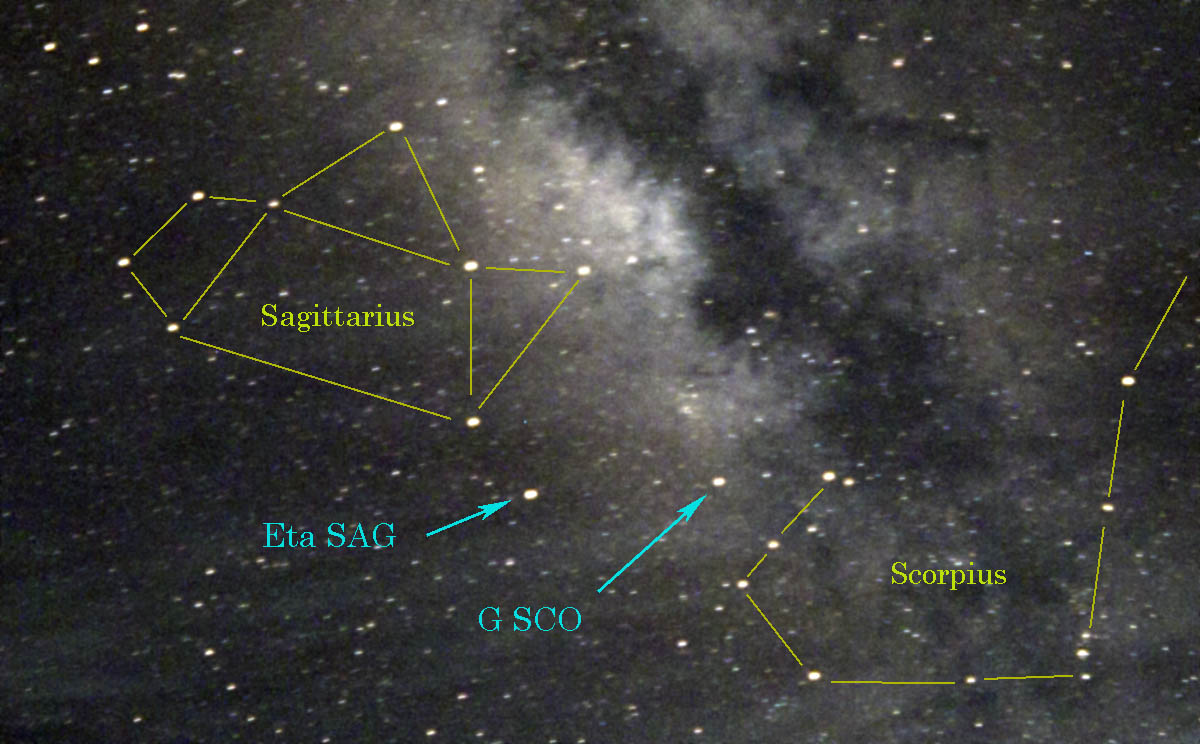
But when airglow is visible as green in the camera or faintly visible to the eye as a glowing white cloud (too faint to trigger eye's color sensors), chances are there is a good display in the near infrared as well. I've got an IR-modified camera that replaces the IR blocking filter with an IR-pass for some cool landscape effectsI've also posted some airglow images and time-lapse clips here before. Of course, being duly prepared for anything, I had packed the camera for the outing Sunday nite, so set up the modified Canon 20D with the Nikon 16mm fisheye on a tripod to shoot a clip. There was indeed a nice display that filled the field of the fisheye lens. In addition, the structure showed good motion, so was great for a time-lapse clip. Interestingly, while the green airglow showed very faintly to the eye, this IR stuff, that looks so much like bands of cirrus moving through the field, was totally undetectable! Oh, and just to show the subtle changes that shooting in the near-IR (NIR) shows, at right is a close-up of the Milky Way center.  While the Teapot asterism of Sagittarius and the end of Scorpius are readily visible, there are some bright stars that seem out-of-place. Eta SAG and G SCO seem brighter - as bright as any of the other stars in the constellations (compare to color image above!). Sure enough, checking their Wikipedia entries, both are spectral class K or M supergiants that would appear brighter in the red...

The IR airglow emissions, interestingly enough, are known as OH Meinel Airglow, named for the scientist, Aden Meinel, who identified the source of the infrared glow from OH emissions in the upper atmosphere. And if you don't know Aden Meinel, shame on you! A Lick Observatory astronomer when he was hired by the NSF to establish a National Observatory (eventually located on Kitt Peak), he served as its first director before moving across the street to serve as director of Steward Observatory, and then went on to found the Optical Sciences Center! He is really the reason the Tucson area is a major center of astronomy and optics, even now 50 years after his efforts! I blogged about one of his last appearances in Tucson 6 years ago (he passed in October, 2011)...

In his first paper (1950) where he presents his evidence the spectral lines were due to OH+, he talked about the "short exposures" of 4 hours at Yerkes Observatory, compared to the 32 hour exposures required (over several nights!) with older instrumentation at Lick Observatory! Of course, this was due to the extremely slow IR photographic plates of the day. Imagine what he would think of the 60-second exposures shown here! So about 80 minutes of monitoring are included in the clip here, after some minor stretching. The banding structures are known as "gravity waves" - not the newly found electromagnetic waves from merging black holes, but bands in the upper atmosphere caused by upper winds and the restoring force of gravity...

Here is the clip - enjoy!

Wednesday, October 5, 2011

Aden Meinel, "The Great Man" passes at age 88

The hits started coming in a couple days ago and still continue today at about one per hour - Google directing folks looking for "Aden Meinel" to our little blog.  If you do the same search, we're the third Google entry after the National Optical Astronomy Observatories and the Wikipedia entry.  Turns out that I posted about Aden Meinel's visit to Tucson about 18 months ago, as part of Kitt Peak National Observatory's 50th anniversary.  Lots of hits can only mean one or two things, but in this case, we learned yesterday he died on Sunday at his home in Henderson, Nevada.

His meager entry in Wikipedia reveals little of his giant stature in Tucson.  He was director of Yerkes and McDonald Observatory when he was put in charge of the search for, and served as founding director of the national observatory which was chosen to be atop Kitt Peak, about 50 miles SW of Tucson.  After the dedication of that institution, he went on to be the third director of Steward Observatory, and from there went on to establish and serve as director of the Optical Sciences Center (now bearing his name) at the University of Arizona.  And that is to say nothing of the plethora of research papers he and wife Marjorie published in optics, telescope design, space, spectroscopy and solar power.

Arguably, he is the reason that for many decades, Tucson was considered to be the center of astronomical research, and the reason it is still called "Optics Valley", from the effects still felt by locating of Kitt Peak National Observatory and OSC within a city block of Steward Observatory..  Having worked at all 3 institutions he served, I can honestly say that without his leadership, would I even be located in Tucson?  A valid question, for which an answer is not forthcoming.

I met Aden only briefly on 2 occasions, but am overjoyed I was able to hear his presentation last year on why Kitt Peak was chosen.  It was magical to be transported back those 50 years and look over his shoulder to the home movies and photos he took on that first horseback ride up the mountain.  He told the story of that frigid November night and the return trip fall off his horse, breaking his arm, doing little to blunt his enthusiasm for the place, which still excites me as well.  We've lost a true visionary, and the great institutions that line the intersection of Cherry and University on the UA campus are perhaps a lasting tribute.

Saturday, June 28, 2014

Airglow Over The Canyon!

There are many glows in the night time sky.  In towns and cities, the normally dark sky is diffusely lit by the scattering of man-made light sources from dust, humidity and aerosols.  This "light pollution" limits many types of observing from urban areas.  But from the Grand Canyon and other dark sites, even mountaintop sites here in Arizona, there are other types of natural airglow.  Aurora, or Northern (or Southern) lights are from energetic particles from the sun coming down the magnetic field lines of the Earth, interacting with the upper atmosphere, mostly at northern (or southern) latitudes, very rare in Arizona.  But the topic of this post, which I've covered before, is of airglow, fainter, but generally more visible from anywhere on the Earth's surface.  Shown at left is the view from the International Space Station, with airglow seen as a diffuse greenish glow in the atmosphere.   An excellent discussion of various properties of airglow is presented in the archives of Atmospheric Optics and Optics Picture of the Day, maintained by Les Cowley.


While obvious from orbit, where you see a stronger glow because of the long path length an observer at altitude would look through, it is harder to spot from the ground.  The last few years we've had good displays from the Grand Canyon Star Party, perhaps because of the dark northern sky, and also perhaps because they are generally held near the summer solstice.  Airglow is caused by excitation of molecules in the upper atmosphere by ultraviolet light of the sun, and the light of the glow is discharged at night after the sun sets.  At the Summer solstice, my thinking is that with the long days, and the sun not being very far below the northern horizon, the airglow display from Northern Arizona might be enhanced.  While the green glow is caused by the excitation and discharge from oxygen molecules, in the near-infrared, the sky is aglow from OH emission caused by the same effect.  The IR emission was discovered by Aden Meinel in the 1950s, a well known astronomer of the middle of the last century that all Arizonans likely know (and I had occasion to meet several times).   Fortunately, I brought my IR-modified Canon 20D, which captures near-IR redward of 720nm.  At left is shown a fisheye view showing this OH emission - it looks like clouds, but the sky is just aglow from a multitude of emission lines.  There was no moonlight, no city lights to illuminate these "clouds" from below...  Looking North towards Polaris, just above center, the fisheye view shows the Big Dipper at left to Cassiopeia at right.


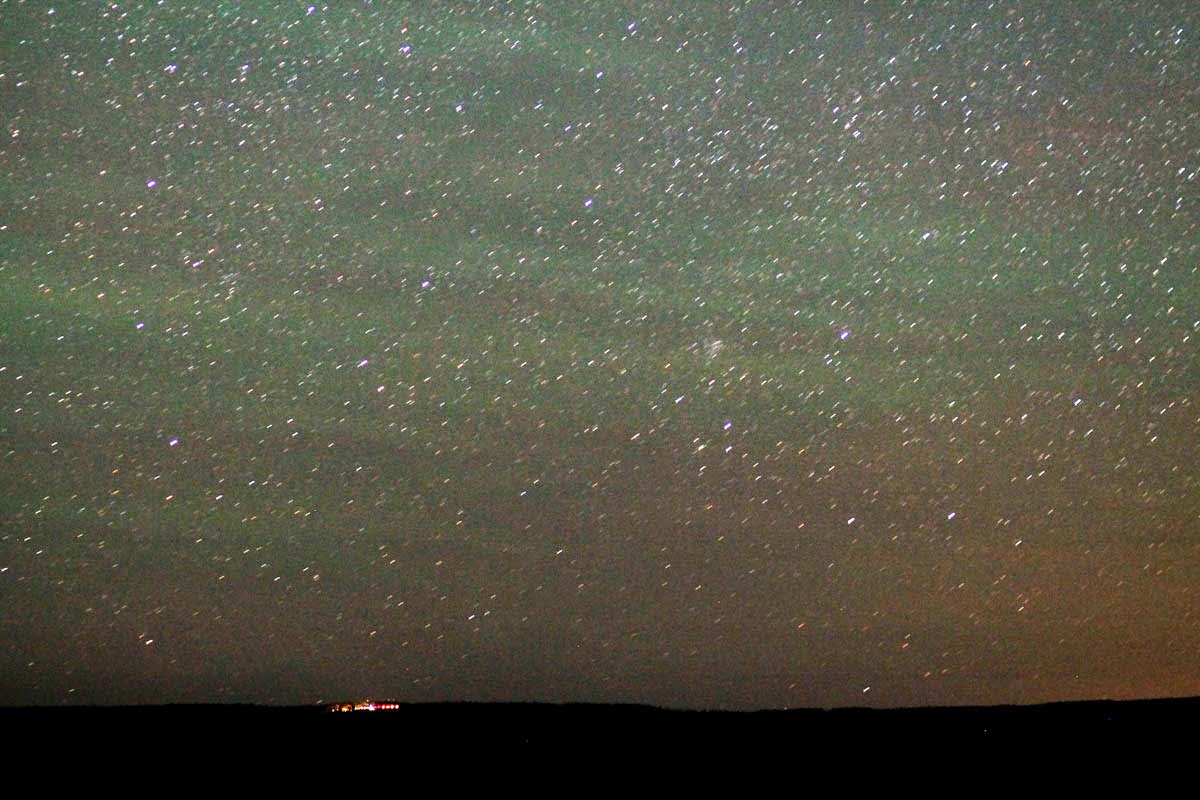
Comparing the above view to a visible-light image, the first thing that I noticed is that besides the change in airglow, even the constellations look different!  Check out the comparison at left, showing the view of the Big Dipper from the picture above, to the visible-light view.  With the lines I've drawn showing the dipper outline, there seem to be "extra" stars on the near-IR view.  Of course, it would look different with different wavelength coverage!  The three stars pointed out in the IR view are red variable stars or otherwise cooler spectral types that appear brighter in the IR view than they do in visible light...  As seen in the right image taken a few minutes later than the IR shot, the visible-light image is dominated by the greenish glow of oxygen emission, though since we're not in the ISS looking across at it, it appears brighter near the horizon where you are looking through a larger cross-section of the emission...


So here are the full-size frames from the fisheye
view in visible light at left, and at right is a frame from an 80mm lens shooting across the Canyon to the North Rim Lodge and stars and airglow to the horizon.  Certainly if there were clouds (as it appears in the IR view above, but it was perfectly clear), there would be obscuration of the rising stars.  You can also see from these images that the airglow is not uniform in intensity nor static.  "Gravity Waves" propagate from the lower atmosphere, affecting the density and chemical abundance, changing the appearance of the airglow pattern.


And while single frames are of interest, many frames taken over time show the change in airglow illumination.  While I didn't invest a lot of time in taking frames (a cold wife, waiting in the car tends to shorten the imaging session), taking frames over a 15 minute period, and cycled several times will have to do for now...  Enjoy the view, and keep looking up!