Showing posts with label Arizona flora and fauna. Show all posts

Wednesday, September 4, 2019

Blooming Season Far From Over!

Even though my last post was about my blooming cereus, and the monsoon officially ends in 2 weeks (generally marking the end of the cacti blooming season), perhaps because of the lack of monsoonal rain, the cereus are shooting out buds like there is no tomorrow!  First appearing last weekend as microscopic (almost) swellings, by now I've counted 27 (!) buds on just two branches - on the same plant!  So there will be another massive blooming session in a few days, perhaps over the weekend.  A few are very near the roof line, so may set up something up close to flowers for some new viewpoints!  Time will tell!

Friday, August 30, 2019

All Night Long!

I've been back at "Ketelsen West" for nearly a couple weeks. When I make plans to be out of Tucson in July, everyone always asks how I can miss the monsoon rains - so welcome to the desert dwellers. Well, I miss the start of the 2+ month rainy season here, but also a lot of the hottest weather and the wondering when the first storms will arrive... The one thing that I do hope I don't miss is the flowering of my cereus repandus - night-blooming cereus cacti! They typically start their spectacular blooming shortly after the monsoons start and last through most of the rains till it cools off the end of September. And while the flowers are indeed impressive, what is fun and "sporting" is capturing the pollinators that inevitably come by to feed on the flower's nectar and in that process, distribute pollen among other plants and blooms. I was in luck - shortly after my return, a quartet of flowers bloomed the same night - on the same arm of the cactus! At left is how it appeared right about sunset - the 4 telltale buds were swollen and about to bloom the next few hours. At right, by 10pm, they were open and awaiting action!


But in recent years, I've enjoyed capturing the rustic sphinx moth pollinators. They appear randomly during the night, perhaps drawn by the very subtle (to me anyway) odor of the flowers, or something else that tells them there is food here... The challenge is always to capture as many as their flighty visits, without taking a million photos! Of course, I could sit there and man the camera myself, pushing the button as they visit to feed. Likely also it would be straightforward to rig up something to do it automatically as they come by. I was able to capture a few of the earliest visitors manually, as they started visiting shortly after the flowers opened. With my head-mounted red light, they buzzed my head as they approached, seemingly as large as a bat as it came past me to feed. There was no missing their approach, and even during their stay, I could see the cat's-eye reflection of my red lamp from their eyes! The most fascinating thing to me is there nearly 15cm (6") long proboscis, so tried to take their photo before they landed on the flower. The results here demonstrate that successful plan.


But I was not prepared to stay flower-side all night. I increased my chances by setting up the camera so all 4 flowers were in the image. That way, if any moths came to any flower, I'd document its visit. Also, I used the on-camera flash (on my 10-year old Canon XSi) to illuminate the scene. Taking a photo every 20 seconds (3 per minute, 180 per hour!) I was hoping to catch a few moth visits! 5.5 hours later, the camera and flash were still going after nearly 1,000 photos! The next day I downloaded the all and went thru it frame-by-frame - I had caught over 80 images of moths! That included 4 frames where there were 2 moths in the frame - an absolute first for me! They weren't consecutive frames either, so weren't the same 2 moths hanging out together! These two frame sets show the 4 images with moth pairs in them...


What is most amazing about these moth images is the length of their probiscii! At least when they are flying around the cereus repandus flowers they appear to be fully extended. I believe I've seen images showing them coiled up when not in use, but flying around with something extended that is larger than your wingspan must be dangerous, if not at least a little risky! The image at left is quite incredible! Be sure to click on it to load the full resolution image...

And some of the moths dig so deeply into the flowers. Either they are a little smaller, or perhaps they've got a shorter or broken proboscis, and need to go deeper to feed. Check out the image at right - can barely see the moth body...


So this particular night (19 August) was a particularly busy one! I had stopped the camera at 4:30am, but stopped by a couple hours later to do some close-ups to compare to some I had taken earlier in the evening. At left is a "before" photo showing the abundance of pollen and the still-green stigma and pollen-covered anthers...

At right is a close-up of the stigma after a busy night of pollination. You can see the moths have transferred a lot of the little round pollen grains, and it appears that the moths have also left behind an abundance of their scales - the feather-looking filaments that appear to be stuck to the stigma. Note how bare and naked the anthers are, now devoid of pollen...

At 6:00 the sun was just coming up and the flowers were about to close. I set up the camera once more with the timer to take a photo every 8 minutes for 3 hours. Rather than make a time-lapse, I made a GIF, shown here demonstrating the rapid closing of the flowers once the sunlight hits them.

It looks like the bud/bloom cycle continues, as does the monsoon rains. Will keep my eyes open for more photo opportunities!

Thursday, January 31, 2019

Cranes!

This last weekend I made my first trip to Whitewater Draw this season. Normally we would do a couple trips per season, so there are lots of posts and photos to peruse from years past. In recent years the sandhill cranes that over-winter seem to be dropping in numbers, perhaps associated with the lower levels of water there. Whether it is a natural-caused issue or if they aren't pumping as much as in the past, I'm not sure. In any case, there is still a live web-cam for viewing (and hearing) the cranes, located at a site run by AZ game and fish...


It is always a nervous time driving down the access road - what will you see? Often times arriving in the afternoon is a gamble as most of them fly out into local crop fields to feed during the day and only return around sunset. In my opinion, I love arriving mid-afternoon and waiting to watch (and hear) them upon their return!  As I parked, an eerie sight was beheld - lots of cranes, but was strangely silent! They often cluck and talk to each other, but on Sunday it was almost reverently quiet... There were lots of people - I came a week after the "Wings over Willcox" celebration on purpose, when it was likely even more crowded. Taking the last parking lot close to the viewing areas, I mounted the 500mm on the tripod and took the couple hundred yard hike.


As I walked up the trail, was able to squeeze off a few shots including a variety of birds shown at left above. Besides the grey and buff sandhill cranes, there were the almost pure white snow geese, and the Northern Pintails grazing in the shallow water. At right I caught a few of the snow geese taking off from that location - the last of the bunch we saw that afternoon!

While shooting the cranes standing on the ground is like "shooting fish in a barrel", they look a lot more graceful as they fly. They can also pass appreciable closer while flying by than standing at a safe distance. Of course, catching them flying introduces a whole new set of issues - focusing and tracking them as they move! Fortunately the big 500mm lens has pretty much instantaneous focus, and will even take out any unsteadiness as you pan to track them! As a result, I can usually get a couple frames like that at left. My criteria for sharpness is if you can resolve the pupil of their eye! Fortunately, I also like shooting the cranes passing by local landmarks like nearby mountains, in which case, no tracking needed. At right are a flock of them passing by a favorite landmark - Cochise's Head, located north of the Chiricahua mountains. Also visible are cars on the local access road and irrigation equipment in nearby fields...

Speaking of a sharp eye pupil as a standard of quality, I noticed something else this trip. In shooting some of the nearest cranes to our observation stand, one of the cranes looked bizarre - it appeared to have NO pupils at all! Now over ALL the sandhills I've shot over the years, they all appeared to have the yellow pupils that I thought were standard. Yet, as shown at left, the bird on the right appeared to have some eye disease or something! Strange, huh? A minute later I took another shot, and modified the image so both birds were magnified and moved next to each other. You might be able to detect in the image at right that, in fact, it does have pupils, but the eye color is dark brown - weird!


I must say, though, that while all sandhill cranes look regal in the above photos, that when they are looking straight at you with both eyes visible, they look a little what, dorky? I don't know what it is, but it makes them look a lot less intelligent, almost like an idiot caricature of themselves... Maybe its just me!

There were other birds near us we got to see up close. In years past there were at least 2 large shallow ponds that attracted many water fowl that mostly have disappeared now with the low (or no water in the ponds!). Goodbye to Mergansers, pie-billed grebes and even the American Coots - none seen this year! One of the few additions to the monoculture of Sandhills were Northern Pintails, as shown at right. They were near us, mostly heads underwater grazing in the shallows. In this shot the male is below and the female above - an amazing difference in coloration and pattern!


I prefer a clear sky while visiting Whitewater - illumination and shadows seem sharper. But there were some high clouds that moved in on Sunday, thicker as sunset approached. But as it will sometimes do in AZ, it suddenly thinned as the sun sank behind the mountains to the west. Suddenly there was a spectacular coloration to the west, and a phalanx of photographers gathered at the west side of our platform!

At first I took a shot of the sunset, at left. After that, it was fun to get profiles of the photographers at work shooting birds and sunset together, as shown at right.


I took a few more, but my favorite is the close-up shown at left, showing a photographer in close profile, with another telephoto intruding at right barely seen in the dark part of the sunset...

Shortly after this suddenly a din erupted as cranes seemed to converge from all directions! It was just getting dark enough that imaging them was very difficult as the coloration and lighting was dim to get their silhouette, and it was mostly their noise that assaulted the senses! I did manage to get the shot at right, with a profile of hundreds of cranes in the last light of the twilight...


Finally darkness descended, but I had one more trick up my sleeve! Just having obtained a flash while in the Midwest (unfortunately, the full-format canon 6D has no built-in flash) I used it to reach out to a flock of cranes gathered perhaps 150 yards away. With a high ISO (3200) fast aperture (F/4) and full flash power, I got the shot at left. What is most amazing is the cats-eye effect (same as red-eye in human subjects in a darkened room). The light from the flash is focused in their eye, and reflects back out like the glass micro-spheres in reflective road signs. Every crane that had an eye pointed in my direction (at least one had both eyes visible, and another duck or waterfowl) showed the effect! Always fun stuff!

I'm hoping to get back again before March arrives and cranes head north. Even though a mid-afternoon arrival requires sitting and waiting a few hours for sunset to arrive, I can think of fewer locations that are as nice to just "chillax" for a long period of time!

Monday, September 3, 2018

Monsoon Season Winds down!

I returned from the Midwest a few weeks back and was afraid that I'd missed the blooming season for the cereus repandus cacti on the east side of the house. Fortunately, as I rounded the corner, I saw about 20 buds that would provide about a week of blooms. The are remarkable flowers, attaining nearly 6" (15cm) diameter, with the blooms opening fully well after sunset, and on their way closed shortly after the sun hits them. So they depend on night time pollinators, and it has been a hobby of mine to document this "night shift" every year. Here is a link to some of my favorite pollinator  posts the last few years...


My first Friday night back I had gone to Phoenix to attend an astronomy club meeting, and returned after midnight to find 7 (!) flowers open, so set up my old Canon XSi (with built-in flash) to take a photo every 20 seconds through the remainder of the night. Starting about 1am, the camera ran unattended until about 5:30 when I went and stopped it - it was already getting light and was surrounded by bees, which take over after the moths stop coming. So yes, there were over 800 photos to examine! As shown above, the full frame covered 2 blooms to see if they worked them sequentially. It turns out I never saw one on the rearward blossom.

It was a long wait for the first visitor - the shot above at right was after 3am, 2 hours after the start. Hard to tell if the flash startles them or not. Some only stay for one flash, some for several. The one at left came only 2 minutes later, but I don't think it is the same one - the latter looks larger and I can't match any of the fine patterns... Then, almost 2 hours later one fed for 3 of the consecutive exposures. Looking much smaller than the moths in the other exposures, I have no explanation. I don't believe they grow as they age, so am mystified a little by their apparent smaller size. It looks to be the same species as the markings are nearly identical, the exception is that the above have 3 orange spots down the side and these smaller ones have 5...


A few minutes later I caught the corner of a wing, and the flash silhouette of another moth, so I'm counting 4 visits even though this one is marginal! About 30 minutes later the first honeybees came along and are the last to have their way with the flowers before they close shortly after sunrise. But even among these bees there are some interesting variations! At left is one of the few that had it's "fannypack" stuffed full with pollen already! Note I had repositioned the camera with macro lens for these shots with the ring flash.


The oddballs continued with the appearance of a large, black, fuzzy bee in one frame - I think is a female carpenter bee. In addition there was a small strange moth that also appeared in one frame shown at right. It appears green with brown trim. Unfortunately it wasn't in sharp focus, so remains a mystery - wasn't able to find anything close in Google images...


Finally shown here is the result of a night of pollinators... At left is shown the resultant stamen where the pollen is deposited and must adhere with a sticky substance. Individual pollen grains are resolved in this full-resolution 15-frame focus stack. Meanwhile the anther that normally is loaded with pollen look like bald, yellow raisins. At the start of the night they are fuzzy and loaded up with pollen grains. Make sure you click on the image to see it at full scale.

And here is a flower a few nights earlier that shows what the flower parts look like early in the evening, when the stamen (green fingers) are fresh and devoid of pollen at left, and at right the anthers are shown loaded with pollen...

So the bloom season has now ended, and continues again early next summer. The desert provides few blossoms for pollinators in the fall, so not much of interest coming up, but I'll be sure to be out next summer!

Monday, June 25, 2018

2018 Canyon Wrapup

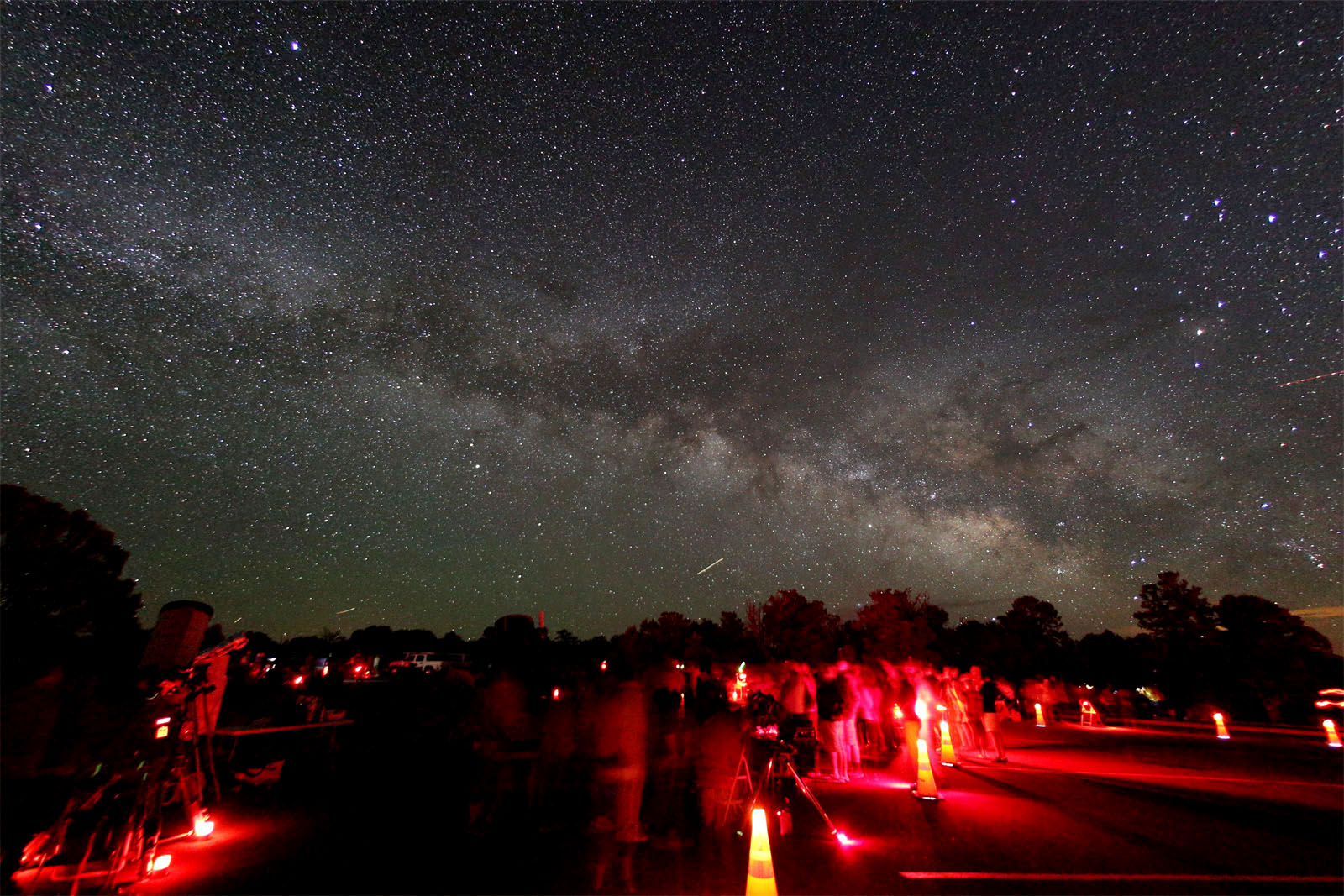
Again, better late than never, here are a few photos and stories from this year's Grand Canyon Star Party! It ended a week yesterday, but as normal lately, the photos have to settle into my brain before figuring what I'll do with them - text normally follows the photos I've selected! With a recently-obtained fisheye (Sigma 15mm F/2.8), I think these are the most striking photos! Particularly the one at left that shows the Milky Way rising over the crowd of star party telescopes and observers...

The shot at right is a bit more personal as I'm shown sitting beside my Celestron 14".  The string of red lights is one of the park rangers stopping by to say hi, and there is also someone looking thru the telescope. The bright "star" at upper right is planet Jupiter, and Saturn, a little fainter, has just risen above the trees, just to the right of the observer's head... The same part of the Milky Way - the brightest part near the Sagittarius/Scorpio border, is always spectacular as a backdrop. These are both 30 second exposures, wide open and an ISO of 4,000.


In the right shot above of my C-14, you can see above the observer's head my 500mm lens mounted there for some snapshots taken after the crowd thins out... I did this last year and was a lot of fun, so decided to do it again! With the C-14 properly polar aligned, it should easily track for a couple minute sub-exposure, so took a few frames to stack to decrease noise and increase signal and color saturation. At left is an eternal favorite this time of year - Messier 20 above (the Triffid Nebula), and Messier 8 below (the Lagoon Nebula). On more than a few occasions, I pulled up a frame of this image and used the colors to explain the physics that caused them. Of course visually no colors are visible - just shades of grey. It was a powerful demonstration - people could see the blue (reflection from a nearby blue star) and red (hydrogen fluorescing from UV light from nearby hot stars) nebulae, but no color. It demonstrated how our eye has evolved so that our B&W sensors (rods) allow us to see in dim conditions, but the color sensor (rods) only work during daylight brightness levels.

Also visible nearby in Sagittarius was the comet 2016 M1 PanSTARRS. I knew approximately where it was and in my 3rd shot there it was! Comets are easy to spot when near the sun - they show up green from the dissociation of carbon molecules by sunlight. On this night (11 June), it was 120 million miles from us on the Earth, and 214 Million miles from the Sun! While it gets a little closer to the sun at perihelion in October, it will not be visible from the northern hemisphere... This is a stack of 4 exposures of 60 seconds each. Oh - that fuzzy star at upper right? That is Messier 70 - a globular cluster about 29,000 light years towards the center of our galaxy...


Anyone who knows me also knows I'm a fan of dark nebulae! How do you see a black cloud, I hear you ask? Well, you see it in silhouette against clouds of stars, so looks like dark clouds against the Milky Way, as in the fisheye shots above. A spot in southern Ophiuchus is rich in dark clouds. Shown here at left thru the 500mm is part of what is called the "pipe" nebula because of its resemblance to a smoking pipe with more dark nebulae curling upwards...


And at right is a little dark cloud visible at the top in the link's wide field - the Snake Nebula, or B72... The "S" shape of the snake is strikingly apparent in photographs, but try as I might, have never seen it visually!


There IS one dark nebula you can see - Barnard 86, the Inkspot Nebula! It is shown at left in the full frame of the 500mm. Seen against one of the brighter clouds of the Milky Way center, the small dark cloud is easy to see in silhouette between a small star cluster and bright-ish star... Several friends and I show the dark cloud at the Canyon for something "totally different"!

Also for something different, Omega Centauri is a spectacular globular cluster that just clears the southern horizon.  Not many people have it on their observing list at the Grand Canyon, but I happened to notice that it was hanging just over the visitor center from my telescopes location on the field. I happened to have my 200mm mounted on the scope that day so took a 30 second snapshot of it - shown at right. It is a HUGE cluster, upwards of 4 million stars about 16,000 light years away.  But it is usually a dim glow seen so lowly in the sky. A photograph can make it look more apparent - here over the VC roof!


We had a great 6 nights of the star party, but some clouds and sprinkles (!) at the end. There were spectacular crowds at night, good crowds of astronomers too - likely about our best year given the weather at the end. We had elk too! Remember I've been going to these things for 28 years, and in the beginning saw absolutely NO elk. Now they are hardly getting excited about. They are evidently smart enough they know how to turn on the water fountains to get a drink - the photo at left taken near the bathroom at our old site at Yavapai Point... And as the star party wound down, a young female stops by the telescope field to say hello to Erich Karkoschka! We are supposed to stay over 100 feet from them, but we're not sure the protocol when they walk up to YOU!


Finally the last Sunday dawned clear - very clear, and after a few days of clouds, a trip was needed to go see the Canyon. We all took many photos of the Canyon, but one of the most striking of mine was from Mojave Point where an agave flower in its brilliant yellows was seen against the reds and browns of the Canyon. At left is an HDR shot of the plant mostly in deep shade, and at right is a close-up of the flower with what I think is a female black carpenter bee pollinating the beautiful flowers...

Next year's star party, the 29th, faces some uncertainty as the current organizer Jim O'Connor has broadcast his intentions to retire from those efforts. But the event is so successful that I think it would continue regardless. The astronomers love it, the public and park loves it, so I'm sure it will continue far into the future in something like the present form...

Friday, June 1, 2018

Fishing for Pollinators!

Back at "Ketelsen West" in Tucson where it is deep into late Spring - the "5th Season" careful observers get here, where it is ungodly hot and made comfortable by the lack of humidity! It is supposed to be 108F this Sunday, yet the humidity will likely be somewhere close to 5%, making it entirely comfortable if you are at least out of the sun...

As for local flora, we are nearly to the end of the Saguaro blooming season, so there is little on the bloomin' calendar till the summer rains start another spurt of desert growth in 5 weeks or so. But wouldn't you know, my cereus repandus on the east wall of my house, spurt out 7 buds on 2 plants last week, and I enjoyed 3 consecutive nights of flowers of a couple per night! The photo at left shows a good number of them (click to enlarge image) about 4 or 5 days before start of blooming. By late afternoon you can spot the ones that are going to open that night, finally opening to their full 5 or 6 inch diameter (!) by 10pm or so. Once the sun hits them the next morning, the show is over and they close, either setting fruit or if un-pollinated, drop off in a few days... At right is a photo of the last night of blooming showing the spectacular flowers.


These flowers are so large and deep that they require pollinators with a long tongue or proboscis to be able to reach the nectar. There is a story where evolutionary biologist Charles Darwin predicted the existence of an unknown pollinator that could reach the bottom of a 12" long flower in Madagascar, and it took 130 years to prove his prediction! For these flowers, one need only wait and they will come to you. My favorite hunting technique is in setting up a camera on a tripod, taking flash photos in the dark on the off chance of catching one. It has worked well except rarely do I catch moths in the early May blooming - my suspicion is that they are not active in the pre-monsoon season... Here at left is shown a great photo I took a few years back of an uncurled proboscis of a rustic sphinx moth as it is about to dive in to feed on nectar. How deep does it go? Well, the photos at right (again, from years ago) show how far in they reach, and you can see their effectiveness as pollinators - they must get covered in it! The fact that it was in 3 consecutive photos indicate it fed for at least 90 seconds...


On Wednesday night I set up the gear and started it about 11:30, and awoke about 5:30 to fetch it. At 2 photos per minute, that corresponded to something over 700 photos. Did I catch any moths this time? YES! Exactly 2, their images shown here left and right. The one at left came in at 20 minutes after midnight, and the one at right came in at 3:07 am. Don't know if the flash scared them off, as they only appeared in a single shot each, but I've spent some nights in the May blooming without capturing a singe one, so am ahead of average in May!


And yet, pollination occurred - I can tell by looking at the stigma to see if pollen has been transferred from the anther... With the macro lens plus extension tubes at 5:30 in the morning, sure enough, it appears the stigma had a good coating of pollen as well as "moth feathers". Make sure to click on the image to show the full resolution. This was a 3-frame focus stack to slightly extend the depth of focus of the exposure...

SO success for the May blooming outing - rare indeed from my earlier excursions to catch anything. But it is always fun to try and see what you will catch. You bet I'll be back in the busier August and September blooming season!
