Showing posts sorted by relevance for query cranes. Sort by date Show all posts

Thursday, January 31, 2019

Cranes!

This last weekend I made my first trip to Whitewater Draw this season. Normally we would do a couple trips per season, so there are lots of posts and photos to peruse from years past. In recent years the sandhill cranes that over-winter seem to be dropping in numbers, perhaps associated with the lower levels of water there. Whether it is a natural-caused issue or if they aren't pumping as much as in the past, I'm not sure. In any case, there is still a live web-cam for viewing (and hearing) the cranes, located at a site run by AZ game and fish...


It is always a nervous time driving down the access road - what will you see? Often times arriving in the afternoon is a gamble as most of them fly out into local crop fields to feed during the day and only return around sunset. In my opinion, I love arriving mid-afternoon and waiting to watch (and hear) them upon their return!  As I parked, an eerie sight was beheld - lots of cranes, but was strangely silent! They often cluck and talk to each other, but on Sunday it was almost reverently quiet... There were lots of people - I came a week after the "Wings over Willcox" celebration on purpose, when it was likely even more crowded. Taking the last parking lot close to the viewing areas, I mounted the 500mm on the tripod and took the couple hundred yard hike.


As I walked up the trail, was able to squeeze off a few shots including a variety of birds shown at left above. Besides the grey and buff sandhill cranes, there were the almost pure white snow geese, and the Northern Pintails grazing in the shallow water. At right I caught a few of the snow geese taking off from that location - the last of the bunch we saw that afternoon!

While shooting the cranes standing on the ground is like "shooting fish in a barrel", they look a lot more graceful as they fly. They can also pass appreciable closer while flying by than standing at a safe distance. Of course, catching them flying introduces a whole new set of issues - focusing and tracking them as they move! Fortunately the big 500mm lens has pretty much instantaneous focus, and will even take out any unsteadiness as you pan to track them! As a result, I can usually get a couple frames like that at left. My criteria for sharpness is if you can resolve the pupil of their eye! Fortunately, I also like shooting the cranes passing by local landmarks like nearby mountains, in which case, no tracking needed. At right are a flock of them passing by a favorite landmark - Cochise's Head, located north of the Chiricahua mountains. Also visible are cars on the local access road and irrigation equipment in nearby fields...

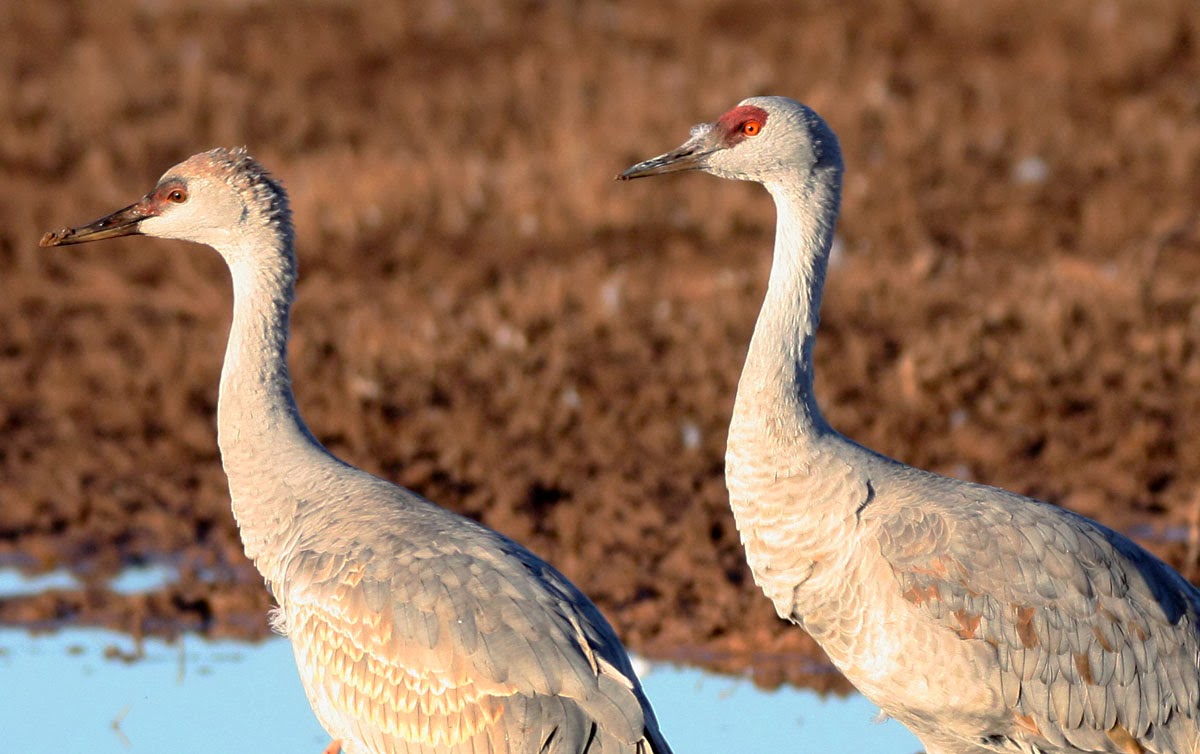
Speaking of a sharp eye pupil as a standard of quality, I noticed something else this trip. In shooting some of the nearest cranes to our observation stand, one of the cranes looked bizarre - it appeared to have NO pupils at all! Now over ALL the sandhills I've shot over the years, they all appeared to have the yellow pupils that I thought were standard. Yet, as shown at left, the bird on the right appeared to have some eye disease or something! Strange, huh? A minute later I took another shot, and modified the image so both birds were magnified and moved next to each other. You might be able to detect in the image at right that, in fact, it does have pupils, but the eye color is dark brown - weird!


I must say, though, that while all sandhill cranes look regal in the above photos, that when they are looking straight at you with both eyes visible, they look a little what, dorky? I don't know what it is, but it makes them look a lot less intelligent, almost like an idiot caricature of themselves... Maybe its just me!

There were other birds near us we got to see up close. In years past there were at least 2 large shallow ponds that attracted many water fowl that mostly have disappeared now with the low (or no water in the ponds!). Goodbye to Mergansers, pie-billed grebes and even the American Coots - none seen this year! One of the few additions to the monoculture of Sandhills were Northern Pintails, as shown at right. They were near us, mostly heads underwater grazing in the shallows. In this shot the male is below and the female above - an amazing difference in coloration and pattern!


I prefer a clear sky while visiting Whitewater - illumination and shadows seem sharper. But there were some high clouds that moved in on Sunday, thicker as sunset approached. But as it will sometimes do in AZ, it suddenly thinned as the sun sank behind the mountains to the west. Suddenly there was a spectacular coloration to the west, and a phalanx of photographers gathered at the west side of our platform!

At first I took a shot of the sunset, at left. After that, it was fun to get profiles of the photographers at work shooting birds and sunset together, as shown at right.


I took a few more, but my favorite is the close-up shown at left, showing a photographer in close profile, with another telephoto intruding at right barely seen in the dark part of the sunset...

Shortly after this suddenly a din erupted as cranes seemed to converge from all directions! It was just getting dark enough that imaging them was very difficult as the coloration and lighting was dim to get their silhouette, and it was mostly their noise that assaulted the senses! I did manage to get the shot at right, with a profile of hundreds of cranes in the last light of the twilight...


Finally darkness descended, but I had one more trick up my sleeve! Just having obtained a flash while in the Midwest (unfortunately, the full-format canon 6D has no built-in flash) I used it to reach out to a flock of cranes gathered perhaps 150 yards away. With a high ISO (3200) fast aperture (F/4) and full flash power, I got the shot at left. What is most amazing is the cats-eye effect (same as red-eye in human subjects in a darkened room). The light from the flash is focused in their eye, and reflects back out like the glass micro-spheres in reflective road signs. Every crane that had an eye pointed in my direction (at least one had both eyes visible, and another duck or waterfowl) showed the effect! Always fun stuff!

I'm hoping to get back again before March arrives and cranes head north. Even though a mid-afternoon arrival requires sitting and waiting a few hours for sunset to arrive, I can think of fewer locations that are as nice to just "chillax" for a long period of time!

Sunday, February 8, 2015

A Whitewater Draw Quickie!

For years and years we've made at least a couple of trips to Whitewater Draw, a wetlands operated by Arizona Fish and Game. If you are new to the local population of cranes, feel free to peruse the search that reveals some of our recent visits. Word is getting out now, but a few years back, few knew that upwards of 30,000 sandhill cranes wintered there from Mid-October to Mid-February. With all our alternate activities over this Winter, we hadn't made it yet, and with the end of their stay approaching, we jumped at the chance for a road trip yesterday with the new Ford Van.

We left late in the day for us, about 1:30, and once we hit Benson, decided to stop and pay a short visit to friends Pat and Betty, who we've not seen or talked to much since Christmas. Our "15 minute" visit turned into a half hour, and after driving through Tombstone without even thinking about another stop, got to Whitewater Draw right at 4pm, 2 hours before sunset.

We feared that last year's drought and rumors of a broken irrigation system might have left permanent damage to the bird population, but with plenty of rain this year, the ponds and wetland's water level was about the highest I've ever seen! With a quick latrine stop, we snagged the last parking spot in the lower lot and hiked in towards the hiking trails. Fortunately, the rattling calls of the cranes greeted us like old friends, and as we approached a crowd of observers nearest a group of cranes about 75 yards away, we recognized friends Gary Rosenbaum and Frank Gacon, who we'd just seen at the astronomy club meeting the night before!  After chatting for a bit, we continued on to an overlook with a bench for relaxing.

I had a new lens to check out - a Canon 300mm F/4 gotten recently from Astromart. While not a pricey fast one for astronomy (and seemingly football games!), with a 1.4X converter, it got me into the 400+mm focal length that seems the minimum for shooting birds.  While I've got telescopes for ultra-closeups, the autofocus of a real camera lens allows shooting in dim light and on moving objects that I don't even try with a 700mm or longer telescope.  The shots above are testament that it works pretty well, though even stopped down to F/9 or so seemed to have a narrow depth of field...

Once parked at our little overlook (where most of the benches I recall had been removed!), it was nice to take the standard shots I shoot every year - at left is shown the distant mountaintop profile of "Cochise's Head" with part of the flock of cranes in the foreground.  Certainly the 300mm was a perfect focal length for that!  And at right is shown the Large Binocular Telescope atop Mount Graham, a good 80 miles (!) distant, with a flight of cranes crossing in front.  I was shocked to see the white snow atop Graham.  We had plenty of rain in Tucson last weekend, but the mountains near Tucson didn't get any snow, but it was certainly there.


While most of the cranes kept their distance, fortunately we had other diversions. Not far from the seat we found on the trail on one of the dikes, a mated pair of northern shovelers were easier to catch with tails in the air, feet furiously pumping to keep their heads under water, than their heads above water. And at right is an American Coot coming ashore right below our vantage point. While they have a distinctive look above water, their disturbingly ugly feet are only spotted on land - eww gross!

The sun continued on its path, sinking below mountains to our west.  Of course the cranes that have been out feeding wait till after sunset to return, some flying right over us, as shown at left.  At right a trio of distant cranes pass the last rays of sunlight illuminating hills to our north.  It was about this time that I met a woman from Prescott having issues with her camera.  While she said she was taking a class in using it, she knew little about it and was randomly changing modes on it trying to get decent results.  Near tears, I gave her some advice on using her equipment which seemed to improve her mood.


But even as darkness descended upon us and picture taking became more of a challenge, the action picked up! While we wandered back to our vehicle, the noise of the cranes increased in volume as the skies filled with their return. At left the silhouette of dozens of birds were captured against the deep twilight. And finally at right, the last images taken were of an American Coot with somewhere to go, leaving a wake against the twilight...

All in all it was a fun trip.  The 300mm lens worked well - it took all the above pictures, though the early ones used the 1.4X converter.  The van worked great too, was fun to drive, getting us back home in less than 2 hours, after we decided to again not stop in Tombstone.  We're still thinking of another trip before the cranes leave - we'll see!

Saturday, December 27, 2008

The Cranes of Whitewater Draw

Melinda and I made what was my 4th trip to Whitewater Draw (her second), a wildlife preserve built around a man-made wetlands where Sandhill Cranes spend their winters. Thanks again to Tom and Jenn Polakis who first exposed me to the place (with David Healy and Jeff Medkeff), about 25 miles east of Tombstone, AZ.

In all my previous trips, the "lake", varying between 10 and 40 acres, was literally crowded with up to 30,000 cranes. Today, at mid afternoon, it was totally devoid of cranes, though there were a few American Coots, Northern Shovelers, Buffleheads, Northern Shrikes, and a few others I've yet to ID. It was eerie - the normal din of tens of thousands of cranes was replaced by silence. The few birders braving the cold wondered where they were - we had seen and heard a few groups pass over, but none landed near the water.

Then, 'round about 4pm the masses arrived! From the north up towards Mt Graham (about 85 miles away), waves and waves of thousands of cranes descended, most all of them landing in a pasture about a mile to the west of us. The clouds of cranes could be seen tens of miles away. This photo shows 3 or 4 waves of them against the snow-covered Graham mountains, with ground fog near the base, and the LBT telescope seen on the western slope.

About the time dusk was falling, we could no longer stand the cold, and headed back to the car, there was a mass ascension from the pasture and the sky was filled with incoming cranes. We scrambled back down the trail to take these images. It really was amazing with them darkening the twilight sky. They slowly settled into the lake and we soon spotted Jupiter and Mercury through the masses. The sight and sounds of their calls is not to be soon forgotten.

Just for grins, before leaving I thought I would see if the camera flash would be bright enough to illuminate the closest of the bunch, perhaps 50 yards away. It was not, but interestingly, the cranes show a "catseye" effect where the light is reflected back to the source, making most all of them showing at least one eye brightly illuminated.

It would have been nice to stay and observe for a while, but we were already chilled to the bone. The cranes stay till mid February, so perhaps next dark of the moon. As it was, just the bird watching was memorable enough! BTW, all photos taken by the Canon XSi, the top 3 images taken with the 80mm Meade APO F/6, the last 3 with 70-200 F/2.8 Canon zoom.

Wednesday, January 29, 2020

Whitewater Draw Weekend

With Winter firmly ahold of us (temps in the 60s!), it was time to plan a birding trip to Whitewater draw. I've posted about our many trips there a couple times a year for nearly a decade since we discovered it. In recent years, Arizona Game and Fish have installed a webcam to keep an eye (and ear!) on the action there. This year showed a LOT more water than in the last few years. I'm not sure it is from more rainfall or if the irrigation system is working again after failing a few years back. It sort of put a crimp on the cranes the last few years, so was looking forward to seeing the place again.

I ended up going out both Saturday AND Sunday! There were lots of cranes, but interestingly, they were all avoiding the water! Years past they all gathered in the shallow water to avoid predators (coyotes) through the night, but now they gathered on the banks. But this behavior brought them closer to the walking path, so was able to get some good close-ups.

The main activity besides resting (feeding is generally done in fields away from the wetlands), as well as male posing, presumably looking for females, or exerting dominance. The pair of males shown here were trying to out-do each other. I was in the perfect spot for the photo at left where they were standing tall with wings outstretched - mirroring each other. The left image is a full-resolution blowup to show the steely gaze of the crane looking my way.


It so happened that I was set up next to 2 other photographers - all of us shooting with the same setup - Canon cameras with the 500mm and 1.4X extender! I was the only local one. Anyway, the two cranes continued their antics shown here. At right, one went low the other high, and finally at right it appears the confrontation was over. I wasn't sure which one won the contest, but I'm sure that THEY did!

The group of cranes adjacent to the walking path was closest to us, but was small in numbers compared to the main group which seemed to the west side of the wetlands, about a quarter mile or so away. They were raising quite a racket out there, and in binoculars, seemed again to be avoiding the water. Some snow geese were, as usual, scattered among the sand hill cranes.

I love their rattling calls. If you tune in to the webcam above, you can hear them. On occasion when something causes them to take to the air, the show starts when you hear the wing beats of thousands of cranes taking to the air, then the ruckus starts with the calls also filling the air. I can sit and watch/listen for hours, which I generally do - occasionally taking a photo or two!

At left, the view is towards the west - the large groups of cranes can be seen at bottom, with many taken to the air, seen in silhouette against the Mule Mountains. The lowlands contain fields where the cranes often congregate.  At right is a view to the northwest, again seen against the mountains illuminated by a very low sun.

As has happened a few times in the past, as sunset neared, there appeared a "tornado" of blackbirds, rushing in huge groups to congregate in the reeds and rushes around open water. Upon closer examination, they were, in fact, yellow-headed blackbirds. At left they are seen as they gather, with cranes in the background. They are evidently close cousins of the more common redwing blackbirds, but Whitewater is the only place I've seen the yellow-headed version.

There were many other species of birds feeding. Here at right are seen a group of American coots taking one last feeding trip across the wetlands before it got dark. Only seen in silhouette here, they sport nearly white beaks and dark red eyes, making them more striking in full sunlight...


I had spotted a great blue heron as we entered from the parking lot, and right on cue at sunset, it flew right in front of me to roost in a clump of vegetation not 50 yards away. In the deepening twilight, the exposure was long enough that the wing flaps were blurred, but in scanning to follow it, at least the pupil of the eye is still sharp!

The usual routine was for the cranes to return to the protection of the water as nightfall came. Many took to the air and flew nearby, and it is always a challenge to capture them against the twilight sky. At right is about my best effort as they were gliding without flapping their wings. Even as it got dark they were sharply captured.


I'll have to say, that Saturday's twilight was likely the most spectacular I've ever seen! Of course, there are a lot of those in AZ, but this one was very long-lasting, actually 45 minutes of color from looking at the time stamp on my images. I've got 2 to show here, at left a single image showing some of the birders here distracted by the sunset colors. And at left is a 3-image "HDR" (High Dynamic Range) photo that combines different exposures to extend the visibility of highlights and shadows...


It was clear enough on Sunday to take a few
star photos.  The big news in astronomy now is that in the constellation of Orion, the upper left star, Betelgeuse has been growing fainter than it has ever been seen!  Instead of the brightest star in the prominent constellation, it is now third-brightest, effectively tied with Bellatrix, the upper right star.  At left I took a photo purposely out of focus to show the colors of the striking constellation.  The orange color of Betelgeuse reveals it to be a red giant star - very cool (thus orange-colored) compared to the bluish other stars of the constellation.  At right is another not quite as far out of focus to show much fainter star colors.  While most are still blue, many fainter ones have reddish colors as well.

I've only started to harvest images from these 2 trips, so look for more soon, as well as likely more trips while the cranes are here!


Wednesday, January 11, 2017

Newish Glass!

The past few years, whenever I would suggest a purchase, Melinda would usually respond with "when I'm dead you can spend my life insurance money", which usually brought any discussions to a halt - you can't argue with a cancer patient! She did agree to a new TV when the old CRT set died, and she eventually came around after flat out stating that the 48" screen was "too big" at the beginning. Watching our Cubs win thru the summer became our favorite pastime...

Anyway, now that she has passed, and now there IS insurance money, I've tried to be responsible and spend it on what she would approve - paid off the AZ mortgage, and still debating on the IL house... Invested most of it so retirement should be more pleasant... But I did buy a little "toy" - one she even might have approved of if we had some disposable income! We were both fans of birding at Whitewater Draw and elsewhere, and also of astronomical imaging, so when I saw a Canon "super-telephoto" lens on Craigslist, I had to check it out. Shown at left, it is a 500mm F/4 - very fast optics allowing short exposures for astronomy and pretty good reach with fast autofocus and image stabilization for birding. It is an older first generation, but was a good deal including the camouflage-cover, the Wimberley tripod head and a Canon 2X converter. Note in the photo that most of the large diameter part is the sun shade!


I got the lens in the closing days of November and have had it out a few times and it is impressive in it's performance... If you do a Whitewater Draw search on this blog, I've hoisted a few telescopes along for birding a few times and while the images for a distant crane is impressive, the very fast autofocus and image stabilization it is a whole 'nother ball game! I can now focus and follow birds in flight and have them come out tack-sharp! I've made 2 trips to their over-winter home and have gotten a few favorites already. At left are some cranes in flight at that "magic time" just before sunset. And at right is a straight shot taken with the lens of cranes at rest.


In my most recent trip this last Sunday, I
caught some distant flocks of cranes coming in from miles away where they were likely feeding on grain fields in the area. Over the same mountains shown at upper left, here at left are 127 cranes (by my count) coming in for the evening. There is "strength in numbers" as they spend the evening together at Whitewater, using the water pools as protection from predators (usually coyotes). Click on the image to enlarge to full scale to see the multitudes of cranes... And at right is the standard shot of LBT glowing in the last rays of sunset from the Observatory near 11,000 feet elevation. At 80+ miles away, it is still eye-catching as it is usually parked at an angle that reflects sunlight to us birdwatchers... This frame is actually a focus-stack of 2 frames, otherwise either the birds or observatory would have been out of focus. But here 2 shots were combined to keep the sharp part of each image.


This last trip out there was a larger variety of smaller water-birds from a month ago when there were mostly just cranes. They also cruised closer to the observation platforms, so were a natural to photograph with the 500mm! At left is a long-billed dowitcher that was difficult to freeze as it was in constant motion marching and picking thru the shallow waters... And at right is an eye-catching killdeer - a common bird, but a beauty nonetheless!


And even though we're suffering through what seems like the cloudiest Fall and Winter in recent memory, I've gotten the lens out on a couple occasions for astronomical imaging. The first time I was fighting thin clouds and wasn't a good test for its capabilities. But the next time I shot a few objects and got some promising results. At left are a couple nebulae that shine by fluorescence of hydrogen resulting in a reddish glow. Commonly called the North American nebula at left and the Pelican Nebula at right, they are analogous to the glow from a fluorescent bulb, but excited not by electricity but from a bright star out of the field. This image is a stack of 17 frames totaling about 35 minutes of total exposure. The lens is extremely sharp from corner-to-corner across the full-frame 6D sensor, and I did stop it down to F/5.6 to reduce vignetting at the corners a little. But overall the results are quite good! At right is another glowing cloud of hydrogen - this one known as the Rosette Nebula, looking almost like a ghostly Christmas wreath! This one is only 10 minutes of total exposure!

So I'm impressed with the overall performance of the lens for both birding and astronomy! It will be one of my standard tools when going out on excursions, and might be just about perfect for the upcoming solar eclipse in August! But it is a sobering reality to know that it is a product of a life insurance payout... Would much rather do without it and have the presence of my bride back... But it will give me a chance to remember her every time I have it out with me!