Showing posts sorted by relevance for query rustic sphinx moth. Sort by date Show all posts

Sunday, August 10, 2014

Keeping Astronomers Hours!

As I prophesied a week ago when we returned from the Midwest, our Cereus repandus on the east side of the house has been a busy plant lately.  Past observations have revealed that a pinky-fingernail sized bud transforms to a nearly 14cm (5") diameter flower in 8 days!  Last night was the 3rd consecutive night of blossoms, but nearby storms and gusty winds made any images difficult, but I had a setup out the 2 preceding nights.  I've done the time-lapse thing before, and documented the transformation from bud to flower to pollinators, so what to do this time with the abundance of riches before me this time?

My decision was to take a detailed census of the night-time visitors that came by the flowers during the night.  Shooting a frame every 3 minutes (used on the time-lapse above), makes it likely that some will be missed, so the frame rate was moved up 6X to 30 seconds between frames.  The flowers don't open fully till about 10pm, so started about then, going to nearly sunrise at 5:30.  Yes, that is a lot of pictures (1672!), and most just show the lonely blossom, but some show more, and that is the purpose of the exercise!  At left is shown the "standard", mostly repeated 730 times the first (Thursday) night.  Of the two flower open that night, this one was about 50cm (20") off the ground - the other option was about 200cm (7 feet) off the ground!  My Canon XSi was used with the kit 17-85 lens shot at 55mm focal length, F/9 with the on-camera flash.  A third party intervalometer was used to trip the shutter every 30 seconds.


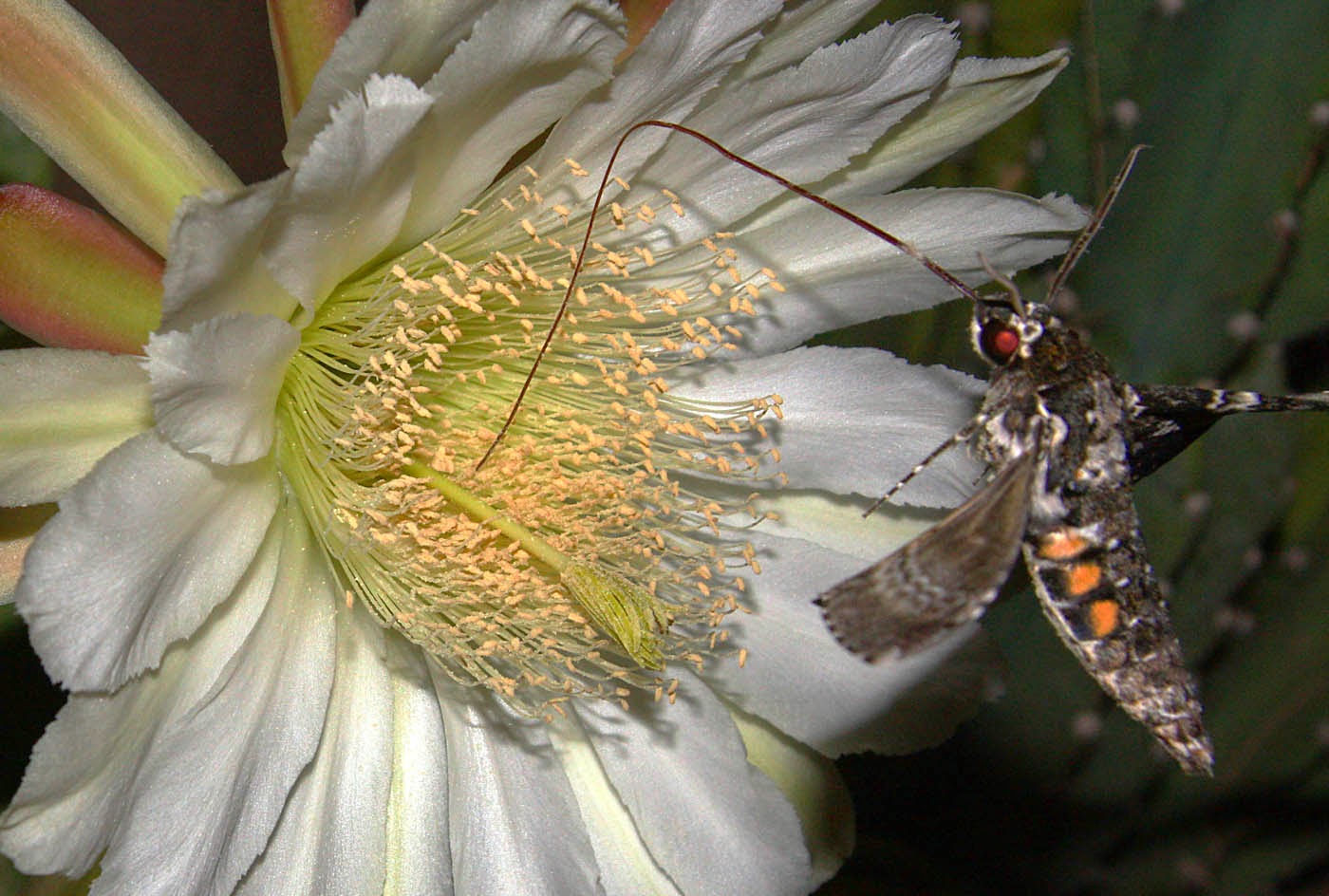
While was watching TV inside, I didn't have long to wait!  Ten minutes after starting the series, the first moth came by.  And it didn't mind the flash, hanging around for at least 90 seconds (three frames).  They are assembled together here at left.  This one didn't mind digging deep for a taste of nectar!  Click on the frame and you will note the little slit visible near the tip of the wing.  As shown at right, this same moth Note the wing slit!) returned 30 minutes later for a single frame.  While not visible in the left images, this shot shows the yellow side spots, identifying it as Manduca rustica, the rustic sphinx moth.


It was then quiet for a long time...  Some 3+ hours later elapsed until the next visitor came by at 3:15.  Another Sphinx moth, this one showing off his proboscis and head details.  Note the absence of a wing slit, so this one is a different moth.  Hard to say if the flash frightened him off or if they can feed in under 30 seconds.  Certainly the 3-frame set above, with its head buried in the flower might not have  been as distracted by the flash of light. 

Photos were taken until 5:15 am Friday morning, when the intervalometer stopped - nothing else was shown...


The following night (Friday), the flower opening was at eye level, about 180cm off the ground.  I decided to look face-on into the flower for a different perspective.  I started the sequence a little earlier, right at 10pm, and had to wait a little longer till Midnight for some action.  Thhis reveal is another rustic sphinx moth, with wings on full display, showing his large size.  I measured the flower later at 14cm (5.5"), so the wingspan is a good 12cm (5").  In order to get it all in I downsampled the image, so resolution is lost in the left frame.  The right image is shown at full resolution for maximum detail.  Antennae are folded down, and it sports what look like rabbit ears, also folded down, but might be an artifact of the coloration pattern.


A minute later another spotting, likely the
same moth was seen hovering over the flower inserting its proboscis.  It is slightly out of focus as it is too close to the camera, but if you look at the frontward of the orange-yellow abdomen spots, the upper edge is whitish as the above shot.

Fifteen minutes later, another spotting, but much more out-of-focus, so more difficult to do an identification.  for what it is worth, the proboscis, which is nearly in focus, shows a kink about at the end of its front leg.  Interestingly, in the left image, the is a kink in about the same place, so there I a chance that all three of these images are likely the same sphinx moth...

Well, that was the end of the moth appearances, but no the end of the activity.  At 5am, suddenly a spider is seen working on a web off the edge of the flower.  It has some resemblance to a huntsman spider, but I read they generally don't spin webs...  While the spider itself only appeared in one frame, the web was there the rest of the night, the flower petal it was attached to slowly bending as the above section of the web was finished and tensioned...  The web extends up 120 cm (4 feet) to the eave of the house, where it still stands.  Hmm, what might it have been trying to catch???


At 5:15 (interestingly the time I stopped taking frames the night before), it is like an alarm went off and the blossom was attacked by honeybees!  It was rare for a frame to catch less than 3 or 4 bees in the picture, often many more!  This effect is visible in the time lapse referenced in the first paragraphs time-lapse link.  From 5:15 to sunrise the bees fed hungrily.  It is interesting to note their full pollen baskets on their rear legs, even those who first appear at 5:15.  One of the frames, shown at right, looks to show a couple of intoxicated bees taking a break as they lie on their backs taking a rest before resuming work...  I never spotted any of the bees struggling with the spider web, but the location of the web might have been chosen for that purpose!


And as the twilight grew and the sun came up, the bees halted their visit too and the flower closed up and the night was over.  Very few other pollinators were spotted - I saw what looked to be an iridescent green bee of some sort, very tiny and out of focus, but mostly bees and sphinx moths, but it was fun to do the census and see what all came by during the night.  There appear to be an abundance of these night time bloomers around, and while the absolute number of these moths are small, hopefully the food source will increase as more plant these cereus.

Wednesday, August 17, 2016

One Night To Shine!

3D anaglyph image!
3D anaglyph image!
Since July and August weather doesn't agree with astronomy (it is our monsoon season, threatening rain most days), one of my favorite activities is chasing the blooms, flowers and pollinators of the array of Cereus repandus cacti we've got growing on the east side of our house. Clicking the above link will take you to some of our earlier posts of these amazing flowers. If the 15cm (6"!) diameter, night-blooming flowers aren't enough to keep your interest, the specialty pollinators that come out at night to feed are amazing too! These top two images here are recent bloomers, shown here as anaglyphs - get out your red/blue glasses to see them in 3D stereo! The right image is unusual - normally as soon as the sun hits them they are on their way to closing - I've got a time-lapse of that!


Days to blooming!
For my one-eyed readers, or those of you who don't have any anaglyph glasses, you can enjoy this image at left. There are usually a pair of blooming seasons per summer - the first one in May with a few blossoms, but the real blooming session appears to be in late July and August, at least in my yard with my variety. We missed the first blooming season when we were in Illinois for a couple weeks, and the latter season was while Melinda was taking the tour of health facilities around Tucson... Fortunately, I would come home late each night to do cat chores, so usually came upon the flowers already open. Interestingly this second season, the flowers either seemed to be 7 or 8 feet off the ground, or down a foot off the dirt, so would either have to get out stepstool and the tall tripod, or lie down on the ground. Fortunately, there was one blossom at the perfect 4 foot (1.2 meter) level that I waited to bloom. Also, once the flower bud was first spotted - a little nub less than 5mm (1/4") across, I started regularly imaging it until it bloomed, as shown at right...


So from the afternoon shot taken earlier in the day, I knew this bloom would blossom that night. I didn't get home till well after 1130, and sure enough it was already wide open and I arranged my camera (Canon XSi - 'cause of the on-camera flash, macro and  about 5cm of extension tubes). Focusing quickly on the center green stigma of the flower - I could see that the pollinating moths had already visited. How could I tell? Well the Stigma was already covered with pollen and some of the hairs and "feathers" of the rustic sphinx moths that normally visited. Look at the image at left, and the same image at full camera resolution at right. While the anthers are still relatively loaded with pollen, with the stigma loaded up (they must be sticky to hold on to pollen and moth hairs) you can see it had been visited the previous 90 minutes the flower had likely been open.

So what does it look like before the moths visit? Glad you asked as a few days earlier I caught one just as it opened before 11pm. Shown at left you can see the stigma is a clean green with anthers fully loaded with pollen just waiting for a passing moth to brush some across it. By early in the morning, I went out to shoot a corresponding macro shot of the stigma after a long night of visiting pollinators. Shown at right is the above flower at 5am. Compared to the images in the preceding paragraph, it looks absolutely furry from moth hairs, and the anthers are pretty much denuded of pollen...


So who did we attract as pollinators this time? Between about midnight to 5am I took pictures every 20 seconds, hoping to accidently capture some pollinators. The 830 frames show exactly 4 visits by rustic sphinx moths, though you will see that one likely visited twice making only 3 moths visiting overnight (also not counting the moths arriving before midnight. In the images at left and right, each of these moths stayed for 2 exposures taken at 20 second intervals, so about a half minute. This is the moth pair I'm thinking is a second visit by the same moth. Only 7 minutes between visits, you can also spot a pair of gaps in it's left wing, more visible in the left hand image of each.


Here at left is the first moth visit recorded after midnight - 1236 by my camera clock. Note that the wing edges are very clean and the colors pretty bright - likely indicating a young moth. Then after the same moth visit from the preceding paragraph, at right is the last one, coming by at 3am for a visit. Even though much of the image is out-of-focus, you can see the left wing has some sizeable chunks out of it - indicating an older specimen perhaps, and certainly making identification easier had it made more visits... Unfortunately, there are no more buds indicating any flowers coming up, so the blooming season might be over...

Still these are always interesting to observe - the proboscis longer than the body allows feeding on nectar far down the throat of the flower. Had I time to stay up and monitor the camera/flower, I could have manually taken many more of the moth visits, though usually depend on the intervalometer to take frames at regular intervals. The moths don't seem too upset by the flash - last year managed 6 frames of the same moth over its 33 second visit.  Also interesting this blooming session was the complete lack of honeybees.  In times past the last few hours of the predawn hours were swarmed with bees, but not one to be spotted this time...

So after the flower blooms? After closing early in the morning after it blooms, it shrivels and dries out. At left is an image a day later, then again 3 days after the blooming. Note on the bottom image there is a little crack on the stem near the base. By just touching it, I managed to break off the flower, leaving the stem behind. Most of the flowers do that after blooming, the stump remaining turns into a fruit. After the flower broke off at right, the stigma hangs out by its long stem. Slicing the flower lengthwise shows the remaining flower parts, including the anthers, filament threads and flower petals...

As I said, you've got to make your own fun during the monsoon nights while you can't be observing. Fortunately these sorts of things are available to distract me from the cloudy skies!

Saturday, September 5, 2015

My Night-Time Buddies!

The Summer monsoon weather pattern has been hanging on for dear life - "good for the corn" as they used to say in the Midwest with near-daily clouds and rain, but bad for the stars and photon-deprived amateur astronomers around here! What is an observer of the universe expected to do? Well, like in Illinois when I switch to lookin' at bugs in the backyard, there are similar subjects here in Tucson. Fortunately, late monsoon season is a good time for the spectacular flowers of cereus repandus - night bloomers with flowers up to 15cm (6") in diameter! It is sometimes tough to tell very far in advance when they'll bloom - at left is one about to open, shown near sunset. Yet a mere 3.5 hours later, it is transformed to the image at right.


But while the flowers are beautiful, what is interesting to me are the visitors that come by during the night. Almost magically, about a half hour after fully opening, the moths start drifting in to feed on the nectar and help pollinate the plants. It is the transitory appearance that is of interest to me. I've blogged about them many times, starting with the time-lapse I made back in 2012. Back then taking only 20 frames/hour, I was lucky to catch one moth during the night.  Close examination of the time lapse indicated from flower movement that many more were visiting while not exposing. Since then I've upped the frame count up to 240 per hour and now am seeing 20 or more during the night - a busy location indeed! Something to note is what they accomplish during the night - at left is the near-virginal flower enlarged from the right image above. Note the clean greenish central stigma, and the anthers loaded up with pollen. Of course, far down the throat of the flower is where the nectar is located that the moths crave. The image at right shows the stigma after only 8 moth visits over the course of an hour.  The sticky stigma is "dirty" with the shed scales of the moth, as well as pollen from this as well as other plants carried by the pollinators.


Over the course of the night this continues with dozens of moth visits. The large tubular flowers require pollinators with a long proboscis to reach down the flower to where the nectar is located deep in the flower. Note the long probes of the moths seen (and blogged) previously here, as well as here. This year I might have caught my best proboscis picture, shown at left. You can see the length exceeds their wingspan by a considerable amount. You can also see how far in they "attack" the flower - from the image at right (a different moth) they can reach considerably far down the neck of the flower!  Note also the moth at right has some wing damage - it doesn't seem to affect its flying characteristics much, and would actually serve a useful purpose to identify future visits to the yard...


And if you'll indulge me a few more images (got lots of 'em now!) at left is another great proboscis shot, though the moth is mostly out of focus. Still, you would think they have to be careful as they come in for docking - damaging that thing would likely affect its feeding significantly! At right is the best view I've had of the proboscis base - note that it is actually a pair of tubes! I've not noticed this before, nor know the purpose, but find it quite interesting... Almost all of these images that includes their eyeballs shows a "catseye" effect. If you shine a flashlight or take a picture of them, the lens focuses the light on their retina and there is a beam that comes directly back to the viewer. It is an easy way to find your cats in the dark yard - shine your flashlight around and look for the glow from their eyes. Works for moths too!

Note that all of these moths are the same species! The 3 orange spots down the thorax indicate manduca rustica - the rustic sphinx moth, with a classic image shown at left. I've never caught any another species until last Sunday evening at 10:48, the 3rd moth to visit the blossom along the house. Shown at right it looked pretty similar, perhaps slightly smaller, though it had pink spots down its side! Submitting it for an ID request to Bug Guide, by morning I had an answer! Interestingly, it is called a pink-spotted hawk moth, or Agrius cingulate. I only captured the one image of it, but is the only non-rustic that I captured of 32 moth-visits over one and a half nights of imaging, and of course, over my previous sessions over the years. Rare for me, anyway!


Note that nearly all of these images were taken with a timer - I set it up to take images every 20 seconds on 30 August, and every 15 seconds on 2 September. It resulted in 1300+ images on the first night and 640 over about 3 hours the later. But the return of 32 moth visits was pretty good in my book (a little under 2%). As modern shooters are fond of saying - "digital film is cheap" - it isn't like we've got to pay for film and processing these days! Still, as a result, most of of the images are "accidental". Short of sitting in a chair and pushing the button manually or devising some sort of "moth detector", I can't see doing much better. I actually did have one come visit while I was checking the camera and caught 6 images over its 33 second visit by pushing the button myself. Shown at left in the montage, the number indicates the elapsed time in seconds after the first image. It shows that the moth made several "lunges" at the flower, presumably to reposition its proboscis and assist in feeding.

 I almost forgot!  On Sunday evening there was a full moon, and before heading to bed I tried to take one by the light of the full moon instead of the on-camera flash, like all the others. The result is at right - pretty good, thought the narrow depth of field tells you I opened up the aperture to its maximum 2.8 for the 30 second exposure.


As I've noticed before, the moths stop coming by about a half-hour before sunrise, and minutes later the bees arrive and do their thing till the flower closes an hour or so after sunrise. See the animated clip in the second paragraph to see for yourself. As I was taking a few close-ups before dawn, I shot the bee at left, shown at full camera resolution. Note the anthers, so packed with pollen early in the evening, are mostly bare here. Seen in drifts on some of the photos above, where did it end up? Well, at right is shown an 18 (!) frame focus stack of a cropped, extreme close-up of the stigma after a long night of pollinators. Besides the dark-looking straws (scales) from the moths, they are packed in spherical pollen grains, eventually to be seeds in the ripening fruit.

Anyway, the flowers and their pollinators are suitable distractions for observers looking for details! Give it a try - likely it will clear up eventually and show us some twinkly lights. But in the meantime - "gotta make some hay while the sun shines" - another Midwestern adage!


EDIT: I forgot to mention in this post that an earlier-in-the-summer blooming, only 3 months earlier hadn't brought ANY pollinators! At the end of May, a full night of camera monitoring showed nothing came by, not even the honeybees at the end of the night... Nothing sadder than an unused, unpollinated flower... Given the visitors we have this time of year, obviously the earlier blooming was before these pollinators were active in their life cycle...

Friday, June 1, 2018

Fishing for Pollinators!

Back at "Ketelsen West" in Tucson where it is deep into late Spring - the "5th Season" careful observers get here, where it is ungodly hot and made comfortable by the lack of humidity! It is supposed to be 108F this Sunday, yet the humidity will likely be somewhere close to 5%, making it entirely comfortable if you are at least out of the sun...

As for local flora, we are nearly to the end of the Saguaro blooming season, so there is little on the bloomin' calendar till the summer rains start another spurt of desert growth in 5 weeks or so. But wouldn't you know, my cereus repandus on the east wall of my house, spurt out 7 buds on 2 plants last week, and I enjoyed 3 consecutive nights of flowers of a couple per night! The photo at left shows a good number of them (click to enlarge image) about 4 or 5 days before start of blooming. By late afternoon you can spot the ones that are going to open that night, finally opening to their full 5 or 6 inch diameter (!) by 10pm or so. Once the sun hits them the next morning, the show is over and they close, either setting fruit or if un-pollinated, drop off in a few days... At right is a photo of the last night of blooming showing the spectacular flowers.


These flowers are so large and deep that they require pollinators with a long tongue or proboscis to be able to reach the nectar. There is a story where evolutionary biologist Charles Darwin predicted the existence of an unknown pollinator that could reach the bottom of a 12" long flower in Madagascar, and it took 130 years to prove his prediction! For these flowers, one need only wait and they will come to you. My favorite hunting technique is in setting up a camera on a tripod, taking flash photos in the dark on the off chance of catching one. It has worked well except rarely do I catch moths in the early May blooming - my suspicion is that they are not active in the pre-monsoon season... Here at left is shown a great photo I took a few years back of an uncurled proboscis of a rustic sphinx moth as it is about to dive in to feed on nectar. How deep does it go? Well, the photos at right (again, from years ago) show how far in they reach, and you can see their effectiveness as pollinators - they must get covered in it! The fact that it was in 3 consecutive photos indicate it fed for at least 90 seconds...


On Wednesday night I set up the gear and started it about 11:30, and awoke about 5:30 to fetch it. At 2 photos per minute, that corresponded to something over 700 photos. Did I catch any moths this time? YES! Exactly 2, their images shown here left and right. The one at left came in at 20 minutes after midnight, and the one at right came in at 3:07 am. Don't know if the flash scared them off, as they only appeared in a single shot each, but I've spent some nights in the May blooming without capturing a singe one, so am ahead of average in May!


And yet, pollination occurred - I can tell by looking at the stigma to see if pollen has been transferred from the anther... With the macro lens plus extension tubes at 5:30 in the morning, sure enough, it appears the stigma had a good coating of pollen as well as "moth feathers". Make sure to click on the image to show the full resolution. This was a 3-frame focus stack to slightly extend the depth of focus of the exposure...

SO success for the May blooming outing - rare indeed from my earlier excursions to catch anything. But it is always fun to try and see what you will catch. You bet I'll be back in the busier August and September blooming season!

Thursday, June 19, 2014

Meanwhile, On The Other Side Of The Yard...

It was just a few days ago that I posted about our potted Trichocereus spachianus, which bloomed in the midst of about the driest Spring on record...  Then last night, the queen of the back yard, our Cereus repandus threw out 3 blooms in one night!  Spectacular stuff!  It is amazing to note the differences in the species when it comes to the flowers.  The former potted cacti had buds showing for weeks before finally showing signs of blooming.  The Cereus repandus just showed a bud a mere 8 days before blooming last night!  On 9 June, it was a mere bud just over 1cm long, shown at left.  By last night it had transformed in the about-to-explode bud shown at right.  The viewing angle is similar in both views, both taken with the Canon 100mm macro, but of course, backed up significantly to get the entire bud in at right...  The potted Tricocereus bloom also opened a round sunset, while the "Peruvian apple" blossoms only fully open well after darkness.


I started out shooting a frame every 2 minutes, intending to do a time-lapse of the blooming, though it would be difficult to do better than the one done a couple years ago...  The flowers are huge - something close to 7" diameter!  The shot at left was taken when finally wide open something close to Midnight...  Of course, I had to do a focus-stacked shot, assembled from 14 frames taken at slightly shifted focal positions for increased depth of field.  Shown at right, the close-up shows nearly everything in focus.


Another big difference from a couple nights ago were the surprises found when doing the regularly-exposed shots all night - pollinators showing up to do their job!  I had 2 cameras exposing until the shutter blew up on one of them, and caught some very nice shots of Rustic Sphinx Moths.  While I had caught a couple back when doing the time-lapse before (a couple months later in mid-August), the pictures taken last night show their incredible probiscii - as long or longer than their considerable wingspan! The shot at left shows the best overall shot of the moth, likely resting while feeding on nectar.  At right shows one likely coming in for a landing or hovering with the incredible proboscis.


Similarly, if you can tolerate one more, another is coming in from a different angle, but shows a similar long proboscis...  It is always incredible to watch the short-term changes as these flowers open and close up again by sunrise.  Don't know if I'll assemble the time-lapse, but if we get more buds later in the summer, you can bet I'll be out looking for camera prey like these moths again too!