Showing posts sorted by relevance for query Whitewater. Sort by date Show all posts

Monday, January 23, 2012

Another Whitewater Trip

Catching up on old business - it was over a week ago now that we did what will likely be our last trip of the season to Whitewater Draw to visit with the sandhill cranes.  It is always a treat to bring people that have never been there before to show off what would seemingly be so rare in Arizona - birds that winter over in a wetland area!  We had some friends ask how to get there - how could we not offer to lead a trip?  After a stop in Tombstone for a late lunch, we hit Whitewater about 3:30.

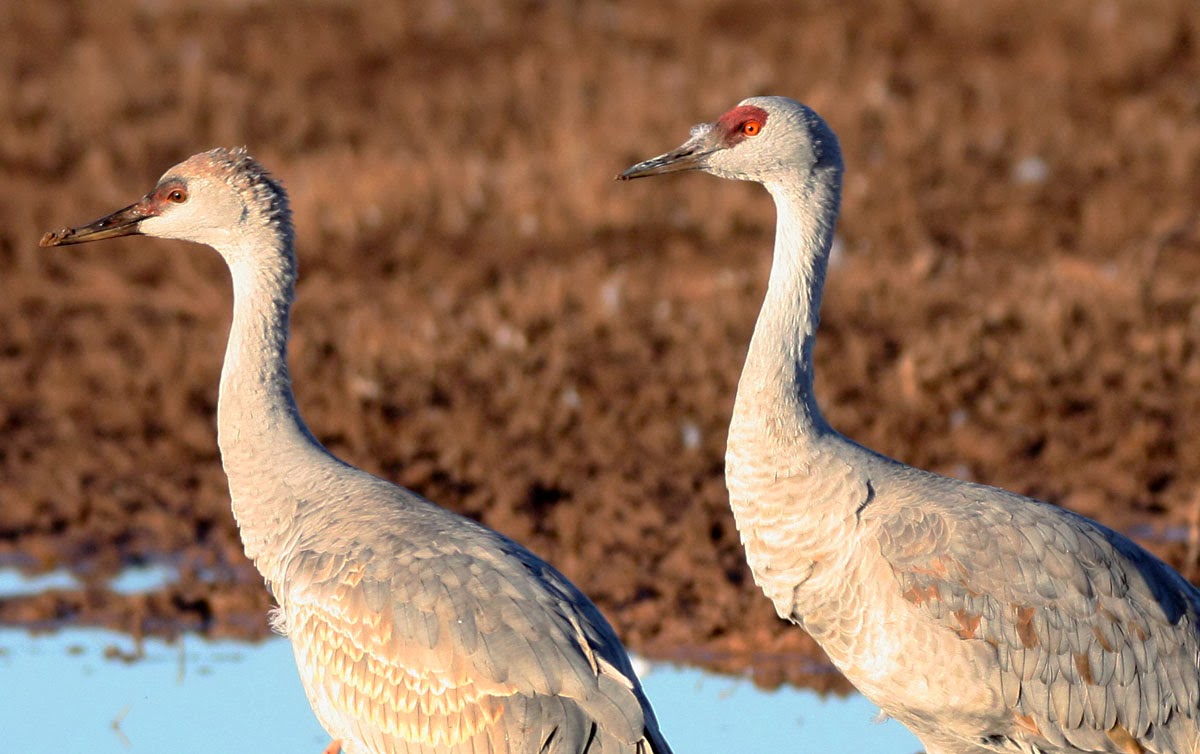
Not a lot had changed in the 2 weeks since we'd been there, but with a little blustery wind, the cranes seemed mostly grounded.  There were a lot of birds on the ground, which tells me that they likely didn't go off during the day to feed in the nearby fields.  But while we found many thousands waiting for us, as the afternoon progressed, we did see many waves of those who did go out, come back to the wetlands.  In binoculars, it was cool to see lines of them appearing out of the cloudy sky silhouetted against distant hills.  When they landed they joined the general din of noise as they called back and forth.

Also like last time, a flurry of activity just before sunset heralded the arrival of the yellow-headed blackbirds.  They don't appear here every year, but it is certainly a banner year given the number we've seen our last 2 trips.  Their din almost drowns out that of the cranes.  Their flashes of color are certainly striking as they dart around jockeying for position in the reeds.

The picture at left shows the public parking area at Whitewater.  It shows a LOT more cars than a few weeks ago, when we pretty much had the place to ourselves.  It turns out that this weekend had been the "Wings over Willcox" crane festival.  Even with larger crowds it was great - even got to see some ginormous camera lenses - one woman had a Canon 600mm that left me with some lens-envy!

We still didn't get to see any vermilion flycatchers, the showy, scarlet highlight of most of my trips to Whitewater.  We did catch a pair of Northern Harrier hawks this trip.  I happened to be following the female when she dove for a mouse. 

Clouds thickened later in the afternoon, so we didn't get much of a sunset, and we left the area earlier than we normally do, arriving back home by 9pm.  Our work and travel schedules don't permit us to get back while the cranes are still here, so it was fun to get in another trip before they head back north.

Saturday, January 3, 2009

Whitewater Wrap Up

Time has been a-flying! It has been a week since we travelled to local birding hot spot Whitewater Draw, and though we posted about the delayed crane sightings, we really didn't talk about what else we observed there. So time for a wrap up!

Had we mentioned it was cold? A winter storm had just passed through, and the sky cleared just before sunset. With the radiational cooling, it was likely into the 20s as we were leaving. Some of our astro club members happened to be there the next day and reported large expanses of ice, so it got well below freezing that Saturday night.


As we mentioned before, the cranes were absent early, but there was a wealth of other birds. Upon first walking up to the viewing area, the American Coots were first seen. These are pretty large birds, and are quite odd-looking with their not-quite-normal looking beaks and freaky looking lobed toes. I've seen them on every trip to Whitewater, so are quite common.

Duck-looking birds are numerous, perhaps most striking is the Bufflehead with its striking white head. This one was pretty shy and kept tending away from us, and spent a good percentage of the time underwater as it fed in one of the shallow holding ponds.


These rude birds are Northern Shovelers, who spent most of the time digging in the shallows with their broad bills. Evidently they strain out aquatic plants and animals through their comb-like teeth. They rarely had their heads above water to show their iridescent colors.

Another striking bird I've seen before at Whitewater is the Loggerhead Shrike - a medium sized bird with distinct black mask from it's hooked bill across the eyes. It is not particularly shy, allowing me to get pretty close for a photo.

I'm not sure on the identity of this one - you can tell from the beak it is an insect-eater, but it's colors and patterns are indistinct. I'm pretty sure it is a Say's Phoebe, but I'd be glad to be corrected. We're just getting into this birding thing, so it is a learning experience!

Similarly on this pair, the identity is a little uncertain. I'm pretty sure the left photo is a White-Crowned Sparrow, but am less sure of the right. One of our bird books says an immature White-Crowned may have buff or brown head stripes, so it may be a youngster.

We saw others for which we didn't get a reasonable image. There appeared to be a solitary Great Blue Heron that stayed way out in the middle of the estuary. Snow Geese are common at Whitewater, but tend to stay pretty far away from the public areas. They stayed over in the pasture this day. All in all, even on a "slow crane day" it was a lot of fun and we'll likely be there again this winter. And by the way, all shots taken with the Canon XSi and Meade 80mm F/6 triplet (w/good-old manual focus).

Tuesday, February 17, 2015

Whitewater Washout!

Even though we had just gone to Whitewater Draw a week ago, our friends Frank and Jenny expressed interest in going, so planned another trip on Sunday. The forecast was for 20% chance of rain, but usually in Arizona that means you might have to take shelter for a few minutes... Co-worker Steve West claims that one should pray for rain to see the snow geese come out. We hadn't seen any our previous visit, so chance of rain or not, we were going!

We left Tucson well before noon, and got to Tombstone in time for a late lunch. Turns out we had stumbled into "Vigilante Days" and the town was as crowded as I've ever seen it. Not only were there scads of old-timey saloon gals and roughnecks waving guns around, but also, a LOT of lawmen and frontier women, all in period costumes. We didn't stick around for any gun fighting, but got in, got lunch and headed on out.

As we approached McNeal, near the turnoff for Whitewater, we could see scattered rainstorms in the area, including a big one to the east. No sooner had we parked at Whitewater than sprinkles started, increasing slowly into steady rain. We walked down the dikes to the viewing area, acting as good hosts to show Jenny and Frank (first-timers) the area. There weren't a lot of birds there, perhaps a couple thousand cranes, and they were eerily silent, compared to their raucous calling in fairer weather. At left is a small group of cranes, seen against the distant outline of "Cochise's Head". Compare this picture to the one a week ago - more cranes, and much better visibility. About the only other picture I took was of a feather in the water below us - it looks to be a sandhill feather, in enough detail to see the individual barbs. Note that on the thumbnail moirĂ© fringes might be available as the barb frequency and smaller pixel display frequency are close together. If you click the image, the fringes will disappear in the larger image. Note also the drops of rain getting the top of the feather wet. It was raining hard enough I didn't want to expose my camera and lens, as they wouldn't quite fit under my Tilly hat!  Oh, and BTW, we did see hundreds of snow geese, but they were hunkered down in the rain on the far western side of the wetlands, at least a quarter mile away, likely closer to a km...


Great Horned Owl by Frank Koch
Fortunately Frank's camera was small enough (plus umbrella to keep dry!) that when we returned to the van, he stopped at the pole shed where we'd seen a pair of great horned owls. He took the image at left and supplied it for the blog. If you click on it for the full-size image, be sure to note the talons on that thing - pretty dangerous looking!

The rain looked like it wasn't going to let up anytime soon, and with it being Jenny and Frank's first time in that area, we decided to continue down the 20 miles to Douglas. Melinda and I are big fans of the Gadsden Hotel, and wanted to show it off to them.


Douglas is a sleepy little border town of a little over 15,000, and for visitors like ourselves, the Gadsden Hotel is certainly one of the highlights! Built as a real frontier hotel in 1907, it burned to the ground and was rebuilt in 1929. Highlights include the two-story lobby with marble columns and staircase. At left is shown a 4-frame mosaic of the lobby around to the staircase. At right is a statue guarding one of the corners of the staircase.

In the background of that picture is an incredible 42 foot-long stained glass mural made by Tiffany of a desert scene.  We couldn't imagine its production and shipment across the country 100 years ago, so figured it was made by artists in residence on site.  It is always shockingly spectacular to see it backlit where it is located on the second floor.  At left is shown a 2-frame mosaic of the majority of it from across the lobby.  It was still too early to eat dinner at the dining room (opened at 5), so we loaded up the van and headed NW, avoiding the dirt roads this time and passed through Bisbee, and stopped for dinner at the Crystal Palace in Tombstone.  We were home in Tucson about 9:30, and even though we didn't get to hang out with the cranes much, it was a nice weekend day trip.  The cranes are headed north soon, so the season is over for them, but there are still plenty of things to see within a day's drive of Tucson!

Sunday, January 12, 2014

Whitewater Draw 2014!

Yesterday saw us finally getting to Whitewater Draw for the first time this Winter.  We've been there and posted many times, and is always a fun day trip for us, about a 2 hour drive to the southeast of Tucson.  It is amazing that the high desert of the Sulfur Springs Valley can host such an amazing variety and number of birds, especially the sandhill cranes, which winter here after migrating down from northern Canada.  We announced our intentions to the astronomy club last weekend and had 7 people in 3 cars meet us there.  I understand that last year they had some issues with irrigation pumps, with some of the ponds bone dry, so it is always a bit of a surprise what you will find there.  But it looks like all is well, there was a goodly amount of water in all the ponds, though a distinct lack of plants, so not a great food source for smaller waterfowl.  We were gratified that there was a good supply of cranes though...


A couple of our group were there for the first
time, and it is always fun to see it through their eyes - I think they were impressed!  We got there about 2:30 and stayed until well after sunset, perhaps 4 hours.  There was a good initial supply of cranes, but not particularly close to the viewing stands, perhaps 75-80 meters away.  I was ready for that by packing in my William Optics 11cm F/7 refractor (770mm focal length) telescope, which zooms in on them pretty well.  The disadvantage, of course, is that it is manual focus, and with birds there just isn't time to use live view for critical focus for every frame.  But by carefully using live view and making sure the adjustable diopter lens on the viewer was set properly, I got a good percentage in decent focus - perhaps 40% or more on non-moving targets.


Because at the "near" distances involved, the telescope provides a pretty shallow depth-of-field.  One bird might be in perfect focus, but one right behind or in front might be blurry with the 700+mm focal length.  I like learning new techniques and methods, and as I posted a week ago, I learned about focus stacking to improve depth of field.  Multiple images are taken at different focus settings and the images blended in Photoshop.  As shown here at left, a single image shows some birds in sharp focus, but those behind are quite blurry.  In this case, I took 4 frames in quick succession while racking the fine focus slightly.  Blending them together in Photoshop provides the image at right with a better focus range.

Similarly in this shot of a single bird, while it is in sharp focus, I wanted the reflection in the water, the bird and the stalks behind all in focus.  Taking 3 images at various focus accomplished it.  There are some artifacts in some of the blends, especially in high-contrast areas near the crane necks in the image in the preceding paragraph.  I'll need to get more experience to see if it can be minimized, but it isn't too objectionable...


I shot a couple things besides cranes - here is buddy Bernie who came down with us on his first visit to Whitewater.  He got a new Canon 6D the other week, so was having fun with his new camera system.  When he got far enough away I could focus on him with the WO telescope, I snapped him.  At right is a long-billed dowitcher, which we saw in Mexico a couple weeks ago, and I think we've seen it at Whitewater before too.


Always up for a good challenge, catching the cranes in flight with the telescope, especially when focusing manually, seems to be a nearly impossible challenge.  But that didn't stop me from trying.  As it neared sunset, the cranes that were in the shallow water mostly departed for nearby fields for some late-afternoon feeding, providing lots of chances.  In the fading light, mostly guessing at focus, panning along their path, if you can catch the iris in their eye, you must be living right!  The only unfortunate thing is that the wing position is identical in both of these...


Sunset came and went, and the birds stayed away
- visible in hay fields a couple miles to the west - thousands and thousands of them.  Only a few hundred remained anywhere near us, at left visible silhouetted against twilight colors in a multiple-frame panorama.  We waited, knowing that they would eventually return.  Whether their delayed return was due to the warm temperatures ( at near 70F, I think it was the warmest I'd ever seen there in January!) or perhaps because of the nearly full moon, I don't know, but finally nearly a full 45 minutes after sunset, with nearly all hints of the sunset gone, their increasing rattling calls finally signaled their return.  The western sky filled with their hordes, though it was too dark to do much with the cameras.  For this last exposure I switched to the kit lens, shot at full zoom of 85mm for a tenth of a second. 

Our intrepid band of observers caravanned to Tombstone where we rejoined for dinner at the Crystal Palace, finishing our meal just as a LOUD band was starting to play.  It was a nice way to draw a great day to a close...  We'll try to get down again before they leave in another month or 6 weeks.  It is always a fun trip on a slow weekend!

Wednesday, February 10, 2010

Weekend Trip To Whitewater Draw

As noted in our last post, we made our second, and likely last trip this season to visit with the Sandhill Cranes at Whitewater Draw. They usually depart mid-February, so they'll be headed north very soon. We made a slight detour on the way down and visited Dave, who lives near Sierra Vista. He was on our first trip what, 3 years ago, and indicated that a lens of his, a 400mm F/4 might be available to borrow. Well, we finally got a chance to make good on that deal. He wasn't up to join us on the trip, but the lens did!

We've been chasing birds for a couple years now, both here in Arizona and up in Illinois, but my "premium" lens has always been either a Nikon 500mm F/8, or a Meade 480mm F/6 - a small telescope, really. The problems with both is that they are manual focus, and birds rarely want to wait around while you spend time focusing on the glint of sunlight off their eyeball! So it is a joy to use one of these "super-telephoto" lenses that not only have auto focus (in a small fraction of a second) and image stabilization to boot! All pictures from our last post, as well as this one, (except the sunset pic in Sunday's post) were taken with the 400 F/4 either alone or with a 1.4 converter. He is also allowing me to keep it for a week or two for some astronomical imaging, but we're in the middle of the rainiest weather we've had in years! We'll see if I get to try it at night...

Like we said in our last brief post, it was a little blustery upon our arrival at Whitewater, and while there were a lot of cranes and Snow Geese, they were mostly hunkered down from the wind, without any opportunities for "close encounters" with the big lens. I took a few shots from the viewing stands, but nothing spectacular. A little closer to sunset, from a different perspective, I was able to get some birders and cranes with the bright glint from the Large Binocular Telescope atop Mount Graham, 85 miles to the north.

I did have some success though with some of the smaller birds in the lagoons there. Even with the windy conditions, they gotta eat, so I followed a little Black Phoebe and managed some nice closeups with the 400+1.4. Their behavior is very much like the Vermillion Flycatchers mentioned a few posts ago. They fly off to catch a bug, but almost always return to the same roost between flights.

While waiting for the wind to die down, we did have some Northern Shovelers drift past, but they seemed more concerned feeding underwater than pay any attention to the birders. Mostly got lots of pictures of their butts in the air. Note the wind-induced waves - surfs up!


We always spot some new birds with every trip there. At least 3 this time including a pair of Common Snipe (pics only from a distance) and a female Northern Harrier. The Harrier was quite spectacular in it's behavior. It came gliding in very slowly, almost hovering over some of the marshy islands looking for mice and prey. She made multiple passes over 15 or 20 minutes, though none very close. She was amazing to watch and you can see why they named a jet aircraft that hovers a harrier!


Another new one for us at Whitewater were a couple of Pied-Billed Grebes. The first approached us closely, though was almost directly up-sun, daring us to take photos of it. The second was nearer to sunset and was much more cautious. It was getting dark enough that I even used the on-camera flash to pull out a little more detail,and the reflection can be seen in it's eyeball. This one shows the more characteristic black stripe on it's bill displayed during breeding season.


The last picture to show off is of the crowd of Yellow-Headed Blackbirds. As I posted from our last trip, they appeared minutes before sunset, though seemingly sensing the big lens I was carrying, they kept their distance. But even from a distance, the flock collecting on the bare trees seemingly transformed them into flowering shrubs.

The visit was a classic - even with the wind and lack of close-up opportunities, it was a beautiful late afternoon and sunset, and a great time just to sit and watch nature happen. As the sun set, the cranes gathered in the growing darkness. I took a few shots - my favorite shot of them was in our last post. But as the stars came out, it was hard to leave, but the 2 hour return drive demanded it...

Saturday, December 11, 2010

Some New Faces to go with the Familiar Ones...

We're way behind posting, but hopefully will catch up this weekend. Waaay back on the 2nd we took a day trip out to Tombstone and Whitewater Draw, one of the earliest visits of the season we've made to the popular birding site. The excuse for the trip was our Phoenix friend Donna and her mother Shirley visiting from Florida making a multi-day tour of Tucson. Add to that another friend Margie who was taking the scenic route to her place in Mexico, and Derald, who we talked into joining us to help balance out all the females, and we had a crowd! Shirley had never been to Southern Arizona before, and she was pretty much astounded by the vista as we rounded every corner. Our general plan was a morning departure, spend a couple hours checking out Tombstone (the town too tough to die), purported at one time to be the largest city between St Louis and San Francisco in the mid-1800 heyday. Then, after a bite of late lunch, head the 25 miles to Whitewater Draw to watch the Sandhill Cranes return from their feeding to gather at the wetlands there.

Interestingly, on our first stop in Tombstone, sort of an art gallery co-op, we ran into an astronomical celebrity! Bob Kepple looked familiar to me as we entered and roamed around, but it wasn't till we saw the "Night Sky Observer's Guide" in front of him (he is co-author) that I remembered we had chatted just this last summer at the Astronomical League meeting. He lives nearby in Sierra Vista and just happened to be volunteering that day to tend the gallery. Since all of us had a little astronomy background, we chatted it up and he pointed out his astronomical-themed paintings he had done. Unfortunately, he didn't make any sales to us, but we did take him up on his recommendation for lunch and headed to the Longhorn. Most of the females in the group shopped on the way, Margie for art and jewelry, Donna and Shirley for souvenirs. I caught Melinda making out with a cigar store Indian, and also captured mother and daughter before they ducked out of view into another shop.


After lunch at the Longhorn, we headed to Whitewater Draw. It is always a surprise as to what will greet us on our arrival, but we were gratified there were lots of cranes. Unfortunately, the water level was just about the lowest I've ever witnessed. The ponds that were usually filled with coots and duck varieties were mostly dry, and while there were lots of cranes, they were not particularly close to the viewing areas. The waterfowl attendance was very low, though we did spot some Northern Shovelers and Cinnamon Teal. Shown above too is a Say's Phoebe, showing the characteristic short loopy flights of flycatchers, oftentimes landing at the same spot they launched.


Of course, I was overjoyed to catch my favorite of the location, the Vermillion Flycatcher. The male is so spectacular, how can you not love him? The female is a drab brown, and was hanging about nearby. Interestingly, I've never seen more than a single male - I think they are pretty territorial. Whether I've been seeing the same individual year after year, or different ones, I'm not sure, but I'm glad to have captured him. This one fluffed the feathers atop his head, and looks like he's wearing a really bad toupee from the rear...


Inevitably, the sun headed for the western horizon and the birds started settling in for the night. The Northern Harrier that we saw last trip made a couple passes, always producing a commotion when passing as the birds shout out warnings. I spotted a Loggerhead Shrike, but he was too fast for me to catch with camera. At left is a shot of our group (except for me) at one of the viewing stands, with the sunset-lit LBT dome atop Mount Graham 85 miles distant. From left are Donna, Shirley, Margie, Derald and Melinda. Always visible from the site is the profile of the Chiricahua Apache Indian chief Cochise, in a landmark called "Cochise's Head", nearly 50 miles distant. By the way, ALL of these shots were taken with the Canon XSi shooting through a small Meade telescope - an 80mm F/6, 3-element APO (480mm focal length), with manual focus, of course.

The sun set, and as darkness approached, so did additional cranes, returning from nearby fields to the water for safety from predators. I was able to get one more shot in the dying light against distant pink clouds. The deafening noise that 30,000 cranes make is hard to describe, but even as the frigid temperatures envelop you, it is difficult to leave as hundreds and thousands more arrive, flying invisibly over your head, yet calling to those already on the ground. As we finally walked back in the dark, we had yet one more friend to greet from last year - a Great Horned Owl, seen only as a faint silhouette in a tree, yet confirmed by his glowing eye in the flash picture. We finally departed for civilization, enjoying a fine Italian dinner near Derald's house in Corona de Tucson, and we made it back home about 10pm, even getting to watch the last few plays of the Arizona Wildcats losing to arch-nemesis ASU. But still a great day spent with friends and the cast of characters we visit once again at Whitewater Draw.