Showing posts sorted by relevance for query Star-B-Que. Sort by date Show all posts

Sunday, September 21, 2014

Star-B-Que!

Yesterday was the Fall Star-B-Que for the Tucson Amateur Astronomy Association (TAAA) at Kitt Peak National Observatory.  What is a Star-B-Que, you ask?  Well it combines the best 2 parts of belonging to an astronomy group, socializing at a potluck picnic, and observing under some pristine skies.  The picnic area at the National Observatory is very nearly perfect for such an event.  It has a pavilion, flush toilets, and an open area with concrete pads to set up scopes.  The employee association even provides a gas grill for our use - it is always great!

Plans were complicated this week by Hurricane Odile, which came up Baja and was supposed to bring up to 7 inches of rain or more to the Tucson area.  Fortunately, it got the to the US border and veered east, so while we got some rain early in the week, we didn't get hammered like Baja did.  But for some reason, the moisture didn't clear out like it usually did and the Observatory spent 3 days buried in clouds and fog, finally dispersing Friday evening.  Saturday, Star-B-Que day dawned with severe cloud buildups over the mountains, and even as we drove out to Kitt Peak for the event, we saw some desert downpours just 15 miles SW of the mountain.  Arriving to set up, there were plenty of clouds, but a promise of clear skies to the west.  By sunset after some grillin' and eatin' there was a rush to set up gear under clear skies.

I'm keeping this post short, I did some visual observing with the 14" and also did some wide-field imaging that I'll post later if I get anything of interest.  Just as it was getting dark, I took the wide-field self portrait at left with kit lens and a 40 second exposure showing clear skies and a bright Milky Way galaxy arching over us.  With a couple new eyepieces (Meade UWAs), I and others were treated to some spectacular views of some favorites.  The Triffid Nebula, M20 was looking pretty much just like the picture in my last post, though in black-and-white, since the cones in our eyes don't work in low light levels!  I also showed a few people the great globular cluster M22 in the rich Milky Way background, and a little later, the Helix Nebula was spectacular with a nebula filter to increase contrast.

A bunch of us also visited John Davis, an engineer who works with me at the Mirror Lab.  He had just finished working on an equatorial mount and had its debut under dark skies with a 12" telescope and camera.  I'll be sure to show some of his pictures if he sends them along.  His mounting sure was impressive!

We didn't have too late a night - we were about the last to leave shortly after 11pm and were home by 12:30.  It was a nice night, given that most were there just for the picnic with the threat of rain.  Sometimes nature smiles upon us!


EDIT-  John Davis has posted the images he took Saturday evening on his blog.  My favorite of the night was of the HII region Messier 16 in the midst of the Summer Milky Way - he sent me a larger size than appears on his blog, so I stretched it a bit and show it here. Not bad for 9 minutes total exposure with an unmodified camera. It was through a 12" telescope though, and the image quality is testament to the quality of the mount he has built.  Note that you can see a little star bloat in the corners - he was not using a coma corrector for the Newtonian telescope.  Future efforts should have better images!  Going to the more general address of his blog, you can see his progress from the machining of the mount through the first exposures... Fun stuff!

Monday, September 30, 2013

More Star-B-Que 2013!

The Fall Star-B-Que of the Tucson Amateur Astronomy Association was held up at Kitt Peak this last Saturday.  I already blogged about the lizard-in-a-strait-jacket yesterday, so time for more mundane stuff, like the latest pictures...

I also recently told about my IR-converted camera's vacation to New York State, and I wanted to bring it along to the mountain to shoot the contrasts between the titanium-painted domes, vegetation and clear sky.  With the Fall sunset seeming to come early, I didn't have a lot of time to play given my responsibilities as Star-B-Que organizer, so only got the above images.  The one at left is a straight shot of the 4-meter and Steward 2.3 meter framed by a pair of oak trees at the picnic area.

The shot at right is a 5-frame mosaic of shots showing the wide expanse from the VLBA radio dish, located at the picnic area, across the profile of the Observatory.  This picture brings up a topic I've been wanting to discuss for a couple weeks - mosaic software!  I was happy for the last year or so with Autopano Pro in assembling mosaics, but a recent disk crash required a reload, and I couldn't find the version I bought (key protected), and I was loathe to pay another $100 for the new version.  Photoshop has a "Photo merge" feature, but it often has difficulty in assembling anything but the most simple panoramas...

A friend recently turned me on to "Microsoft ICE", which I understand means Image Composition Editor.  The website has an impressive demonstration where a 200 frame mosaic was assembled by the program in seconds, retaining the full resolution of the original frames, or zooming out to see the "big picture"!  The great thing, besides the incredible job it does, is that it is a free download!  The other great thing is that I've yet to be able to stump it - I've fed it star-field pictures and somehow it assembles them perfectly and seamlessly!  You will see the results of my latest effort below...

After the excitement of saving the lizard earlier in the afternoon, a variety of scopes were set up down the clearing of the picnic area.  My Celestron 14" might have been the largest, buddy Roger brought along a 5.5" F/8 refractor that was nice for scanning along the Milky Way.  We had a lot of attendees that couldn't stay late for one reason or another, and just came to socialize and look thru the scopes for a bit at some great skies before the 75 minute drive back to Tucson.  The picture at left is taken with a Nikon 8mm F/2.8 for a 2 minute exposure once it got fully dark.  The glow of the Milky Way bisects the picture vertically, and astronomers with red lights illuminate the foreground.  The outline of the C-14 can be seen in the right foreground.  The brightest star at the upper edge is Vega, below and left of Vega is Altair.  This is a tracked image using the Vixen Polarie.

As advertised, here is the Milky Way mosaic.  It is a 9-frame assemblage, each shot was a stack of two-2 minute exposures taken with a Nikon 80mm lens at F/4.  At left is a single frame, cropped from the one that shows the hydrogen clouds M8 (below) and M20(above and right).  Since the camera was mounted on a ball head on the tracker, I wasn't sure of the overlap or framing, but was hoping that it was sufficient to do the mosaic without any holes!  Once all 18 of the frames were stacked into the 9 individual shots, they were dumped into the ICE program and it was done in seconds!  It was cropped slightly to smooth out the edges, and had levels adjusted some, but is otherwise shown in all its glory at right.  Of course, as I've lamented before, the blog limits pictures to 1600 pixels wide, so you can't go exploring through the Milky Way like I can on the 6,000 pixel wide original...  The Teapot asterism dominates the lower left corner, with the dark clouds and Nebulae scattered along the plane of the galaxy emphasized with the 20Da camera.  The black bits are where the frame edges stopped, and I'm mystified how ICE assembles it without any apparent errors.  Anyone who has been tempted to try mosaics but has baulked at the price ought to give it a try!

Sunday, October 18, 2015

Rainout at the KPNO Fall Star-B-Que...

Last night was our Fall, 2015 Star-B-Que at the Kitt Peak picnic area, held for about 20 years now. Last night's reminded me of the very first one - Kitt Peak had been very paranoid about anyone outside astronomers being on the mountain after the death of Marc Aaronson in 1987. It was nearly a decade later that we convinced them that the picnic area with its open-air pavilion, flush bathrooms and 6500 foot elevation was the perfect place for a "Star-B-Que", a cookout and star party, and it has happened ever since. That very first one, where we were permitted only 25 attendees, filled up with those wanting to join in, and even though the weather was questionable, 23 still showed! I recall it rained so hard that we had a hard time keeping the charcoal grill going! But it was a memorable time, as is nearly every trip up that mountain.

Again, the weather was questionable, but there were lots of blue skies and sun on the 60 mile drive to the SW of Tucson. As organizer, I had to arrive a little early, head to the visitor center and collect the keys to the picnic area and staff area where the gas grill is now locked up. Arriving a little after 3pm, I found the night time programs had been cancelled for the weather, but as I'm fond of saying, at least we'll have a cookout!

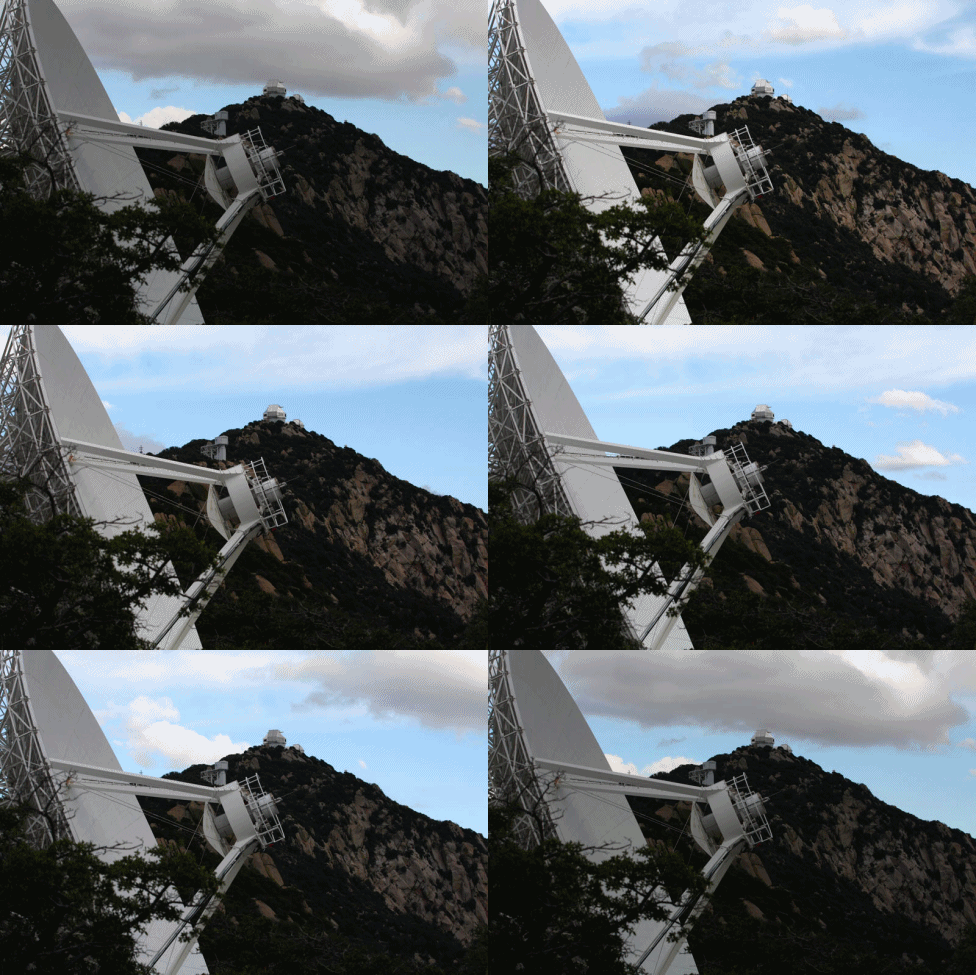
Upon driving up, I grabbed a camera to take some more time-lapse of the VLBA dish. It was just a week ago that it was moving multiple times per minute to a new object, and it seemed to be sticking to that schedule. I took a short sequence with a frame every 20 seconds and show it as a GIF here at left.

We had a few attendees dribble in, so the grill was pulled out and set up adjacent to the restrooms. We also had some auspicious visitors! Mike Spooner, telescope maker extraordinaire and his wife Elvira attended after I contacted them a few weeks earlier. Mike has joined the ranks of the recently retired, and had brought one of his gems down with which to observe. Also, Demetry Papadopoulos, a doctor, had flown in from where he lives in Charleston, SC for some desert observing. Ironically, it was clear back home, and the Peach Star Gaze in Georgia, where he usually goes to observe this weekend, also had clear skies! Besides Jim and Elaine Miller and Paul Lorenz, TAAA stalwarts, that was about the extent of our crew.  With Melinda and me, we could all fit at one picnic table!

But as I said above, even if the skies don't cooperate, there is usually something of interest going on, and storms can be spectacular from elevation where you can see them for 100 miles! While we didn't have any raindrops early, the view off the west side of the mountain was at times breathtaking. At left is shown a view of vertical rain shafts to the distant west, alternated with some slanted crepuscular rays where the sun shown through breaks in the clouds.  You can see that the distant west looked to be clear, and if it looks familiar, I've mentioned them before in identifying the Pinacate volcano field. The flat-topped range are the Mesquite Mountains, about 40 miles west of Kitt Peak, and the peak to the left is Mount Cubabi, just into Mexico south of Sonoita/Lukeville border area. As time passed, the storms grew a little nearer, with associated lightning too as shown at right. While I was using a timer at the moment this was taken, I actually pushed the button manually, as these strokes sometime last long enough to react to. I would have been lucky indeed to catch one taking an image every 15 seconds with intervalometer!

Locally, the rain picked up and I was out protecting the cameras I had going with my trusty umbrella! Behind a bush I saw a glow and thought the sun was sitting on the horizon already... Walking a couple meters, it was the sun reflecting off sheet flooding out in the desert! The sun, still hidden behind clouds, eventually dropped into the clear gap and gave a spectacular encore setting behind some storms and providing some amazing colors. I shouted out to the attendees, hunkered down in the pavilion to come see and all were amazed. Unfortunately in my haste to catch it, the camera was slightly out of focus, so didn't make a time-lapse, but did catch 3 representative frames as the sun moved through the gap. The top one shows the sun reflecting off the flooded desert I mentioned, then the sun eventually coming into view and momentarily being partially hidden by clouds.

As the sequence neared its end with sunset, the rain intensified and everyone ran for the cars.  I stayed to the bitter end, holding the umbrella against the downpour.  Between the lightening and rain, everyone was long gone before I packed up, and I had to return the key to the mountaintop before leaving.  It has been a long time since driving in rain that heavy, but at least the near-constant lightning helped light the way!  At 7:45, it was about the earliest we've ever gotten back from a star party - even got to catch the last inning of the Cubs playoff game!  The storm followed us, arriving in Tucson about 30 minutes later, but lacked the intensity of the Kitt Peak version.

But as I've said before, a trip to the mountain is always entertaining, and this one was no exception!

Sunday, May 5, 2013

Well, Two Out Of Three Isn't Bad!

Yesterday was the Spring Star-B-Que at Kitt Peak National Observatory.  Twice a year now, for almost 20 years we've gotten permission to hold a cookout and star party for the Tucson Amateur Astronomy Association (TAAA).  It is always a lot of fun, socializing over a pot-luck picnic, and the skies can't be beat for observing afterwards.  The mountain employees association also supplies their gas grill for our use, and with the pavilion and flush toilets, the site lacks nothing! 

This year we had an extra attraction, after schedules
prevented us us from realizing it the last couple tries - a tour of the Wisconsin, Indiana, Yale, NOAO telescope (WIYN).  The public rarely gets the chance to see this modern 3.5 meter telescope, and the new technology contrasts nicely with the nearly 2 generation old Mayall 4-meter Telescope across the mountaintop.  Since one of my part-time tasks at the Observatory is giving occasional VIP tours of WIYN, I was able to offer an afternoon tour of the building to early arrivals to the Star-B-Que.  Amateur astronomers are a difficult audience, and I was unprepared for some of their questions regarding basic hardware of drive mechanisms, encoders and instrumentation.   Fortunately, I was able to answer questions about where it was polished (my 3rd 3.5 meter telescope at the Mirror Lab in the early '90s!).  Fortunately I had brought along an appropriate lens for a group shot at the telescope, but I couldn't decide on horizontal or vertical format, so you get both here!

As we finished the WIYN tour, the mountaintop
was about to close - time for normal visitors to depart the Observatory.  But after a stop in the Visitor Center for souvenirs, our group headed down to the picnic area to set up our own scopes and have our picnic!  The grill had been delivered as promised, and fortunately, I had a key where it was locked in the mechanical room off the bathrooms.  After setting that up in the pavilion, I wandered off to set up my scope, as did others.  I was planning to use the Celestron 14" on the AP1200 for visual observing early on, and perhaps some imaging later in the evening.  I had a couple friends that are recently heavy into astro-imaging, so wanted to provide a tutorial in use of the Hyperstar there.  Once the scope was set up time for dinner!  We had a great pot luck!  We brought brownies for dessert and as normal, there was a wide assortment of items to feast on!  I've never been a fan on organizing too much on what people should bring, and that proved to work fine here.  My friend Byron's chicken salad was a favorite, and everyone had a great time socializing over the picnic tables or over the grill.  Folks wandered off to the scopes after eating - got some good white-light views of sunspots, and in the picture at left, Wayne is looking through my C-14, trying to read the manufacturer of the AC unit at the 4-Meter Telescope - he was unconvinced on my insistence it was a "Carrier" brand, while Jim and Pat trade storied in the background.  At right, Irene (at left) was giving Marilyn some pointers on her new Sky Commander encoder system she had recently installed on her 16" telescope.

There was a really nice assortment of telescopes
assembled.  At left is shown what nearly became the "valley of the Schmidts", though a vintage 8" Cave Newtonian showed up, and a couple refractors can be spotted too.  Melinda is chatting with Byron, one of our new buddies who is getting into astrophotography.  The sacred mountain Baboquivari watches over us, about 15 miles distant and about 800 feet higher than Kitt Peak.  Shortly it was time for sunset, and while the sky had been crystal clear, suddenly some clouds popped up.  It made for a spectacular sunset, though, and attracted a pretty good crowd at the couple overlooks with views to the west.  These sunset views are HDR shots - 3 exposures are taken in quick succession with varying shutter speeds to try to preserve the high dynamic range of the scene.  These are mostly successfull - catching the views from the solar disk (setting into the smoke of the California fires) to the muted colors up in the clouds.


As the sunset waned, the wind, that had been
brisk to begin with, became even stronger, and more clouds moved in.  Through gaps (sometimes called Sucker Holes!) we spotted Jupiter and 3 of its moons.  Interestingly, over a 3 minute period about 7:35, Jupiter's moon Io moved out of eclipse and became visible where it had not been just moments before!  That was about the only astronomical observation, though as clouds became thicker...  While many gathered around the scopes and chatted, it soon became obvious that trying to observe in the wind through the cloud gaps was going to be a losing proposition, so cars started wandering out by 8.  Melinda and I (with Irene as a rider) hung out for a bit longer, but were packed up and ready to go about 10, with only one die-hard from the Phoenix area left, swearing to take his chances.  At least we had a great tour and picnic, but observing will have to wait for 28 September - the next edition of the Star-B-Que...

Monday, December 31, 2012

Year End Review!

I'm taking a page from our friend Andrew Cooper and writing a year end review of my favorite photos and events from the last year!  It seems somehow appropriate that our 100 post of the year be on New Year's Eve, and review the highlights of 2012.  For details, go to our blog post from that date.  So here we go!
Jan 3: Night flash pic of Whitewater Cranes looks has x-ray appearance.


Jan 13 : Public program on Kitt Peak w/Zodiacl light, Moon and Venus


Jan 29 : 4 panel panorama ofTucson lights and Kitt Peak


Feb 5: Stereo Pair of Moon and Oak (cross-eyed view).


Feb 26 : Post public observing session w/20" on Kitt Peak.


Mar 13: Stereo view cactus flower Organ Pipe Monument (cross-eyed view).


Apr 21: Gambel's Quail proclaiming territory!


May 6: Blackhawk Helicopter transiting Supermoon!


May 13: Milky Way rises over TAAA Star-B-Que on Kitt Peak


May 13: 30m telephoto shot of Antares region at Star-B-Que.\


May 21: Melinda caught F-18 on sun before Grand Canyon Solar Eclipse.


June 9: Blythe (glasses, pointing) leads sunset talk at Kitt Peak.


Aug 13: Me on RAGBRAI, enjoying pork chop on a stick!


Aug 15: Automated sequence captures Hannah and Sphinx moth!


Aug 17: Great niece Alivia's 6th birthday!


Sep 8:  Dave Harvey's Passing - my absolute favorite of his Venus Transit.


Sep 14: Violet and green banded airglow display from Shooting Star Inn, Flagstaff.


Sep 17: Russians!  The View from "A" Mountain.


Sep 19: Group shot at Kitt Peak McMath-Pierce Solar Telescope.


Sep 20: More Russians - Maya enjoys her Kinnect game.


Sep 22: Russians in western wear at Tucson Mall.


Sep 24: Russians at Meteor Crater.


Sep 25: Russians Chillin' at Canyon.


Oct 15: Illinois fall colors.


Oct 30: Hawaii w/in laws and Pele!


Nov 1: West coast of Big Island by Moonlight looking SSW.


Nov 9: The Girls at the lava flow at base of Mauna Kea.


Nov 1: Andrew Cooper allows a peek at Keck spare mirror segments.


Nov 14: More Hawaii - Gold dust day gecko in native environment.


Dec 4: Europa's crescent shadow crosses Jupiter at opposition.


Dec 29: Lucy, aka Lucifur, aka Lulu in closeup.