We're glad to see you here! Come and share our daily lives with us, we welcome your company and your comments. We hope there is something here for everyone!
Here we are on the 5th of December, a good 2 weeks till the Winter Solstice, and yet, if you look at a table of sunset times, right now is the time of earliest sunset! "Wait", I can hear you all say - "I thought that happened on the first day of Winter on 21 December!" Well, you would be partly right - the shortest DAY occurs on the first day of Winter in the northern hemisphere, when the sun follows its lowest arc across the sky. Referring back to that table of sunset/sunrise times, you will also note that the date of latest sunrise occurs in mid-January, a couple weeks AFTER Winter Solstice. So the shortest day happens on 21 December, but because the Earth's orbit is not completely circular, but slightly elliptical, the earliest sunset, latest sunrise and shortest day do not all fall on the first day of Winter. If it did, life would be a little more boring, and we wouldn't be able to use these tidbits as excuses to learn something new. But do go check out those sunrise/sunset times - you will see I'm right! You can think of it this way - with the sunset time getting later day by day, it won't be long till the Winter that isn't here yet will give way to Spring and Summer!
Oh, and the picture above - taken a couple months ago from Kitt Peak National Observatory with my little Meade Telescope - an 80mm diameter apochromatic refractor, F/6, with a 480mm focal length and Canon XSi camera.
My friend David Levine (shown here at left with wife Elinor at McDonald Observatory) was a buddy of mine from the local astronomy club, the Tucson Amateur Astronomy Association. We shared similar interests, which included setting up for many public events, including the Grand Canyon Star Party, as well as more serious observing from TAAA dark-sky sites. He had a way of telling a tale that was sometimes difficult to tell if it was true or not. I could usually tell by the twinkle in his eye, but in the dark, it was harder to tell. The Horsehead Nebula in your 8" telescope - Sure (wink-wink), I can believe that! One of his stories involved observing a shadow transit on Jupiter, where the normally round shadow of the moon was crescent-shaped! He was short on details, but indicated it was close to opposition when Jupiter was opposite the sun, rising at sunset, and the moon itself was blocking part of it's shadow. Well, I had never heard of such a thing, and I've been around the block a few times, but he swore it was true!
Well Dave died a few years back but that tale has always stuck with me, and it just so happened that early yesterday Jupiter was at opposition. Looking at a Javascript for the moon positions, it happened that Europa had a shadow transit about 6 or 7 hours past opposition - time for an adventure! Since I work at Kitt Peak part time at their Nightly Observing Program, I was able to reserve the telescope for after the program. There was a bright moon, so little demand for a late-night program. Unfortunately, the shadow transit didn't start till after 2am local time - hard for a school night, but hey - these myths need to be dispelled! I packed my webcam and laptop and headed to the Observatory after my wife left for her NICU shift.
It was a great, clear night and better-than-average seeing given the blustery breeze that was blowing. I spent a couple hours trying some wide-field images in the moonlight, waiting for Europa to move into position. Finally it was time to get set up - I've got little experience with the Imaging Source camera I got about a year ago, so it was a great night for some practice on the 20" scope. The state-of-the-art of planetary imaging these days involves taking video sequences and taking the best images to stack into some truly amazing photos, and the camera/telescope combo worked well. I took 2 minute sequences every 10 minutes or so and 3 of them are shown here. At left Europa is shown approaching from the east and at right it is shown 20 minutes later as it casts it's shadow on the disk.
And some 70 minutes later, about the time I stopped with some thin cirrus moving in, the moon and shadow had crossed over halfway across Jupiter's disk. The Great Red Spot had also rotated into view, and you can see a smaller red spot near the moon/shadow image. Given the quality of the night, and that the seeing had deteriorated to about average, I'm amazed at how well these images came out. And also, you can see that the disk of Europa indeed does occlude part of the black round shadow, a crescent shadow being the result - Dave was telling the truth! A new observation for me, but I'm thinking that it has to be done within a few hours of opposition, and also, it will most likely occur for the inner moons Io and Europa. I'm thinking the longer projection distance of the outer moons would make it more difficult to observe. And yes, after disconnecting the camera and putting it away, I looked for seeing the partial shadow visually. When waiting for moments of good seeing, yes, the crescent shadow could be seen, so it is possible to see with your own eyes.
Well, it was long day at work after almost 3 hours of sleep, but it was a great adventure, and I'm glad to harken back to the old days sitting and talking astronomy with a dear departed friend. The use of the 20" RCOS telescope is courtesy NOAO/AURA/NSF.
The Internet is a fun place, but it suffers from sort of a "sameness" when it comes to astronomy blogs. I'm always searching for something that will draw me back time and again. So it is always fun to find something new, my favorite this week is Astropixie, an astronomy and life interests blog from Australia. She posts often and reading through the archives is a lot of fun - go check her out! next time we update the "blogs we read" I'll be sure to get her up on those links.
One of the little links I found on an older post of hers was interesting - it brought to mind the link I found of Einstein at his blackboard where he would write whatever you wanted. What, you don't remember that blog post? Well, here it is in the original idea I had at the time - we put it on business cards once and passed them out whenever anyone wanted our e-mail or links to our blog when we set up at public events. We've long run out of them, but would be fun to do it again - and yes, you can have "Uncle" Albert do your bidding by going to the website link on the image - and a variety of other images as well if you prefer...
Anyway, yes, the new link I saw - it is one where the message is written out by galaxy shapes! The link, to My Galaxies, is written by Steven Bamford. I believe he uses the Sloan Digital Sky Survey as source for galaxy images to use, and his routine allows you to try different images if the letters aren't clear enough for you, but it is kind of fun. At left is one version of our blog address. The website even identifies the galaxies used for the letters! How often can you write someones name across the night sky - definitely something new and different!
Last night was the grand opening of the "new for me" Astro-Physics AP1200 telescope mounting. It is a big upgrade in the carrying capacity of the mount I've been using for the last 15+ years. I obtained it from an acquaintance in the Chicago area this last summer when he upgraded to a newer model. While the mount is in perfect shape, he kept some of the needed accessories, so I needed to obtain a new pier (machinist in Phoenix), saddle plate where telescope attaches (from Astro-Physics), and a new set of counterweights (water-jet steel from a local engineering company, machining by me!). Finally all was ready to go, so with Roger C. in town, who made the 7" Apochromatic refractor about 10 years ago, we invited ourselves to the home of Richard Buchroeder to set up, and who took the enclosed pictures - thanks Dick! At left, I set up the mount for the first time, and about the first time don't have an under-mounted telescope! At right Roger critically checks out the view of the Moon at high power.
Besides the APO in front of the house, Dick also had a 5" APO that he designed for Meade Telescopes years ago in the side yard, and in the back yard had a 7" Maksutov telescope (also a Meade), both of which he recently obtained used. So during the bulk of the 4 hours spent there, we circled the house checking out alternatively high-power views of bright stars overhead (it is what optics nerds look at!), what little terminator the nearly full Moon showed, and Jupiter a little later when it rose above Dick's trees. Jupiter cooperated by having the Red Spot cyclonic storm rotate through the meridian for best viewing about 10pm - it looked great! Of course, Melinda and our friend Donna are telescope fans too, and here are checking out the view of the Moon early in the evening through the Mak. It was a fun evening - no need to leave town in search of a dark sky with the bright moon, and this way we got to have lots of viewing in a comfortable observing spot with refreshments! In a few weeks when the moon passes, it will be time to search for darker skies and push the mount a little harder with the 14" Celestron and see how it performs with a heavier load. Looking forward to it!
Yesterday was Thanksgiving, and even though we didn't host any family or friends like we usually do, we didn't hold back on the cooking! We'd had a turkey taking up space in the freezer since I don't know how long (always hoping to smoke one during grillin' season). And once you commit to the turkey, it snowballed into mashed potatoes, stuffing, gravy, veggies, brown-n-serve rolls, the works! And while we normally would have stopped with a pumpkin pie, our house sitter and significant other were "stopping by for dessert", so I ended up making a chocolate cheesecake - normally only produced when we're giving most of it away like a potluck or other holiday party.
I had been running short on sleep lately, so as I slept in some on Thursday, Melinda woke at the crack of 7:30 and started making stuffing! Here she is shown loading up the turkey cavity and giving the stuffed bird a nice butter massage...
Last week during grocery shopping, Melinda had loaded us up on Brussels sprouts, so we were looking for a new way to cook them up other than steamed. In Joy of Cooking we found "Brussels Sprouts Cockaigne" (I don't know how to pronounce it either), where you brown up a few cloves of garlic in a few tablespoons of butter until it browns, remove the garlic, then cook the sprouts split side down till cooked. They were quite tasty, though I'm sure loaded up with a lot more calories than steamed!
The turkey came out great, as did the stuffing. But one of the highlights is always the Chocolate Cheesecake (again, from Joy of Cooking). Here you can see Pixel overseeing the re-packaging of the cheesecake Thanksgiving morning, with Lucy studying the situation from below. While yes, Pixel is allowed on the counter (at 16 years old, he has earned that privilege), he shows no interest in people food and regarded the cheesecake as he would my shoes! The only cat who paid any attention to us eating was Scruffy, recently passed, who would come begging, triggering other cats to do the same. This holiday, no one came around for handouts, almost sad to say...
We've had a good year and have much to be thankful for. We're both healthy and gainfully employed, and have been able to relax and travel as we desire - in particular spending time touring the state with our new Russian family. Similarly our families back in the Midwest are doing well and hope to catch up with them in a few weeks in our "holiday" trip. Our great sadness this year has been the loss of our dear Scruffy a couple months ago, Atticus going missing in June, and of Marley's passing about a year ago. Our cats are our family members and it is always sad to lose a dear one. And of course, we were blessed with Lucy early in the year, though it has been a trying year dealing with some of her issues. But for the moment, all is calm on the home front. And while it was a quiet holiday at home, sometimes those are just the sort of break one needs!
Part of the Nightly Observing Program at Kitt Peak National Observatory has us leading the group up to a sunset vista. Even on partly cloudy evenings there is usually something of interest to see. While flying back from Hawaii recently at 35,000 feet on what seemed a flight that was twice as long as the trip west, we again saw a very pretty sunset - but with a twist. While we've seen many sunsets while flying, we are always flying east or west, so we've never seen the sun directly! But we can still see many of the effects of the sunset, this being no exception.
On the long flight, with them showing a movie we'd already watched on the outbound trip, I was doing some reading (Alan Alda essays!), mostly playing a zombie when I noticed an interesting glow from outside the plane. The sun was still up, bathing the wing and engine cowling in a yellowish glow. My camera was at my feet, so I wrestled it out and started taking pictures.
The lighting changed pretty quickly - I could imagine the golden disk of the sun sitting on the hazy edge of the horizon. As it sinks it gets redder as the light path travels a longer path through the atmosphere. This photo, taken 5 minutes after the first one above, shows the reddening effect. You can also see something new - at the left-side horizon there is a darker line above the horizon - the shadow of the earth! From our elevation, we saw a different perspective than the setting sun, which is projecting the edge of the earth's surface into the atmosphere.
3 minutes later, and from our vantage point, it appears that the sun has set - no glow at all directly from the sun's disk. But look at the shadow at left again - as the sun sinks, the shadow rises higher into the sky! It is so very apparent because the shadow is projected into the lower part of the horizon where there is lots of haze and moisture to back scatter the light to our observing location. As the shadow rises, it quickly rises into the higher atmosphere where there is less to scatter the light, and it soon fades away into the darkening sky. You can also see the "Belt of Venus", the golden-orange glow atop the earth's shadow, caused by the reddened sun - the edge of the shadow being caused by that same low sun that caused the color shift above. We see these effects from the Kitt Peak sunsets at 7,000 feet, but a careful observer can likely observe them from nearly anywhere. But they do seem sharper and better defined from atop the atmosphere where we were!
I've still got a couple Hawaii blog posts in me! While I posted about the trip to Kilauea and Halema'uma'u crater while we were still in Hawaii, I've got some nice pics along the way that are too good to miss. In the meantime, at left is a panorama of the crater - unfortunately, blogger doesn't allow large image sizes to examine the picture in detail, but many small steam vents can be seen even outside the crater!
While we usually have a destination when we're driving, we've taken to stopping at nearly every scenic overlook. We figure if it is good enough to make a sign and provide parking places to pull off, it must be a worthwhile stop - especially in Hawaii! Our destination that Monday was Hawaii Volcanoes National Park, taking the "long" way around the south side of the island. Melinda and Shannon hadn't yet been through Kailua-Kona, so we drove along the tourist shops and hotels that border the Pacific along Alii Drive. After finally driving through most of the development, we headed up towards the main road again - Scenic View - time to stop! I was taking a pic of the cruise ship in the harbor while something caught the eye of one of the girls. Melinda is pointing to something she has spotted - a lizard! Well, they just about tripped over themselves getting a picture, and when their excitement died, I took a turn, quietly mounting the macro lens as I asked where they were looking. Oooh - a really pretty lizard - not the earthtoned ones we have in Arizona! Such pretty eyes!
It is actually a a Gold Dust Day Gecko (Phelsuma laticauda), a native to Madagascar, but introduced into Hawaii. This fellow was pretty shy - he was reluctant for me getting very close with the macro, but got a shot or two before hopping to another branch and disappearing. While appearing lizard-like initially, in closeups they are pretty different - for one, look at the closeup of the photo at left (reproduced at full-rez at right) - the toes look flattened like they've got little suction cups. At least the lizards I've had a chance to get closeups in AZ have little toenails like in this picture...
While we made a number of stops along the way, we did leave some for future trips. We didn't make it to South Point, the southernmost tip of the island, which is the southernmost point in the United States. We also passed up Papakolea Beach - one of only 2 green sand beaches in the world! The other is in the Galapagos Islands - the green coloration of the sand from the mineral olivine from a cinder cone that is eroding into the beach.
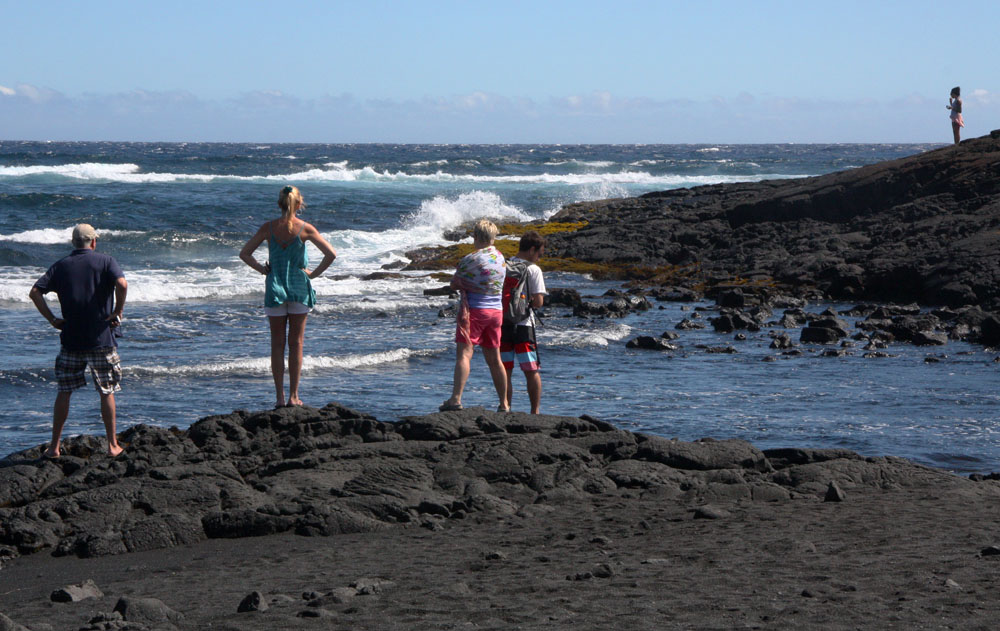
But we did stop at one of the most well-known black-sand beaches, Punalu'u Beach. Like the white sand beaches (at least in Hawaii) caused by breakdown of shells and coral, the black sand is the result of the erosion of the black lava from the island's volcanoes. The beach is shockingly dark, as I expected, I guess... Almost as surprising were the numerous green sea turtles basking on the beach there. In the short time we were there, at least 3 were basking on the beach, while several were seen struggling against the surf and rocks to come to shore. While endangered, we saw several at nearly every beach we spent time with during our visit. We hope this is a trend and they continue to recover.
Like I said, the sand is shockingly dark shown here is a random visitor's foot against the sand while lounging and turtle-watching. Of course, the human toes can be compared to evolutionary remnants of the green turtle toes at right...
It was a rocky, if not spectacular beach with beautiful palm trees and surf. There were also some pavilions for family gatherings and picnics, and it would be great to plan get-togethers there if it wasn't over 2 hours from the western resorts... With the prospect of a spectacular beach and turtles, it would be great to return for a visit...
Volcanoes is only a short distance from Punalu'u, about a half hour's drive or so. A short visit at the visitor center, and a brief refreshment stop were necessary before heading out to the Jaggar Museum where the crater and current activity can be viewed. On the way, we paused at one of the many steam vents - here Susan demonstrates the proper way to unwrinkle your travel clothes after a long day of sightseeing! After a stop at the Jaggar (check the previous post for more pics), we toured the Thurston Lava Tube. Lava tubes are natural caves formed by flows of molten lava during a volcanic eruption. Flows generally get covered by hardening lava, and when the supply of lava stops, the flows sometimes drains out leaving a hollow cave structure. Thurston is artificially lit, of course, and unfortunately we arrived the same time as a busload of tourists, so I had to wait for a chance of a picture without a crowd in it... Andrew Cooper has several posts about lava tubes, his post about Emesine Cave is great!
Finally exiting the tube, we ascended back up to the parking lot through a tropical rain forest. Interestingly, local climate is highly variable here, going from arid to rain forest sometimes over a couple hundred meters! The girls were all waiting patiently for me to finish taking my pictures, and fortunately, though most tourists had passed, we found one visiting from Taiwan to take a group photo of us.
After stopping at Volcano village for some dinner, we returned after sunset to take some night time images. The glowing emmisions lit up by the lava pool just out of our vision was spectacular. With images taken during the daytime, and at night, I finally finished a time-lapse clip uploaded to Youtube. Click on the player at left to play. As always, full-frame at HD mode is always best. What is interesting is that there are numerous vents, upwards of a dozen or so that can be seen in the clip well outside the inner crater. Way cool!
We descended into Hilo and rain as we approached the eastern terminus of the Big Island. We then turned back west and went over the Saddle Road, where it cleared as we ascended to the higher elevations. As we passed the turnoff to Mauna Kea, I was thinking we still had nearly a half hour till the public viewing ended, but my riders strongly vetoed that idea! We were back to our hotel by about 10:30pm after a long, but very satisfying day. Can't wait to repeat that day trip!
FOR ADDED VIEWING PLEASURE -- click on the pictures in our daily posts to see an enlarged (and typically more detailed) picture!
Wow! You came all of the way from _______ to visit us?!!!
Credit where credit is due...
All photos are by Dean and Melinda Ketelsen - even the really cool astrophotography ones. Granted, some pics have come from the Internet...such as pictures of actors, or of Miss Tohono O'odham, etc. However, the astronomy pics, as well as the bird pics are all original - compliments of Dean, and sometimes Melinda too! Layout, editing, and continual tweaking (I think they call that "desk top publishing"), well, that would be the work of "I know I can make this better" Melinda!
 Here we are on the 5th of December, a good 2 weeks till the Winter Solstice, and yet, if you look at a table of sunset times, right now is the time of earliest sunset! "Wait", I can hear you all say - "I thought that happened on the first day of Winter on 21 December!" Well, you would be partly right - the shortest DAY occurs on the first day of Winter in the northern hemisphere, when the sun follows its lowest arc across the sky. Referring back to that table of sunset/sunrise times, you will also note that the date of latest sunrise occurs in mid-January, a couple weeks AFTER Winter Solstice. So the shortest day happens on 21 December, but because the Earth's orbit is not completely circular, but slightly elliptical, the earliest sunset, latest sunrise and shortest day do not all fall on the first day of Winter. If it did, life would be a little more boring, and we wouldn't be able to use these tidbits as excuses to learn something new. But do go check out those sunrise/sunset times - you will see I'm right! You can think of it this way - with the sunset time getting later day by day, it won't be long till the Winter that isn't here yet will give way to Spring and Summer!




 Posts




