Showing posts sorted by date for query Star-B-Que. Sort by relevance Show all posts

Thursday, July 7, 2016

Stars!

A confluence of possibilities came together last weekend that allowed me to get out for a few hours of dark sky observing. Even though our Summer Monsoon season has started, we got a respite on a dark-moon weekend (rare if you ask astronomers), and Melinda was doing well enough to leave for part of a night. Even my observing buddy Roger was tempted to join me for company!

Seems like it has been ages since I'd been to Kitt Peak to observe and other than assisting with an astro-photo class this Spring, it has! Since our astronomy club attendance at the twice-a-year Star-B-Que was dwindling to near zero, I stopped organizing them, so no excuse to go up this Spring at all. My goal was a primitive site at a clearing near mile post 9 - a little level spot off the highway where road materials are sometimes stored. It is far enough off the road that headlights of cars going up or down have no effect on any observing, with room for a few cars and a few observers. The image at left shows a nice panorama of the site from a nearby rise. It is actually darker than the peak of the mountain - hills to the east block the view (and light pollution) from the lights of Tucson, and similarly a little rise to the north does the same for Phoenix. But the view to the south is great - right to the horizon. The panorama shows the view from NE to just west of South. The striking mountaintop of Baboquivari is visible and marks nearly due south for us...

I've talked about Baboquivari several times here. It is a spectacular landmark, about 800 feet higher than Kitt Peak, and about 15 miles to the south. No paved road anywhere near it, unfortunately, though in my more athletic days I've hiked it a number of times on the "Forbes Route". With this trip to check out various lenses on the newish Canon 6D camera, the image at left was taken with a lens from a Pentax 6X7 medium format camera - a 165mm lens (easy to use with an inexpensive adaptor). I set up a couple tracking platforms to run a couple cameras, and Roger set up his excellent little 8" refractor for some visual observing as a side highlight. Before I knew it, darkness was upon us and I got one more exposure of Baboquivari - the stars' short arcs over the mountain demonstrating that due south was actually a little to the west of the unique mountain profile. Just over the peak is a fuzzy star cluster in a rich part of the Milky Way in Norma - NGC 6067. This is a 30 second exposure with the kit lens set to 105mm focal length (F/5, ISO 6400). The slight, barely visible light glow around the peak is likely due to the little town of Sasabe on the Mexican border.

So before I knew it, it was time to get the cameras exposing. Looking to the east, there was a striking view of the Summer Milky Way rising over the hill forming our eastern horizon. This shot is with the 6D and Nikon 16mm fisheye, so has a 180 degree view corner-to-corner. It is tough to realize you are seeing the Milky Way from Cepheus to Scorpius in one view! The glow sneaking over the hill at left is some of the light dome of Tucson... I chose to keep the exposure short at 30 seconds. Any longer and stars would trail. Of course, I could track the stars, but then the hill would trail! A short exposure, w/high ISO minimizes any trailing.


My first target was the glorious Milky Way, just short of transiting in the South. I've heard rumors that the 24-105 kit lens was a pretty good performer and not terribly slow at F/4, so tried that first. Mounting the 6D and hefty lens on the Polarie, I stacked 6 exposures of 3 minutes each at F/5 and ISO 3200. I thought the results were pretty spectacular. Of course, the orange Mars to the upper right and Saturn at upper left dominate the image, the dark nebulae and a numerous reflection nebula and Milky Way make it a memorable first image. Shot at 50mm focal length, the weight of lens and camera was near the Polarie limit. I really wanted to catch all of Scorpius, so for the next set of images, also used the kit lens set to 35mm, and repointed slightly to get the image at right. It certainly picked up more of the Milky Way and all of Scorpius, but also some of the airglow hugging the southern horizon. Still, the image quality and vignetting demonstrate that it might be a decent lens for general use with the large format sensor of the 6D. Also demonstrated here is that the 6D is low-noise enough that I've no longer got to take dark frames while observing. Normally with my older cameras, I would use "long exposure noise reduction" where it would take a 3 minute exposure, then subtract a 3 minute dark to minimize hot pixels. Generally considered bad form for astrophotographers, as it doubles your exposure, or reduces your duty-cycle to 50%, I look forward to not needing to do that any more!

While those images were coming in, I had installed the venerable Canon XSi and 70-200 zoom on an Astrotrac mount. The target - currently the brightest comet in the sky - Comet C/2013 X1 PANSTARRS. I had noticed when looking it up on "Heavens-Above", that it was well-situated, transiting shortly after it got dark, but only about 10 degrees above the horizon in Norma. But I like a good challenge, so went for it! Even with short exposures with the XSi and 200mm focal length, it was easy to sweep up, though I don't think it was near its predicted brightness of 6.5. Perhaps 7.5 would have been a closer guess, though perhaps its low elevation reduced the brightness. Check out the images at left... Both use the same 5 exposures of 2 minutes each (taking a total of 20 minutes with the in-camera darks of the XSi). The difference between them is that at left, the images are stacked on the stars, and at right they are stacked on the comet nucleus. On the left image, the comet moved fast enough to leave a trail, so stacking on the comet nucleus is preferable. If you squint, I think you can see a hint of a tail that goes to the left of the comet. This is cropped considerably from the full 200mm frame...

While first playing with the bigger sensor back in Illinois, I did a comparison of the sensor sizes with a macro lens and suitable subjects - maple seeds and dandelions! But perhaps a star field would serve as a better example of what a sensor twice as large could do... One of my favorite fields is of the Pipe Nebula in Ophiuchus. With the 70-200 zoom set to 200mm and pointed to the field, a series of exposures were taken with both the XSi (APS sensor) and 6D (full-frame sensor), just changing the bodies out between shots. I'll let the images speak for themselves - at left with the XSi and at right, the full-frame 6D. These are the full-frames, so the larger sensor at right translates into a field of view at least twice as large. Between the faster speed, lower noise, and larger sensor, I'm looking forward to getting more from the Canon 6D!

As the evening drew to a close, I finished out with a fisheye view of the transiting Milky Way. Shown here is a 5-frame stack of 2 minute exposures with the 16mm. Tracking on the stars the trees are trailed, as are distant lights of towns on the Tohono O'odham reservation. A memorable view on a memorable evening.

By the way, it was nice having Roger and his scope there too - we got some great planetary views, as well as the comet and a variety of other sights. The goal was to be on the road back to Tucson about Midnight - well, we didn't quite make that, closer to 1220, but I walked into the house before 2am and got to sleep into the 4th of July holiday a little. Of course, once you get a night like that, you can't wait for the next one, and with our rainy season here, the next chance might not come for a while!

Sunday, November 29, 2015

A Telescope's Second Life!

It is said that a home-built telescope is never finished. Likely true as a commercial version upon which thousands have been spent are likely never to be touched by their owners outside a dusting of the mirror or lens. But one built with your own hands in your workshop are easily tweaked or modified to meet one's changing needs. Case in point has been my 11.25" scope built late in the last century... On the long drive back from the Riverside Telescope Makers Conference a couple decades ago, my mind full of new ideas, I was thinking of a "fast" telescope system (needing only short exposures). Besides a short focal length, it would feature a built-in guide scope that would minimize deflection between the scopes that would lead to trailed images. The result is shown at left, set-up at a Kitt Peak Star-B-Que in 2010, likely the last time it was used in that form. Check the link for commentary on the star party and a nice collection of images taken that night. For a home-built, it worked pretty well - the guide scope actually focused through the main scope to the silver focuser, where manual or autoguiding could take place. Off-axis stars were easily found by adjusting the small 5.5" guide mirror's collimation. My favorite from that evening is shown at right - 17 minutes on a supernova remnant called the Veil Nebula - an outstanding result from a short set of exposures.

While the scope was a little unwieldy with the weight and mass distribution of the guider telescope, the focal length was perfect (about a meter), and the speed, about F/3.5 allowed exposures of only a few minutes. What spelled its doom as far as being my "go-to" scope was getting the Hyperstar attachment for the C-14 scope. With the larger 14" aperture and faster-still (F/1.9!) optics, it had a wider sharp field of view with nearly equivalent exposures less than a minute! Also, if you wanted to switch to visual observing, slip out the Hyerstar, put in the secondary and you had a C14 with its excellent optics. But I missed my lil' home-built! We had spent a lot of hours together in figuring the mirror (twice, to get the curve just right!) and building the thing. And we had won prizes together - both a Merit Award when it appeared at RTMC. and again a few years later when we saw all 110 Messier Objects on a single night at the All-Arizona Messier Marathon, when for a week or two in the Spring, you have the chance to track down all of Charles Messier's little fuzzies he cataloged as he hunted comets in the 18th century. Plus, the longer focal length allows a little larger scale of celestial objects.  So I was thinking of resurrecting the scope...

In reality, telescopes are simple devices. The tube of the scope rigidly mounts the optics and focuser, along with any other ancillary optics and accessories. The glass is fragile, and the mechanics of a focuser are beyond most, otherwise there is little complicated in one. Shown at left is how the scope has been in stasis since that Star-B-Que 5 years ago. At right is a view down the working end, and you can see how I made a simple spider to hold the secondary mount, and you might see how the guide scope at left is focused through the main scope to the silver focuser at right - handily next to the camera mounted on the main scope.   Besides removing the guide scope to make it lighter, the only changes I had in mind was a new set of commercial rings from Telescope Support Systems, a small garage shop run by some friends in Michigan, and a focuser to replace the plastic-and-PVC version I'd started with so long ago. I decided on a sturdy 2" focuser from Antares for $180 - seemingly a good step up.


After removing the primary mirror and cell, I reached up the tube and removed the nearly 20 bolts with which I had attached the guide scope to the main tube. The guide scope then came off without any issues. The new tube rings went on perfectly! They had wanted my tube dimensions to a couple thousandths of an inch, and I had 3 ways to measure and report it to the company for accurate machining, and it shows in the product. The two saddle plates I got do double duty - one side attaches to the mount, the other holds the new, much smaller guide scope that I use now for accurate tracking. The new installed rings are shown installed at left, the new focuser still in plastic on the right. After some careful measurements and layout, I drilled 4 new holes for the focuser and attached that too, so literally, in a couple hours of work, the scope was reconfigured and brought back to life. It is now much lighter and easier to manage by myself, and occupies a seat of honor in the van with its own special seatbelt made of a couple clamps and 2" webbing from REI! You might have spotted its initial use here in Tucson at friend Dick's house when he held a little star party early in the month. I mounted it on an alt-az mount designed and built for my TEC 140, but worked fine for some wide-field views through the 11".


I was able to get out for a couple partial
nights to a friend's house near Benson. Not perfectly black skies, but plenty good enough for some trial runs. Shown at left it is mounted on the AP1200 mount. When I acquired the mount a couple years ago, I got a stumpy pier for use with Newtonian scopes, but never used it till now. But the combo seemed to work well, though I've got to crawl on the ground to use the Polaris scope to align the mount to the Earth's rotation axis. And once done, I forgot to lock some of the adjustable bolts the first night out allowing some trailing... The entire huge guide scope I took off has been replaced by the little white scope between the tube rings at left and a digital autoguider camera. You no longer need anything close to the focal length of the main scope (the old standard 20 years ago) these days... Because of the mentioned trailing issues due to some loose bolts, the images aren't too impressive, but I was able to collect 7 frames of 3 minutes each on NGC 891 shown at right. Blobby stars, but shows some promise. Still getting some weird diffraction patterns around brighter stars - saw that also on the earliest images from Dick's house.  I originally blamed it on the coma corrector extending into the beam, but I'm thinking there may be a turned down edge too...

The next time I was out to Benson and Pat's (the night of the Trident Missile launch on 7 November), I made sure to tighten all the bolts, and also made a mask slightly smaller than the mirror to block unwanted diffraction. This time the seeing was poor, but was still reasonably dark. At left is shown a fisheye picture (8mm lens for 90 seconds) showing our sky with Roger Ceragioli's newish 11" refractor and my 11" Newt working side-by-side as the Winter Milky Way started rising. Finally, just as we packed it in, I took a few frames of the Pleiades rising in the east, of which only 2 frames were suitable for stacking. So this is 4 minutes total exposure, with some cropping. Stars are excellent, as are the diffraction patterns. The Pleiades sits in the middle of a dust cloud, which is illuminated by some of the stars here. Note on the right side, about an inch from the edge when looking at the full-size image, there is a little edge-on galaxy halfway from bottom to top. I'm looking for the name of that guy and will report it here if I find out. Anyway, I'm thinking the scope is showing promise again as I get back into some dark sky imaging. Stay tuned!

It has a name!  The lil' galaxy near the Pleiades was tough for me to track down, but thanks to professional astronomer Brian Skiff of Lowell Observatory, who did all the heavy lifting in IDing it, it has a name.  It is UGC 2838, nearly 350 million light years distant (!).  The Uppsala General Catalogue is a catalog of all galaxies brighter than magnitude 14.5 north of the Celestial Equator, using the first generation of the Palomar Sky Survey as its source material.  The image at right shows a little closer view with the galaxy indicated - again, only 4 minutes of total exposure, so you shouldn't expect much!  In some of the writings about it, its brightness is quoted as nearly 18th magnitude, but in others it is listed at about 15th magnitude - still faint by visual standards, but obviously easy to catch photographically with the 11"!

Sunday, October 18, 2015

Rainout at the KPNO Fall Star-B-Que...

Last night was our Fall, 2015 Star-B-Que at the Kitt Peak picnic area, held for about 20 years now. Last night's reminded me of the very first one - Kitt Peak had been very paranoid about anyone outside astronomers being on the mountain after the death of Marc Aaronson in 1987. It was nearly a decade later that we convinced them that the picnic area with its open-air pavilion, flush bathrooms and 6500 foot elevation was the perfect place for a "Star-B-Que", a cookout and star party, and it has happened ever since. That very first one, where we were permitted only 25 attendees, filled up with those wanting to join in, and even though the weather was questionable, 23 still showed! I recall it rained so hard that we had a hard time keeping the charcoal grill going! But it was a memorable time, as is nearly every trip up that mountain.

Again, the weather was questionable, but there were lots of blue skies and sun on the 60 mile drive to the SW of Tucson. As organizer, I had to arrive a little early, head to the visitor center and collect the keys to the picnic area and staff area where the gas grill is now locked up. Arriving a little after 3pm, I found the night time programs had been cancelled for the weather, but as I'm fond of saying, at least we'll have a cookout!

Upon driving up, I grabbed a camera to take some more time-lapse of the VLBA dish. It was just a week ago that it was moving multiple times per minute to a new object, and it seemed to be sticking to that schedule. I took a short sequence with a frame every 20 seconds and show it as a GIF here at left.

We had a few attendees dribble in, so the grill was pulled out and set up adjacent to the restrooms. We also had some auspicious visitors! Mike Spooner, telescope maker extraordinaire and his wife Elvira attended after I contacted them a few weeks earlier. Mike has joined the ranks of the recently retired, and had brought one of his gems down with which to observe. Also, Demetry Papadopoulos, a doctor, had flown in from where he lives in Charleston, SC for some desert observing. Ironically, it was clear back home, and the Peach Star Gaze in Georgia, where he usually goes to observe this weekend, also had clear skies! Besides Jim and Elaine Miller and Paul Lorenz, TAAA stalwarts, that was about the extent of our crew.  With Melinda and me, we could all fit at one picnic table!

But as I said above, even if the skies don't cooperate, there is usually something of interest going on, and storms can be spectacular from elevation where you can see them for 100 miles! While we didn't have any raindrops early, the view off the west side of the mountain was at times breathtaking. At left is shown a view of vertical rain shafts to the distant west, alternated with some slanted crepuscular rays where the sun shown through breaks in the clouds.  You can see that the distant west looked to be clear, and if it looks familiar, I've mentioned them before in identifying the Pinacate volcano field. The flat-topped range are the Mesquite Mountains, about 40 miles west of Kitt Peak, and the peak to the left is Mount Cubabi, just into Mexico south of Sonoita/Lukeville border area. As time passed, the storms grew a little nearer, with associated lightning too as shown at right. While I was using a timer at the moment this was taken, I actually pushed the button manually, as these strokes sometime last long enough to react to. I would have been lucky indeed to catch one taking an image every 15 seconds with intervalometer!

Locally, the rain picked up and I was out protecting the cameras I had going with my trusty umbrella! Behind a bush I saw a glow and thought the sun was sitting on the horizon already... Walking a couple meters, it was the sun reflecting off sheet flooding out in the desert! The sun, still hidden behind clouds, eventually dropped into the clear gap and gave a spectacular encore setting behind some storms and providing some amazing colors. I shouted out to the attendees, hunkered down in the pavilion to come see and all were amazed. Unfortunately in my haste to catch it, the camera was slightly out of focus, so didn't make a time-lapse, but did catch 3 representative frames as the sun moved through the gap. The top one shows the sun reflecting off the flooded desert I mentioned, then the sun eventually coming into view and momentarily being partially hidden by clouds.

As the sequence neared its end with sunset, the rain intensified and everyone ran for the cars.  I stayed to the bitter end, holding the umbrella against the downpour.  Between the lightening and rain, everyone was long gone before I packed up, and I had to return the key to the mountaintop before leaving.  It has been a long time since driving in rain that heavy, but at least the near-constant lightning helped light the way!  At 7:45, it was about the earliest we've ever gotten back from a star party - even got to catch the last inning of the Cubs playoff game!  The storm followed us, arriving in Tucson about 30 minutes later, but lacked the intensity of the Kitt Peak version.

But as I've said before, a trip to the mountain is always entertaining, and this one was no exception!

Sunday, August 23, 2015

A Few Hours In The Dark...

Unfortunately, clear skies through Arizona's monsoon season come rarely, typically only a few times through the 10 weeks from 1 July into mid-September. And I don't count the times it clears at 2 or 3 am - that happens almost daily with rains in the early evening, and clear skies by dawn the next morning. Who has the schedule to wait till the hours before dawn to think about observing? I'm talking about the rare times the monsoon circulation is disrupted and we get some rare nights that are clear throughout.

Well, it happened last week. and we finally had some blue AND dry skies in the afternoon. Melinda had been to the dentist earlier in the day with a tooth extraction, and she was resting comfortably at home, so I ran out towards Kitt Peak for a few hours in the evening. It wasn't going to be a late night - I needed to be at work the next morning. With the sun setting about the time I reached the Kitt Peak turnoff, the interesting clouds I'd been watching revealed themselves - I believe that they weren't clouds at all, but smoke from the California fires some 400 miles to our west. Shown at left, something way over our horizon was casting crepuscular rays from the well-set sun, but the line of smoke stayed low with the crescent moon above it.

With most of the telescopes still in summer shutdown, there was little activity on the mountain, and I set up in an out-of-the way corner of the public parking lot. I've always got a project or two in mind, and I set up two different tracking platforms - an Astrotrac system I've had nearly 2 years, and a Vixen Polarie for shooting wider fields. Those who know me know I love to image dark nebulae, and this is prime time for dark clouds - dust and gas seen not from incandescence or fluorescence, but from their silhouette against the star clouds of the Milky Way. My main goal was to go after the area of the Pipe Nebula in the constellation Ophiuchus with a 200mm lens (Canon 70-200 @ 200mm, F/3.2 w/XSi) to put together in a mosaic. By shooting with a telephoto, you can retain the resolution of the original frames, with the mosaic revealing the wider view.

The result is shown at left - I ended up taking 5 frames in the mosaic, each 5 exposures of 3 minutes each. There was enough overlap that Photoshop assembled the mosaic just fine. As you can imagine, the "pipe" of the nebula has the mouthpiece at right, and the intention is smoke ascends from the bowl at the left side with more dark clouds. Also noticeable if you click on the image is that the "Snake Nebula", B72, is visible as an "S" shaped dark cloud at top center. The "B" designation is from the Barnard catalog of dark nebula, from E.E.Barnard, who discovered and listed 369 such dark clouds from his initial photographic exploration of the Milky Way.

While that was my primary object through the evening, I used a 20mm wide angle lens to shoot another mosaic at left on the Polarie tracker. This one is produced from 2 frames from 6 or 8 two minute exposures at F/4 with the old film-era Nikon lens. Even with only 12 minutes total exposure (of the lower half) there were quite a few deep sky objects visible. I made a labeled version posted at right to show objects in subsequent images, as well as show the position of the Pipe Nebula in the grand scale of the Summer Milky Way. This wide-field much better matches the naked-eye view, with much of the Pipe Nebula and other dark clouds seen against the Milky Way glow in the dark mountaintop skies.


But like a telescope or binoculars show much more of the sky details that can be seen by eye alone, a longer telephoto lens shows much more than the wide field. Seen here is a 3-frame stack taken with a 135mm lens (another film-era Nikon lens shot at F/4 with a Canon 20Da). Besides star and dark clouds and star clusters, also visible are a pair of luminous hydrogen clouds, illuminated by internal fluorescence from bright stars within. Part of the Charles Messier catalog of "fuzzy objects" (he was looking for comets, and is best known for his catalog!). These are labeled as M17 and M16 on the labeled version at right. While the couple-decade-old Nikon optics do an adequate job, if you look at the brighter stars, some of the blue ones have blue disks around them, and some of the red stars have red disks, indicating the color correction isn't really sufficient. Someday I'll update to newer lenses, or use the 70-200 zoom which is quite excellent, but was in use on the other mount.


Finally I close with the last frames of the night. On the Polarie and 135 lens, I shot a few frames of the Lagoon and Triffid Nebulae (M8 and M20), shown at left. Unfortunately, that tracking mount isn't beefy enough to shoot my "newish" 300mm lens to try for astronomy. But with the Pipe Nebula mosaic frames ending on the Astrotrac, the final frames of the same field were shot with the 300 at F/4.5. It looks to me that the lens has very good potential, almost needing use of an autoguider, as even the Astrotrac was barely adequate for this pair of 2.5 minute exposures... These nebulae have been featured here before, most notably at a Kitt Peak "Star-B-Que" 5 years ago, a close-up of the Triffid featured in a first-outing of the TEC140 last year, and both these nebulae and M16, 17 above were all featured in a post on "snapshots" with the Hyperstar on the C14. I really like this area, not only for the bright glows of the gas clouds, but also because of the interplay of involved dark nebula as well. But this pair has not been featured together as well as the 300mm shot at right, so a deeper excursion might be called for in a future outing.

I was a little tardy getting home - originally I was planning on a Midnight arrival, but it was closer to 1am when pulling in. Still, that isn't too much later than our normal bedtime, so made it to work the next morning just fine. I was glad I didn't put it off till Tuesday night as it was nearly overcast, though rain-free. So you've got to get out for those little moments when you can catch them! Unfortunately, in another month as the monsoons wind down, the Summer Milky way will be another twelfth of the way around the sky, lower in the west, and soon after that in conjunction with the sun. I'm glad I got out, if just for a few hours...

Thursday, April 16, 2015

Spring Kitt Peak Star-B-Que, 2015

This last weekend was the astronomy club's Spring Star-B-Que, held at the Kitt Peak picnic area. It is a great venue - a spectacular dark site for observing, and the employee association allows use of their gas grill for a cookout beforehand. We've been doing it for ages, and a search of the blog recalls some great memories.

We went up early this time because we had a special guest - our niece Kathy came down from Chicago! We were both under the weather during her last visit in January, so she came down for the weekend just to join us on the Mountain. We toured all the telescopes that had visitor galleries, and her uncle (me) gave her a running commentary on what we could see as well as stories about the "olden times" when I used to work on the staff. She is shown at left stepping onto the access stairs to the 4-meter equatorial mount.

It was a beautiful day, but we were supposed to have clouds move in, which is what happened.  But the temperatures were moderate, and Kitt Peak is always a fun place to visit and play in nature.


In my recent obsession with 3D anaglyphs, I took a huge number of stereo pairs. I know I have at least one fan out there that enjoyed my recent postings, so will include a few more of the more impressive ones here. So get out your red/blue glasses and follow along! Many of the pairs were taken with my IR-converted camera, as it cuts through haze and the high-contrast images work well in the anaglyph format. At left is a wide view of the south side of the Observatory taken from the visitor gallery of the 4 Meter telescope, and at right is a closer view of the 2.1 Meter Telescope at center. For both, I used the south-facing windows of the gallery for the baseline of the stereo views, so an image was taken, then I quickly moved the 40 feet or so to the side to take another image to use as the 3D pair. It worked great and I think these aew quite spectacular!

Similarly, from the south side of the Observatory, from near the 2.1 Meter scope, I used the same technique to shoot a stereo pair of the 4-Meter. Many of the same telescopes are visible in both image pairs. The distinctive roll-off roof of the 16" used for the Nightly Observing Program is visible in the pairs above as well as here.

A little later, down in the picnic area, I tried my hand at some macro-pairs of bark and the new growth on the oak trees. At right here is some distinctive lichens growing on oak bark, and the close-up 3D looks very much like the topography of the local mountains and valleys!


Given the clouds we had a pretty good turnout - over a dozen showed up, though only 3 of us were optimists and packed telescopes! Most knew we would at least have a cookout, so showed up for that - though driving 50 miles one-way to get there takes some dedication! At left, Melinda and Kathy are shown as we got serious about moving from our social circle set up near the van, down to the pavilion to eat.  You can see that we had cool temps - everyone was bundled up!

The clouds alternately broke up and darkened again.  It looked like rain to the south, we might even have had a few drops at one point.  But the broken clouds at least provided a spectacular sunset.  Shown at right is the view as it set down the north side of a mountain, providing an unusual bite out of the setting sun.

We knew that sticking around for a few minutes would usually reward us with some more colors, and sure enough, while not spectacular, we got some pretty colors cast onto the clouds that remained.  Many folks were starting to stream out about then, and both Jupiter and Venus were blazing through the thin clouds.  I wasn't sure I wanted to go through the 20+ minutes of setting up the C-14 for Kathy to get her first view through a telescope, but luckily, someone plopped down an 8" telescope to provide her a view of Jupiter and moons and the brilliant globe of Venus.  Even as we tried to check out the Orion nebula or anything else, the clouds conspired against us, and we too left for civilization.  Still, a fun day touring the Observatory and making 3Ds.  Likely more of those to come!

Sunday, September 21, 2014

Star-B-Que!

Yesterday was the Fall Star-B-Que for the Tucson Amateur Astronomy Association (TAAA) at Kitt Peak National Observatory.  What is a Star-B-Que, you ask?  Well it combines the best 2 parts of belonging to an astronomy group, socializing at a potluck picnic, and observing under some pristine skies.  The picnic area at the National Observatory is very nearly perfect for such an event.  It has a pavilion, flush toilets, and an open area with concrete pads to set up scopes.  The employee association even provides a gas grill for our use - it is always great!

Plans were complicated this week by Hurricane Odile, which came up Baja and was supposed to bring up to 7 inches of rain or more to the Tucson area.  Fortunately, it got the to the US border and veered east, so while we got some rain early in the week, we didn't get hammered like Baja did.  But for some reason, the moisture didn't clear out like it usually did and the Observatory spent 3 days buried in clouds and fog, finally dispersing Friday evening.  Saturday, Star-B-Que day dawned with severe cloud buildups over the mountains, and even as we drove out to Kitt Peak for the event, we saw some desert downpours just 15 miles SW of the mountain.  Arriving to set up, there were plenty of clouds, but a promise of clear skies to the west.  By sunset after some grillin' and eatin' there was a rush to set up gear under clear skies.

I'm keeping this post short, I did some visual observing with the 14" and also did some wide-field imaging that I'll post later if I get anything of interest.  Just as it was getting dark, I took the wide-field self portrait at left with kit lens and a 40 second exposure showing clear skies and a bright Milky Way galaxy arching over us.  With a couple new eyepieces (Meade UWAs), I and others were treated to some spectacular views of some favorites.  The Triffid Nebula, M20 was looking pretty much just like the picture in my last post, though in black-and-white, since the cones in our eyes don't work in low light levels!  I also showed a few people the great globular cluster M22 in the rich Milky Way background, and a little later, the Helix Nebula was spectacular with a nebula filter to increase contrast.

A bunch of us also visited John Davis, an engineer who works with me at the Mirror Lab.  He had just finished working on an equatorial mount and had its debut under dark skies with a 12" telescope and camera.  I'll be sure to show some of his pictures if he sends them along.  His mounting sure was impressive!

We didn't have too late a night - we were about the last to leave shortly after 11pm and were home by 12:30.  It was a nice night, given that most were there just for the picnic with the threat of rain.  Sometimes nature smiles upon us!


EDIT-  John Davis has posted the images he took Saturday evening on his blog.  My favorite of the night was of the HII region Messier 16 in the midst of the Summer Milky Way - he sent me a larger size than appears on his blog, so I stretched it a bit and show it here. Not bad for 9 minutes total exposure with an unmodified camera. It was through a 12" telescope though, and the image quality is testament to the quality of the mount he has built.  Note that you can see a little star bloat in the corners - he was not using a coma corrector for the Newtonian telescope.  Future efforts should have better images!  Going to the more general address of his blog, you can see his progress from the machining of the mount through the first exposures... Fun stuff!

Monday, June 16, 2014

New Optics!

About a month ago I had a chance to invest in some new optics.  The telescope is a TEC 140 - a 14cm F/7 diameter triplet apochromatic refractor.  It is quite the Cadillac among the Chevys  - beautiful optics with absolutely no visible color aberrations, and a focuser built like a tank.  The owner listed its availability on the "AZ-Observing" listserve.  One of the reasons I jumped on it is that I've used one frequently on Kitt Peak where it is mounted on the Roll-Off-Roof 16", and I've posted a few images from it before.  For proper use, it really needs an aligned mount and autoguider, so contacted my buddy Pat, who just finished his observatory down near Benson.  The scope slid right into his mount, a G-11, and we used my little autoguider scope with his camera and mount for a few images.  Besides trying out the scope for the first time, I was also contemplating the autoguider camera to see how well it worked.  Next time I visit Pat, I'll see if it works with my AP1200 mounting...


Note that the evening I visited him was the day after our Kitt Peak Star-B-Que, so the crescent moon was high in the sky and the first natural target.  So this image can be directly compared to those taken 24 hours earlier from that blog post.  That image was a mosaic from a series through the 14" telescope.  The TEC has a focal length of 980mm, so the moon comfortably fits into the frame of the APS sensor of the T3 Canon I was using. 


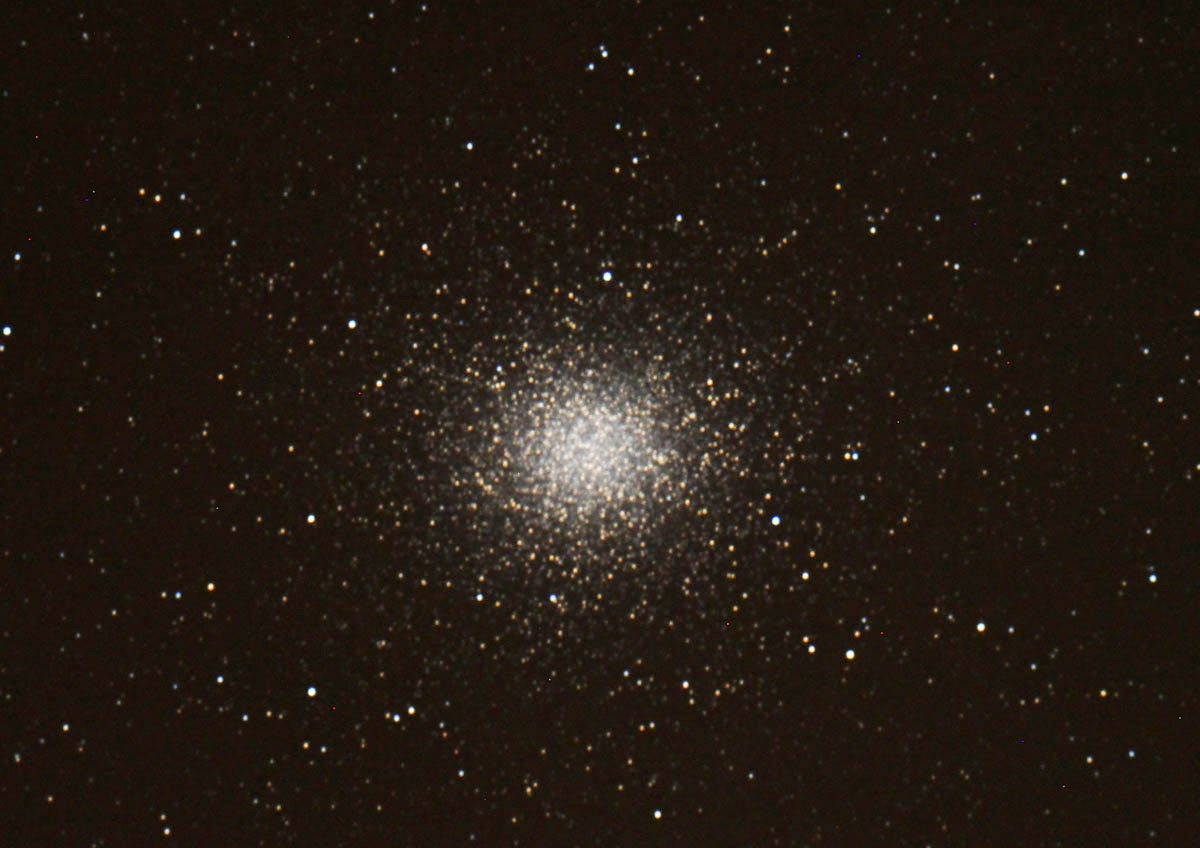
After hooking everything up, it was apparent that the setup was working fine.  The autoguider requires use of a laptop computer - always a drawback for me since I run off batteries, but nowadays a common accessory.  Since I was also new with using the T3 under a dark sky, I continued to run at some high ISOs, and for the first stellar target shot the Leo Trio, with Messier 65, 66 and NGC 3628 (counter-clockwise from lower left).  This is a combination of 9 frames of various exposures and ISOs...  My intent was to only prove the setup worked, but before shutting down, we moved down to take a shot of the great globular cluster Omega Centauri.  At right is a single 2 minute exposure at ISO 800.

So the scope shows promise, not only for astronomical targets, but I anticipate it will be fun for terrestrial shooting too at long-range.  I'm working on a mount so that it can be used when we go to the Grand Canyon Star Party later in the month.  It should work well for shooting those mule trains and river rafters far below the rim - can't wait!

Sunday, April 20, 2014

TAAA Springtime Kitt Peak Star-B-Que!

Last night was our springtime Star-B-Que at the Kitt Peak picnic area.  We've had some spectacular ones in he past - great skies and a nice venue with a pavilion and tables for a sizable group to socialize and picnic.  Since the Tucson Amateur Astronomy Association (TAAA) assists Kitt Peak National Observatory with some of their outreach events, they even let us use their grill for the cookout.  Unfortunately, the weather leading up to the weekend was not promising, but the Clear Sky Chart was hopeful for late clearing, so always the optimist, I prepared for clear, but always enjoy the trip, rain or shine!

Sure enough, the promised clearing was a hoax, but there were some spectacular cloud buildups and long lines of rainstorms visible out in the desert, so lots to watch for.  Of course, clouds and vegetation always looks more impressive with my IR-modified camera, so used it for the 3-frame mosaic of the radio dish and mountaintop shown at left here.  The radio antenna is part of a 10-dish array scattered over the hemisphere, the Very Large Baseline Array.  Using the signals from all of them, they can synthesize maps of an object as if they had a dish nearly the size of the earth!  It was stowed when this picture was taken, but a little later it came to life and was working in the eastern part of the sky, as shown at right.

It is an interesting time of year on mountains of southern Arizona.  The vegetation is dominated by scrub oak trees - considered evergreen, they keep their leaves through the winter, and the old leaves die off and are replaced by new growth this time of year.  When pointing this out to the attendees, most thought the trees were stressed by drought, but in fact in a close examination you can see both old green leaves, some yellow/brown leaves, and the new growth of grey-green leaves.  It was always interesting to get our "Fall" colors in the springtime on mountaintops!


And while I admit knowing little about lichens, I do admire the variety we saw yesterday - it was easy to capture at least 3 different types (of different colors, anyway) a fraction of an inch apart on the bark of an oak tree...

The threat of clouds cut in to our attendance some, but still folks came for the socializing and the chance to get out of town.  We had a nice discussion with Michael Turner regarding his new Canon 60Da, a camera model specifically modified for astronomical imaging.  Joining into discussions was Mary at left and Paul Lorenz at right.  The dark clear sky and bright vegetation is a characteristic of the Wood effect of infrared wavelengths - vegetation readily reflects IR light and the blue sky is naturally dark in IR. 

Since we didn't have telescopes to set up with storms within 15 miles of us, we set up the grill, and in fact, gathered around it to get warm with the cool temperatures and blustery breeze.  You could tell we were all thinking alike as a majority brought brats to grill and potato salad as a side dish!  After dinner we mostly played a waiting game to see what the weather would do.  At right a couple attendees keep an eye on  storms towards Sells and beyond to the west.

Finally I set up my small Meade 80mm triplet APO scope (480mm focal length), and shot some time-lapse of the storms, which morphed into imaging the sunset.  Though watching "live" you need to pay close attention to see the rain falling to the ground, the time lapse amplifies the effect.  Note also that on the first part of the time lapse below, I utilized unsharp masking techniques from Photoshop to accentuate the rain features in the images.  It does introduce some artifacts, like the halo effects near high contrast edges shown here at left, but it works so well in bringing out the sheets of rain, I put up with it.  By the time I've panned over to catch the sun setting, I turn off the sharpening.

Here is the time-lapse of some of the desert rain and sunset.  You can watch it in this viewer or go to the YouTube site to watch it, or click it for full-screen.  Watching it full-screen, likely requires going to the highest quality setting.


As I returned to the van from the outlook after the sunset, it started sprinkling, and by the time optics and cameras were put away, it started drizzling in earnest.  All had left by this time, so we did the same.  As I was locking the picnic area gate in the rain, I looked up and was able to see Jupiter high in the sky over the setting Winter Milky Way!  We were THAT close to having clear skies, but the rain generally increases the humidity enough to cause dewing problems even if it had magically cleared right away.  So it was an early evening at home, though the cats were glad as we got home to feed them at 9pm...