Saturday, June 15, 2013

The Unseen Canyon

More stuff from our recent trip to the Grand Canyon...  Since I'm getting into the time-lapse stuff now, I took something in excess of 4,000 pictures, mostly with my XSi, some with Melinda's too.  What has been interesting through the decades is that most people look in from the edge and see the macroscopic view of the Canyon.  Since it is mostly hidden in an inner gorge, most likely don't even realize it was carved by the mighty Colorado river.  Even fewer know that the length and breadth of the Canyon has a network of trails that are popular with hikers and trod by mule trains to haul supplies and visitors alike.  I made a point of bringing my William Optics 11cm refractor to the rim for some real telephoto views.  It is amazing what I was able to catch in an hour or two of imaging!

The South Kaibab Trail is a popular route for those going down to Phantom Ranch.  It is a shorter hike, about 7 miles to the River, with some spectacular views along the way.  This time of year, the inner canyon suffers hellish temperatures and most hikers headed down leave early to avoid the worst heat.  After first focusing the scope, I pointed to the "Tipoff" and right away caught some hikers going down meeting up with a mule train of riders coming up.  A mule train travels amazingly quickly, so trail etiquette  has hikers yielding to the mules.  Clicking the image will load the nearly full-resolution image.  Note that while obvious here, the mule train was barely visible to the unaided eye, and of course, the hikers could not be seen at all.

Similarly, a few miles up-trail above Skeleton Point,
I looked for and caught a couple hikers also headed down the trail.  Note that all these images were taken from Yavapai Overlook, a couple miles west of the Kaibab trailhead, so these mules and hikers are easily a number of miles downrange.  I thought the 770mm focal length scope performed pretty well!  The picture at right shows the same image of the hikers on the South Kaibab, but at the full camera resolution, showing all the details the system was able to capture.


Glancing down to the Bright Angel Trail just below Yavapai Overlook was a spot of greenery where I spotted some hikers headed up that trail.  I started taking a set of pictures for a time-lapse, and without even realizing it, caught another mule train headed down!  While it seemed pretty busy, I think it was a matter of the early-morning traffic a good part of the way down avoiding the heat...


And speaking of Phantom Ranch, the destination of most of the mule riders and hikers, another group of Canyon explorers also visits - river rafters!  There is a beach a few hundred yards upstream where expeditions can eat meals and take advantage of other services available there.  At left is shown some small inflatable rafts that were paddling away from shore to catch the river currents to continue downstream.


A few miles downstream is another spot of river visible (only these two spots of the river are visible from Yavapai).  I was looking for the above inflatables to cross across this view, but instead these big banana boats came drifting through!  The boats are just visible to the unaided eye, but again, if you didn't know there was a river there, you likely wouldn't detect the boats either!  I've been told the solar panels are for the emergency telephone for use on the lower Bright Angel trail...


A couple days later, I went out to the eastern part of the Park, to Lippan Point, to try to get better views of the rafts going down the rapids.  From that vantage point there is a much better view of the Colorado river, including Unkar Rapids and part of Hance Rapids.  I caught a pair of big rafts going down Unkar, one of which is shown here.  Click on the image to see it clearly in the midst of the rapids...


And just to return to an astronomical theme, I'll close out with a couple of wide shots of the northern sky from adjacent to the Canyon.  We didn't quite stay late enough into the week to take advantage of the moon lighting up the Canyon - it was pretty black when imaging the sky over it at night.  On night one, shown at left, we had a very nice display of banded airglow from the observing field at the Star Party.  Like last year's display, I'm thinking it is because we're close to Summer Solstice and the airglow, caused by solar excitation, is discharged over the hours of darkness.  A few nights later I headed to the rim for more pictures.  Though we had a few clouds, lots of details were still seen.  On the northern horizon at center, the North Rim lodge lights can be seen at center, and to the right of the lights, the small light dome of Page, Arizona can be spotted.  Above the lights of the lodge is a satellite appearing to track through the Double Cluster and below Cassiopeia Constellation.  The Space Station had passed in a very similar orbit about an hour before, so I'm thinking it is likely a supply ship that I know was headed to a rendezvous with ISS.  Above the trail of the satellite is an airplane that appears to be flying in formation...  If there was any airglow on this later night, it was just marginally detected, if at all.

It was fun to use the scope to reveal some of the goings-on in the Canyon that few know about.  In the past 23 years of attendance, I've used my big binocs to show people some of these scenes, but I've never tried capturing them, but it is neat stuff!

Wednesday, June 12, 2013

Grand Canyon All-Stars!

Melinda and I are just back from the Grand Canyon Star Party - the 23rd annual since I started it in 1991!  We only stayed the first half of the 8-day event - I've got appearances to make at both my jobs tomorrow and I've also got a medical procedure late in the morning, so will be making up for time "lost" the last 4 nights we've been away...

It was a great event!  We had some great crowds of public looking though our telescopes, and a pretty good variety of telescopes, from Dennis Young's 28" diameter Dobsonian, to a few large refractors (up in the 6" to 8" range), and even  pair of 6" diameter binoculars.  I had the Celestron 14" on the "new" Astro-Physics AP1200 mount, which got lots of attention from the astronomers.  Evidently the mount is little seen by many local astronomers, so many were interested in seeing how it assembled and how well it worked.  It is a big step up from my older Losmandy G-11 mount, holding up well against the stiff breezes that are not-at-all unusual at the Canyon.

The big stars at the event (get it, sort of a pun!) is the rising Milky Way - our own galaxy.  Here in early June, it rises shortly after sunset and the sight of it rising in the eastern sky is one of the most awe-inspiring events you can spot in a really dark sky!  The shot here at left is taken from the observing field where we set up right behind the main Visitor Center.  The shot was made with a Nikon 8mm fisheye at F/2.8 with Melinda's Canon T1i. and is a 50 second exposure at an ISO of 3200.  This year our ranger had the scopes set up around the periphery of the parking lot, leaving the center portion clear for pedestrians and vehicle traffic when picking up and dropping off scopes.  The red lights are parking cones with red flashlights providing illumination.  The glorious sight of the edge-on view of our Milky Way galaxy dominates the view, visible here from Scorpius at right to Cassiopeia at the left.  The greenish glow at the eastern horizon (picture bottom), is a display of airglow that was visible most every night we were there.

The view of the rising Milky Way was certainly my favorite sight there.  There is little telescopically that can compare with the naked-eye sweep of our own galaxy, and I often found myself gazing upwards with mouth open in amazement!  I took a few walks of the 200 meters or so to the rim at Mather Point near where we set up to gaze outwards over the abyss of the Canyon.  Illuminated only by starlight, Canyon details were mostly invisible, but the stars, planes and satellites overhead were quite amazing.  Walking back to the star party I came upon the scene shown here - the center of our galaxy rising over the scrub trees that line the Canyon made for an interesting sight.  Scorpius is just right of center, Sagittarius just left of center, with the center core of our galaxy between them.  Enormous lanes of dust obscure distant star clouds, creating the gaps in the edge-on glow of our galaxy.  About the only sky glow, seen near the right side is from the small town of Tusayan, about 7 miles to our south.  Las Vegas is also visible far to the WSW, but is little of an observing issue.

The other observing highlight for me was the innermost planet Mercury.  It was perfectly placed for observing - at greatest eastern elongation, seen just about as high as it can be seen in the northern hemisphere, and conveniently places a few degrees above and left of the brilliant planet Venus.  Since Mercury was at its greatest elongation, it showed a beautiful little crescent phase, like a first quarter moon.  Using Venus as a finder aid, Mercury could be spotted very shortly after sunset, and many of our visitors got not only their first glance at the innermost planet, but also understood why it looked like the quarter moon!  This photo was taken Monday night when the thin crescent moon joined Venus to the right and Mercury between them and higher.  My C-14 is at left with the planet-moon alignment at right.  Above them are Gemini's bright stars Castor and Pollux.  Click the image to load the full-size and see all the objects...

Part of the fun of these public-outreach events is catching up with far-flung friends that return to the star party like we do.  This being the 23rd version of the Grand Canyon Star Party, I was happy to see our friend Elinor making the trip from Kansas City.  She and her husband David had joined us at the first edition of the event in '91, as well as being regular attendees over the decades.  Even though David passed a few years ago, she still makes the trip to visit her friends at the star party and also connect with her niece Cathy who lives in Sedona.  At left is a group shot last night, a rare mostly-cloudy evening in front of the C-14.  From left is niece Cathy, Elinor, Melinda, and our friend Donna who travelled with us to the Star Party this year.  Above us in the sky are Saturn at left and the bright star Spica to its right.  Though most scopes stayed covered, we showed over 60 people Saturn through thin clouds.  Over the course of our 8 nights we had over 800 public observe with our telescope.  At right is the view of the beautiful sunset (partly cloudy nights always result in the best sunsets!) from last night as well.  I always tend to be the optimistic sort when presented with these sorts of skies, so we set up "just in case". 

We felt a little guilty leaving at the halfway point of the star party, but our return couldn't be avoided, but the views of the heavens shared with the public this week will keep us going until next Spring!

Wednesday, June 5, 2013

Mysterious Cereus!

Like most home owners, we like having a few plants around.  Of course, with the cats, houseplants are mostly out of the question, and the exterior plants mostly eventually die lack of attention - mostly the needed watering every other day through the hot, dry Spring...  Desert plants fare a little better, especially those in the ground.  Pots are harder because they need extra water, and they are also exposed to the cold (for us) night time Winter temperatures.

A couple years back, our neighbor Jack, who has appeared before with his spectacular cactus, was throwing out some cuttings that we stuck in a pot.  They survived even our care and a couple weeks ago we noticed some flower buds.  We didn't think a lot of it because most cacti flower in the Spring, but these buds kept getting bigger and bigger until it was bigger around than the body of the cactus! 

Finally late the other afternoon it appeared to be undergoing its flowering - a night bloomer, likely a Cereus!  We've got other cereus cacti, in fact, we did a time lapse last August of it's blooming.  But this one is much smaller diameter - how exciting can it be? 

In any event, I grabbed the camera, two in fact,
and set them up for another night-long time-lapse, taking a photo every 2 minutes using the on-camera flash.  While the flower opened on cue through the night, no pollinators appeared like last Summer's version...  But the pictures were dutifully taken through the night and assembled here are photos taken every 2 hours, left-to-right, top-to-bottom.  Like our other cereus repandus, the flower is quite spectacular, with little-to-no scent to it...  It is almost shocking that such a large flower comes out of a skinny cactus!  Identification is difficult, though.  Searching through the multitude of photos under Cereus Cactus on Google brings up thousands of flowers that look very similar, but the body of the cactus was never a match to ours.  Melinda leans towards Trichocereus Buena Vista, a hybrid.  I was thinking more of a Trichocereus Pachanoi, a native of South America.  In any event, we've got a couple more buds on another branch, so may get a replay in a week or so.  Looking forward to it!

Monday, June 3, 2013

A Priceless Relic!

Well, a relic, anyway!  When we are in Illinois and our visits coincide with the first weekend of the month, one certainty is that we will attend the monthly "Flea Market" held at the Kane County Fairgrounds.  Really just a big swap meet, any given visit you will find something that will hold your interest and tempt you to spend a few dollars.

Case in point is the subject of this post.  Towards the end of the day of our last trip there, I spotted a familiar shape - my first "Big Boy" camera - a Mamiya/Sekor 500 DTL!  I remember it well - it was the summer of 1968, I was 14 years old, working the summer at my Grandfather's farm and I was interested in upgrading from my little point-and-shoot Instamatic.  So I did my shopping and pulled the trigger on this camera for $150, almost 3 week's pay for me!  Through my high school years it took a majority of the pictures for our yearbook, it spent many nights with me under the stars, and survived my college years and for my relocation to Arizona.  Eventually I upgraded to a used Nikon system in the 80s, but when I saw it on that table in St Charles, the memories of that first 35mm camera came back in a rush.

This one appears to be almost unused, with a soft case, original neck strap, owners manual (!), and a working light meter!  I'm not sure the meter worked on my camera long ago when it was 12 years old, let alone 45 years later!  This unit was listed at $30, and it was mine for $25...  Interestingly enough, there is even a partially-exposed roll of film in it!  Now I've not shot a frame of film in what, over 8 years, and I'm not too tempted to get back into it to use this unit.  But I just like having it on the bookshelf looking down on me to remind me of those fun days when I first learned to record memories to film...

Saturday, June 1, 2013

A Lunchtime IR Ramble...

A couple years back I got a used camera off of EBay with the intent to convert it for infra-red photography
(IR). Back when I was a pup back in my high school and college days, I'd often shoot the occasional roll of IR film.  In those days Kodak made 3 versions of the film, an IR sensitive, a high--speed version and a color version as well.  Of course, these days film is pretty much dead, though I believe there is a European IR film still being made.

The digital sensors in cameras are also sensitive to IR light, but because our eyes are not sensitive to it and it can play havoc with imaging and color balance, it is normally filtered out with a pre-sensor filter.  I arranged for the 20D camera to have the IR-blocking filter with an IR-pass and viola - a dedicated IR camera.  I've done a few posts before and it is fun to observe normal-looking scenes in literally "a new light"!  The "Wood's Effect", discovered by an early pioneer, makes healthy plants look brilliant white and the clear blue sky very dark, which are the main attributes to IR imaging...  A friend of mine expressed interest, and I offered to loan it to him for a while, so the other day took it to work to remind myself how it all works!

The image at left shows a comparison with a visible light image taken with my normal camera at the same time of a pot on our stoop.  You can see that the vegetation appears white, but the glazes on the talavera pot have quite different IR reflectivities than their visible equivalents.  The darkest shades are from the lightest blue color...


Another shot before I even left the yard presented itself with the last quarter Moon next to my neighbor's palm tree.  While the moon appears the same in visible and IR, it is the reflectance difference between vegetation and sky shown here that makes up the Wood's effect.  With the ready appearance of the moon in the bright day lit sky, I'm thinking that with the darker sky one could try to image stars in the daytime, though I've not yet tried it!


At lunchtime I ambled over to the Student Union for lunch and at the library, a similar ultimate IR image presented itself.  The tall palms against dark sky make for quite a dramatic image.  And just past the entrance, one of my favorite sculptures "Girl with Doves" by David Wynne makes a nice 3D image, particularly with the vegetation and sky and library as background.  This is my normal crosseyed-view 3D view - cross your eyes slightly to examine the left image with right eye and vice-versa.  The center image will reveal depth of the 3D image...


The well-manicured grounds of the campus make a multitude of shots available, and now that school is out until summer school starts, most of the University is vacant.  At left is the south side of the Student Union. At right is the administration building.


Upon my return to work, I ran into one of our students, Morgan, who offered to serve as model to illustrate the effects of IR for portraits.  Obviously it isn't a very flattering version - her pretty auburn hair is mostly neutral or blue-tinted, eyes are pretty dark except for the whites, and skin is transformed to a uniform ghostly white...  Interestingly, there are slight color tints in the above images from slight differences in the red/green/blue filters that are still just beneath the IR transmitting filter in the sensor.  I've imaged a spectrum with this camera and it reveals the furthest IR part of the spectrum as bluish, so the blue filter may have a leak allowing some tints.  With Morgan's "blue" hair tint, we can amp up the saturation and use the hue controls in Photoshop to transform her to a redhead as shown at right.  We also get the sky back as blue in this version, but other than this image, all the IR images shown above are straight out of the camera, save for some contrast adjustment...  Fun stuff indeed!

Thursday, May 30, 2013

Another PanSTARRS Session


I just can't seem to get enough of the latest Comet PanSTARRS performance.  The Earth crossed the orbital plane of the comet early in the week, and instead of a anemic comet with a small tail, the comet appears to have a HUGE anti-tail many degrees long!  It isn't very bright, but still visible in hand-held binoculars, including a couple degrees of anti-tail.  But it is still easy to photograph, with exposures of a fraction of a minute showing it and its new tail appendage.

Tuesday night, I again headed North up the Mount Lemmon Highway in search of dark northern skies.  Instead of stopping at Geology Vista, I went up another 3 miles and perhaps 500 feet higher to San Pedro Vista.  Those few extra miles distance to the Tucson metropolitan area makes a big difference.  I set up at the pullout and set up 2 cameras.  The first was with my tripod-mounted Canon XSi and a 50mm lens (a Nikon F/1.4 stopped to F/3.5).  With the comet so close to the celestial pole, it doesn't trail very much - I took a series (15 in total) of 1 minute exposures, then used the program "Nebulosity" to take out the rotation around Polaris, and reduce the noise from individual exposures.  The lens' field of view is wide enough to show all of the Little Dipper, as well as a pretty good view of the comet, anti-tail, and it also caught the passing of an Iridium Flare during one of the exposures!  It is shown at left, and an annotated version is shown at right.

At left is shown a cropped version of the single 60 second frame where the Iridium Flare occurs - shows up much better here since it is not diluted by averaging with 14 other frames.  I've talked about these Flares before - the antenna of the communications satellite reflects sunlight down on a narrow path on the Earth's surface.  These appearances can be predicted accurately (Heavens-Above).  A fainter satellite also appears - many were in the above stacked frame, but only the Iridium Flare was bright enough to show in the sum (appeared to be about magnitude -2).


The other camera I used was Melinda's T1i on my Vixen tracking platform with the 70-200mm zoom set to 100mm at F/3.2.  It doesn't show a lot more than the above frame, but has a little better image scale.  There was a blustery wind blowing and critical analysis of the star images show some movement, but at these resampled images isn't too objectionable.  It is a stack of six - 100 second frames, so 10 minutes total exposure.


While wrapping up the imaging, before heading back down the hill, I took a few exposures of Mount Graham, visible to the east outlined by a dim glow of Safford, AZ about 50 miles away.  I've been up to the LBT telescope there and was amazed by the amount of light atop the mountain from the state prison at Fort Grant on the southern base of Graham.  Sure enough a full-resolution crop of a stack of five minute-long frames shows not only the LBT enclosure, but shadows in the canyons cast by the lights of Fort Grant!  Click the image to load the full-sized version.

After packing up, I dawdled at Windy Point Vista, a "scenic viewpoint" which is a favorite at night to see nearly the entirety of the Tucson valley.  Of course the city lights are spectacular if you are into that sort of thing.  This is a five-frame panorama with the same 50mm Nikon lens used above.  Unfortunately, our blog provider only allows a maximum picture width of 1600 pixels, so you can't enjoy the 16MB file that is 16,000 pixels wide.  What you see here is the maximum allowed...

Another great night of comet observing.  The tail will tilt-offline from the main tail and get faint again, but the visibility of this anti-tail will be burned in my memory as quite spectacular!  The Grand Canyon Star Party starts in 8 days, and I'm hoping we'll be able to show some good telescopic views to the public there...

Wednesday, May 29, 2013

Latest Cat Toy...

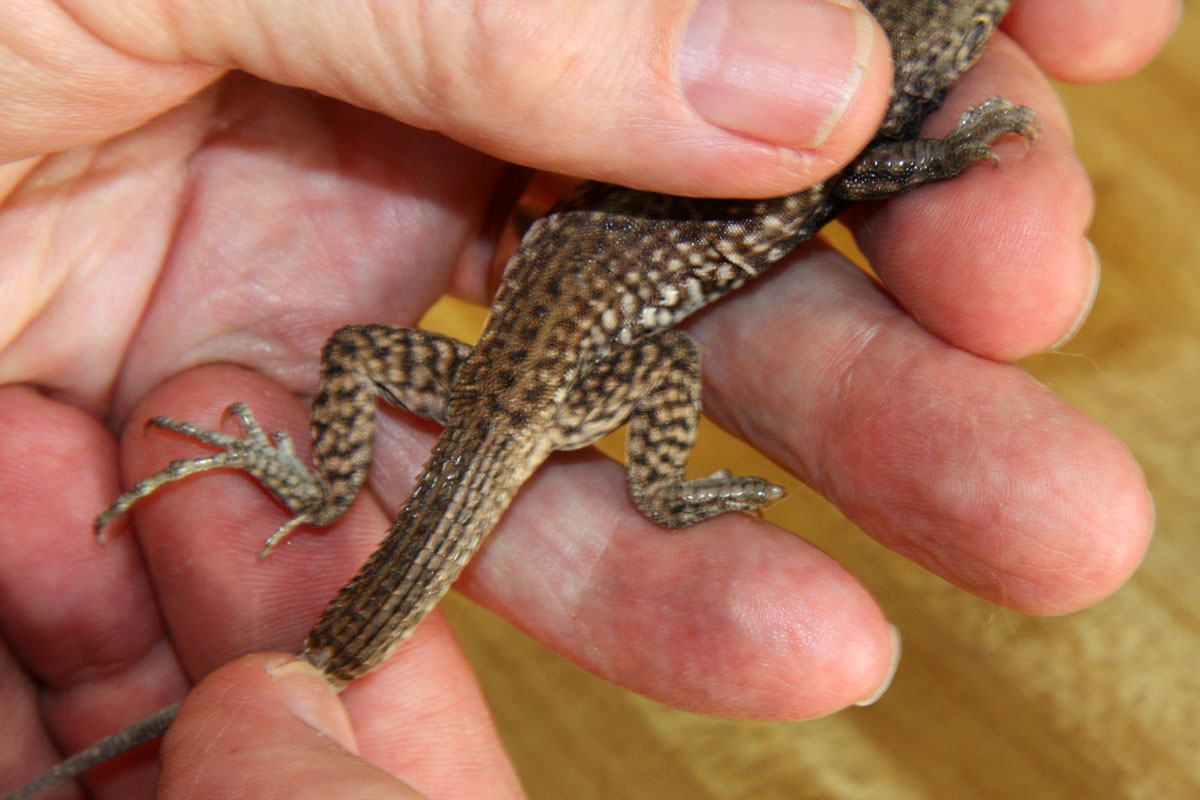
Our cats are an endless stream of entertainment for us, even better than TV sometimes!  And they love showing off, especially when they are proud of their achievements.  Just the other day Hannah came in making some weird sounds, sort of a "HHmmmHH", trying to get our attention.  Well, she had a pretty good-sized lizard in her mouth, about 18cm long.  She put it down, the lizard took off with about 3 cats and 2 adults in pursuit!  Now normally lizards sort of "spin their wheels" on the kitchen linoleum, going full speed but pretty much running in place, but this one actually made some headway.  After getting close a couple times, I finally caught him before he got behind the computer desk, to be lost forever...  He seemed to be in pretty good health, and before releasing him in front of the house, where the cat density is lower, Melinda got the camera out for some closeups.  Don't you just love the little lizard claws?

This fellow had seen better days, but survived to tell the tale of his close escape.  Most lizards can shed part of their tail, the wriggling segment sometimes distracting the attacker long enough to escape.  This fellow's had lost his tail at some point in the past and it was in the process of regenerating when Hannah found him.  He also had some toes on one of his hind feet gnawed off.  Don't know if Hannah is responsible for that or not.  Both these defects are seen at left.


I didn't have much luck doing a search on the Interweb identifying her, but I did notice that amateur astronomer friend Sam Rua had a large number of reptile images on my Google search, so I e-mailed him with the above pictures.  Ten minutes later (!) came the reply - Tiger Whiptail, Aspidoscelis tigris!  That's why Hannah was so proud - caught a tiger!  She tired quickly of having her photo taken, so I released her in our front planter and a split second later was gone, but not forgotten!  Meanwhile, the cats sit and watch the back yard fence for any wildlife brave enough to enter through the cracks...