Sunday, March 31, 2019

Hints of Spring!

Am back to the Midwest at "Ketelsen East" to enjoy the emergence of Spring! It looks like I arrived with perfect timing - there are mostly shades of brown and gray, trees bare, temps still definitely on the cool side after Tucson temps have been flirting with the 90s! But there are definite hints that the new growth of Spring isn't far away! Just a couple meters from the house, in fact, growing up in bits of asphalt piled high by the snowplow clearing the roads in my absence, are some beautiful crocus flowers. Shown here at left is the biggest plant - barely reaching 3" (8cm) tall, so I needed the macro lens for these shots!


And as soon as I shoot the yellow crocus above I notice some slightly smaller white crocus too! I had to check with my neighbor Elaine on the ID - I've not sure I've been early enough to catch these beauties in years past. She claims she has some purple crocus in her yard, but I've not been there to catch those yet.  I like the gentle pale yellow trim on these white flowers - they were kind of hard to spot with the brown grass background, but there were quite a few plants scattered about.


As I mentioned, the temps have been cool, and the flowers close up as the temperature drops as sunset approaches. The photo at left (same yellow crocus as above) was taken shortly before sunset, and today, with temps never going much above 40, I think they stayed closed all day! Lows tonight will be 24, so hope they survive the hard freeze tonight - will check on them tomorrow...

Note that most all of these photos were taken with the macro lens, and in order to extend the range of sharp focus at these considerable magnifications, several shots taken at different focus settings were taken and combined in Photoshop. Known at focus-stacking, they can considerably extend the range of sharpness in these photos...


In my searches for other things just poking out of the ground, I thought the bud at left might be the first sprouting of my beloved Trillium, that I spend time shooting every year. But from my first discovery of these sprouts (only about 1/2" tall) to today, they are starting to reveal their blue colors - Blue Scilla, which will carpet my yard blue in a week or two! Click on the right image for the full-size that shows the appearance of blue colors... Will try to keep an eye out for new members of the Spring population!

Sunday, March 17, 2019

Its a 3D Solar System!

This is a 3D stereo post - so dig up your red/blue anaglyph glasses! You DO all have some, right? I've got a few hundred pair to give away, but can't afford postage to send them all out to you - let me know how to get them to you if you are lacking!

Anyway, this is a 2-part post! A few stereo pairs from a recent trip to Mexico and a recently released 3D data set from a spacecraft that visited a comet! The later is really incredible, and I had taken a few from the Mexican beach, so decided to combine... I hope you enjoy them. BTW, You REALLY need to have a pair of glasses near your computer! They are often used to present images from NASA craft and are also used on APOD frequently too!


The beach shots are all taken by me using a single DSLR camera (Canon 6D), and in this case, a macro lens was used for the close-up, and these first two shots here were taken with the normal kit lens. In each case, 2 images were taken with a shift between them to provide a baseline. When each is viewed with the appropriate eyeball, 3D stereo results! That is what the red/blue glasses does - allow you to see each image with just one eye for your brain to reassemble. The separation for the normal lens (above) is a couple inches, about what your eye is. For the macro, the distance between photos is less because of the magnification involved. Likely a couple centimeters is sufficient! The 3D really brings out the structure and form of objects - MUCH more clearly than a single 2 dimensional image!


One of my must-reads on the Internet
every day is a stop by the Twitter feed of planetary scientist Emily Lackdawalla. She has very similar interests to my own, and daily reposts links that I'd love to look at, from planetary and astronomical exploration, to pushing her girls into STEM, and seeing what is outraging the working scientists of the day. It is ALWAYS worth a look around! In her efforts to clearly explain the intricate details of planetary missions, both of the robotic spacecraft and the resultant data collected, new data sets are often revealed. Such was the case last week when she reposted a set from a couple years ago of the Rosetta comet mission to the comet 67P/Churyumov-Gerasimenko. It is an incredible data set, with details of distance, time and where on the comet the view is located. And the 3D views of this foreign landscape (a COMET!) is just incredible! There are over 1000 anaglyph stereo pairs presented, these are a couple of my favorites. I love both the wide-field ones here, with mighty jets shooting material outwards as ices melt in sunlight, as well as close-us of mighty ridges and caves that likely hide the jets in the deep shadows...


So take these in and be amazed, then go
to the link below to browse away the day!


Click here on this link to go to the Rosetta 3D anaglyph image collection!

Desert Snow!

People have many misconceptions about the Southwestern Desert.  It is NOT like the Sahara with seemingly endless dunes of drifting sands like the Sahara!  It is actually  quite a diverse ecosystem with plants and animals found nowhere else!  And while drier than where you can grow corn in the Midwest, Tucson gets about 10" of rain per year, and actually, local Indians used to grow corn crops since half our rain comes in the summer rainy season!

We also have a secondary rainy season thru the Winter, and occasionally, storms that pass through come down from the Gulf of Alaska, resulting in below-freezing temperatures and often snow up in the higher elevations (over 9,000 feet) ringing Tucson! Tucson itself, relatively low at 2500 feet elevation rarely gets snow, perhaps once every two years or so. But a couple weeks ago, it happened! I had a doctor's appointment and witnessed that it snowed in Tucson for over 3 hours, but because the ground was well above freezing, we didn't get any accumulation... The flakes came down in huge conglomerations or clumps - I witnessed a few over 2" diameter! When they are that large they land with a splat! The view of my "Old-Man Cactus" at left is affectionately called "Bernie"!


The next day, up for a drive, a friend joined me for a road trip up to Globe about 100 miles north of Tucson. While a drive to 9,000 foot Mount Lemmon would have been more impressive, the road was likely still closed to keep people out while it was being cleared. The road north moves around the Catalina Mountains, climbing to 5,000 feet going through Oracle, then dipping into the San Pedro Valley before climbing another snowy range before descending into Globe, an old Mining town... The day dawned perfectly clear, transforming the view of the Catalinas to the north of town quite spectacular. At left is the view from the south, with saguaro cacti dominating the foreground. By the time I circled the Catalinas to pick up my friend, the view of the north side (at right) down a residential street was even more spectacular!


Since Rancho Vistoso (my friend's neighborhood) was much higher in elevation than Tucson, we saw snow all the way to the 25 miles to Oracle. From there the elevation fell down into the San Pedro River Valley, so the striking photo at left, taken from just past Oracle, shows snow where we were, the snow-free valley, then the snow covered range on the other side.


It had been years since I'd been on highway 77, so much of it was new to me, including a new Indian Casino - Apache Sky, which I've just been hearing about... Of course, climbing the next range brought a new appearance of snow and there was a good 12" or 14" where the elevation peaked! Unfortunately the snow plows hadn't come back to clean off the pulloffs, so we parked dangerously close to the highway and waded through nearly knee-deep very wet snow!


It was fun, and all the tourists we saw were having a good time playing in the snow. Interestingly, we helped an elderly woman lay down on the snow and make her personal snow angel, shown at left. She needed help getting up too, and we took a group photo of their trio with her creation...

The trip down to Globe for a side trip to a rock shop and a quick brunch at a burger place was anti-climactic by comparison. We made a beeline for home to make an appointment, but was a fun day to play!

Thursday, February 28, 2019

Look West!

Finally, some clear skies in Tucson! And for the first time, I could go out after sunset and look for Mercury in the evening sky. Almost due west about 45 minutes after sunset, it is the brightest star-looking object just above the horizon! At left is how it looked from the cul de sac in front of my house... It will continue to be visible for about another week before it starts diving between us and the sun towards inferior conjunction on March 14th.

To the casual observer, it would seem there haven't been any planets in the evening sky, but you would have been wrong! Mars, the next planet out from us, is still in the western sky, but is fading and far from striking, other than the orange glow it still maintains. Passing opposition and at its best over 7 months ago (!), it is a shadow of its former self. At right is a wide shot showing both Mars and Mercury, both well below the Pleiades star cluster a good 45 degrees or more up as it gets dark.


But as they say - But wait, there's more! The planet Uranus is also in the right photo above! It is MUCH fainter than Mars or Mercury, and less obvious too when shooting from town in a 10 second exposure! The cropped portion of the above shot shows the center part of the image, and shows Mars and Aries, and what I THINK is Uranus, just above the limits of detection... It is so faint that the normal green glow it sometimes displays isn't visible. But then, it is almost 2 BILLION miles distant from us at the moment...

And just one more... As I turned to go back into the house, There riding high was mighty Orion, and how could I leave without a quick shot of it too? So at right is my front yard with Canis Major and the brightest star (visible from Earth besides the sun) Sirius is Orion with its prominent 3 belt stars. We've had so many clouds lately that I've needed to catch up with what the sky looks like again!

Tuesday, February 19, 2019

Dean's New Implant!

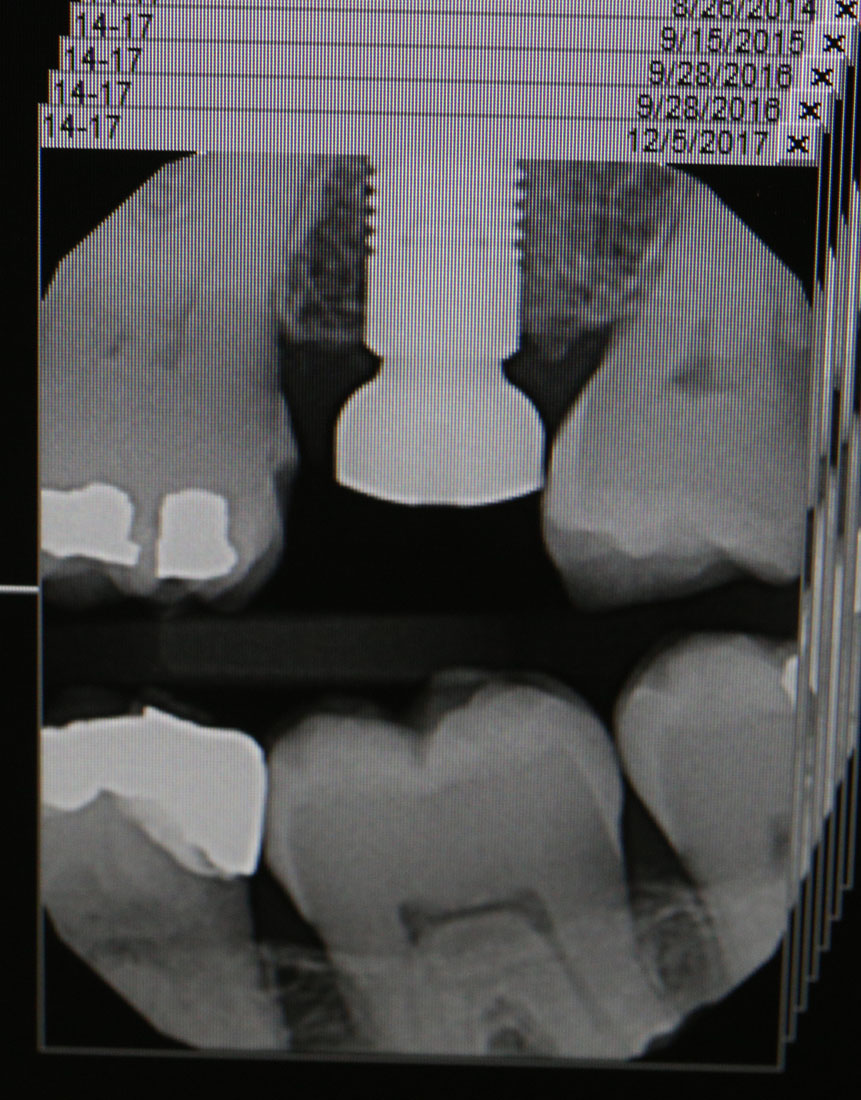
I got a new tooth implant a couple weeks ago. The exact need and timing is sort of lost in the blur of time, but I believe the cause was that I had a cavity under a crown (this more than 2 years ago!). Dr. Chang cleaned out the cavity, but there wasn't enough of a stump to fasten a new crown, so the root was extracted and bone graft installed (by oral surgeon). I vaguely recall that because there was a bleeding issue (since I'm on blood thinners), and had to go in for assistance to stop it. Eventually it took, and a few months later, the titanium threaded insert was installed - all was well. I sort of forgot about it, but a couple months ago, Dr. Chang reminded me we had it hanging over me, so after a session with a mouth full of modeling putty, a couple months later I had a new tooth! That is my always-smiling Dr. Chang at left, and at right is an x-ray of the titanium threaded insert and bolt that was in place for something over a year and a half!


The mouth of modeling clay was new (to me), but he took an impression of the top and bottom row of teeth (one at a time) to get a near-perfect model of my teeth. From that, a new replacement was evidently machined or cast and fired in a kiln with a hole to take advantage of the threaded insert. Shown at left is one of the molds with the implant to go at right. The new (pricey)tooth is shown at right before installation - note the hole the bolt goes through to clamp it down.


The modeling clay was used to make a complete cast of my mouth, and was used to create the new tooth. My upper bite is shown at left with the new tooth in place to check for fit.

The implant is fastened in with a titanium bolt, not to different from what you would find in a hardware store - your standard Allen head bolt, but not quite! The sterile one to be used is still in its bag at right.


After the snug check in the plaster cast above, he tried it in the real gap in my mouth. It went in, but interesting he couldn't get it back out! He didn't really panic, but had wanted to remove it to polish it up some, perhaps take a little off where it was binding. Not wanting to damage any neighboring teeth or the implant, he eventually left it in place and placed the bolt in place - yes, using an official torque wrench at left! It really is a little Allen head hex bolt! After proper torque was applied, he filled the drive hole in the bolt with a little UV-curing cement, scraped it off level and it was done! He took one more x-ray of the finished product for the historical record, shown at right... Eventually the gaps will likely distribute more evenly, but I still can't get floss down both sides of the new one. I have an unrelated cleaning scheduled Thursday, so they will likely take another look at it then... For now, all paid for and all the ivories are "in the pink"!

Monday, February 4, 2019

My Travels with Lillian!

Who the heck is Lillian, you ask?! Well, there is a story involved, of course! I met Lillian back last July at my nephew Mitchell's wedding in July. That is him with his beautiful bride Anna there on the left. Though you can't see it in the photo, evidently she has a green thumb and as gifts to each guest, she sprouted succulents and had a variety at each table to choose from, all growing in white milk-glass containers... Succulents are easy to grow, I hear, and here we are 7 months later and mine is still alive - I've named her Lillian!

After the wedding, wanting to keep her in Illinois, I left her care and feeding with a girlfriend in Chicago, not sure if Lillian would survive if she was abandoned for a month or two at a time until I returned to "Ketelsen East". Girlfriend and I have since parted company, so I regained custody this last trip to Illinois, and 3 weeks ago as I transitioned back to AZ, Lillian came along! That is a close-up her at right.

For the first time in a decade, I had driven up to the Midwest in the big van. There were a number of things to haul, and some to haul back. Since we'd parked the Toyota Highlander there, it is so much more simple to fly and catch a ride to a waiting car - it has been great! Driving it makes you realize why we do it that way! 1,700 miles in 26 hours of driving translates to a good 2.5 days on the road, and certainly with the van, you still can't beat the price of half a round-trip ticket. But I justified it with the hauling I needed to do. So as my visit ended, and a winter storm approaching, I left with relatively short notice for the return. Did the laundry, secured the house... Lillian's vase didn't fit in the cup holders, so she rode shotgun, with seat belt fastened, packed with my gloves and a newspaper to make sure she was secure...

Travel conditions were perfect - cool temps, about 40 degrees, and perfect blue skies. Quickly transited Iowa - little scenery with the crops all in... There was a brief scenic event as I passed Brooklyn (yes, there is a Brooklyn, Iowa), where there were a previously unnoticed windmill farm next to Interstate 80!

We made it to Wichita that first evening, and it was supposed to be below freezing, so brought Lillian into the motel and tucked her into bed as I unwound with a little TV...

Overnight the rain moved in, but it was supposed to be snow and ice the next day, so headed west. Drove through rain all day. Very nearly ran out of gas hoping to find cheaper gasoline in Liberal Kansas - engine died 50 yards from pumps. Fortunately, waiting a minute it started again to get enough momentum to coast up to refill... Rain lessened across Oklahoma and Texas, and mostly stopped by the time I got to Tucumcari. We stayed on highway 54 that bisects south across New Mexico, and as sunset approached, the clouds turned intermittent and made for some scenic driving! At right are some small mountains or hills from what must be the previous storm that had gone through...

As we continued to drive south towards Alamagordo, the second night's stop, the skies almost cleared, and had a beautiful sunset! With the destination in sight though, I only stopped once for the post-sunset lone cloud shown at left with some virga (rain that evaporates before hitting the ground) and beautiful colors against a clear sky.

Even before checking in to the Motel 6, I found a Chinese restaurant for dinner, then relaxed before the final push into Tucson the next day.

I was hoping to pause at White Sands National Monument the next morning - thought Lillian would look good with her milk-glass vase against the white sands, but alas, the government shutdown had resulted in locked gates blocking access! A bit later we did get an impressive view of the Organ Mountains (so named because of their resemblance to a pipe organ, I believe), as we approached the pass to cross them to Las Cruces, NM...

As we crossed southern New Mexico, still 50 miles east of the AZ border, I noticed something white far to the west! This was still 25 miles east of Lordsburg, and I was confused for a bit what it might be - then it dawned on me! It was the snow-covered, nearly 11,000 foot tall mountain Mount Graham! I did manage to grab a snapshot of it at full zoom. I calculate it was still just over 90 miles away! Note the slight orange cast due to the long path-length absorbing or scattering more blue light...

Less than an hour later and we approached Arizona! Lillian offered to drive for a bit and after 2 full days, I was glad to let her take the wheel! I did manage to capture the moment we passed the border!

Just over 2 hours later and we pulled into Tucson, arriving about 2pm. It was nice to get out from behind the wheel and to be where it was a good 20 degrees warmer than "Ketelsen East"! Oh, and the day we arrived in Tucson, central Kansas and Missouri DID get nearly a foot of snow, so I got through it with a day to spare! I think it will be a while till I drive again... It was nice to set your own schedule though - not be dependent on reservations made perhaps 2 months in advance! Lillian seems happy and cats seem to ignore her, so all is well!

Thursday, January 31, 2019

Cranes!

This last weekend I made my first trip to Whitewater Draw this season. Normally we would do a couple trips per season, so there are lots of posts and photos to peruse from years past. In recent years the sandhill cranes that over-winter seem to be dropping in numbers, perhaps associated with the lower levels of water there. Whether it is a natural-caused issue or if they aren't pumping as much as in the past, I'm not sure. In any case, there is still a live web-cam for viewing (and hearing) the cranes, located at a site run by AZ game and fish...


It is always a nervous time driving down the access road - what will you see? Often times arriving in the afternoon is a gamble as most of them fly out into local crop fields to feed during the day and only return around sunset. In my opinion, I love arriving mid-afternoon and waiting to watch (and hear) them upon their return!  As I parked, an eerie sight was beheld - lots of cranes, but was strangely silent! They often cluck and talk to each other, but on Sunday it was almost reverently quiet... There were lots of people - I came a week after the "Wings over Willcox" celebration on purpose, when it was likely even more crowded. Taking the last parking lot close to the viewing areas, I mounted the 500mm on the tripod and took the couple hundred yard hike.


As I walked up the trail, was able to squeeze off a few shots including a variety of birds shown at left above. Besides the grey and buff sandhill cranes, there were the almost pure white snow geese, and the Northern Pintails grazing in the shallow water. At right I caught a few of the snow geese taking off from that location - the last of the bunch we saw that afternoon!

While shooting the cranes standing on the ground is like "shooting fish in a barrel", they look a lot more graceful as they fly. They can also pass appreciable closer while flying by than standing at a safe distance. Of course, catching them flying introduces a whole new set of issues - focusing and tracking them as they move! Fortunately the big 500mm lens has pretty much instantaneous focus, and will even take out any unsteadiness as you pan to track them! As a result, I can usually get a couple frames like that at left. My criteria for sharpness is if you can resolve the pupil of their eye! Fortunately, I also like shooting the cranes passing by local landmarks like nearby mountains, in which case, no tracking needed. At right are a flock of them passing by a favorite landmark - Cochise's Head, located north of the Chiricahua mountains. Also visible are cars on the local access road and irrigation equipment in nearby fields...

Speaking of a sharp eye pupil as a standard of quality, I noticed something else this trip. In shooting some of the nearest cranes to our observation stand, one of the cranes looked bizarre - it appeared to have NO pupils at all! Now over ALL the sandhills I've shot over the years, they all appeared to have the yellow pupils that I thought were standard. Yet, as shown at left, the bird on the right appeared to have some eye disease or something! Strange, huh? A minute later I took another shot, and modified the image so both birds were magnified and moved next to each other. You might be able to detect in the image at right that, in fact, it does have pupils, but the eye color is dark brown - weird!


I must say, though, that while all sandhill cranes look regal in the above photos, that when they are looking straight at you with both eyes visible, they look a little what, dorky? I don't know what it is, but it makes them look a lot less intelligent, almost like an idiot caricature of themselves... Maybe its just me!

There were other birds near us we got to see up close. In years past there were at least 2 large shallow ponds that attracted many water fowl that mostly have disappeared now with the low (or no water in the ponds!). Goodbye to Mergansers, pie-billed grebes and even the American Coots - none seen this year! One of the few additions to the monoculture of Sandhills were Northern Pintails, as shown at right. They were near us, mostly heads underwater grazing in the shallows. In this shot the male is below and the female above - an amazing difference in coloration and pattern!


I prefer a clear sky while visiting Whitewater - illumination and shadows seem sharper. But there were some high clouds that moved in on Sunday, thicker as sunset approached. But as it will sometimes do in AZ, it suddenly thinned as the sun sank behind the mountains to the west. Suddenly there was a spectacular coloration to the west, and a phalanx of photographers gathered at the west side of our platform!

At first I took a shot of the sunset, at left. After that, it was fun to get profiles of the photographers at work shooting birds and sunset together, as shown at right.


I took a few more, but my favorite is the close-up shown at left, showing a photographer in close profile, with another telephoto intruding at right barely seen in the dark part of the sunset...

Shortly after this suddenly a din erupted as cranes seemed to converge from all directions! It was just getting dark enough that imaging them was very difficult as the coloration and lighting was dim to get their silhouette, and it was mostly their noise that assaulted the senses! I did manage to get the shot at right, with a profile of hundreds of cranes in the last light of the twilight...


Finally darkness descended, but I had one more trick up my sleeve! Just having obtained a flash while in the Midwest (unfortunately, the full-format canon 6D has no built-in flash) I used it to reach out to a flock of cranes gathered perhaps 150 yards away. With a high ISO (3200) fast aperture (F/4) and full flash power, I got the shot at left. What is most amazing is the cats-eye effect (same as red-eye in human subjects in a darkened room). The light from the flash is focused in their eye, and reflects back out like the glass micro-spheres in reflective road signs. Every crane that had an eye pointed in my direction (at least one had both eyes visible, and another duck or waterfowl) showed the effect! Always fun stuff!

I'm hoping to get back again before March arrives and cranes head north. Even though a mid-afternoon arrival requires sitting and waiting a few hours for sunset to arrive, I can think of fewer locations that are as nice to just "chillax" for a long period of time!