Showing posts sorted by relevance for query Bad dog. Sort by date Show all posts

Sunday, February 14, 2016

Mining the Archives!

We've not been out of the house much the last week other than visits to the oral surgeon and cancer center, which generally make for boring posts, so have been reviewing some of the photo archives to see potential post material I've missed lately. So not really timely, but this one is recent...

Just 2 months ago (13 December), on my way back from watching the sunset behind Kitt Peak from the Mount Lemmon Highway, I paused at Babad Do'ag ("Bad Dog" as I sometimes refer to it) as I frequently do. About 3 miles up the road to Mount Lemmon, it has a great parking lot and overlook with a spectacular views of the Tucson Valley and beyond. It is where I've shot images like at left with Kitt Peak in the far distance in silhouette behind the lights of metropolitan Tucson.


But there are other targets, including other observatories! To the south across the Tucson Valley are the Santa Rita Mountains, with Mount Wrightson as the highest peak on the left at about 9,500 feet. Mount Hopkins, about 1,000 feet lower at 8,500 feet right in the center of the frame at left is the home of the Multiple Mirror Telescope (MMT). Originally so-named because its innovative design combined the light-gathering power of 6 individual smaller mirrors each 1.8 meters (72") diameter, now consists of a single primary mirror 6.5 meters (256") diameter. I've got a connection to it as it was the first large mirror over 3.5 meters I polished the Mirror Lab where I work. A before-and-after image of the telescope from the website above is shown at right. People ask why it is still referred to as the MMT - my thought is that most large telescopes consist of primary and secondary mirrors to get the lights to the instruments, so "multiple" still applies!


Both of the above photos were taken on 13 December with my 200mm lens - the Kitt Peak shot a panorama put together from several images at 200mm focal length. The Santa Rita's shot was a single-shot taken with the same lens set to 110mm. Mount Hopkins at about 40 miles distance, is a little closer than Kitt Peak's 54 miles from "Bad Dog". At left here is a panorama put together from 8 images taken with the Meade 80mm F/6 APO (480mm focal length). Shown at the Blog's 1600 pixel limit, you can spot the squat building of the MMT atop Mount Hopkins at right center. At left is the frame showing the MMT at nearly full-resolution. Not a lot of details can be spotted compared to distant views of Kitt Peak, but you can see how the conical mountain profile would provide smooth laminar airflow over the peak, which is supposed to provide excellent seeing at MMT. There are actually a number of smaller scopes making up Fred Lawrence Whipple Observatory near the peak at Hopkins, but they aren't visible here, since they are located on the south side on a saddle below the peak.


Finally, before leaving "Bad Dog" that evening, I took another set of images with the Meade scope in full darkness to see if I could still capture the mountain profile. Sure enough, with 30 second exposures, it can be spotted, since the profile is backlit by the light glow from Nogales, AZ another 30 miles to its south. The bright lights are either from the drag strip or the Pima County Fairgrounds near Houghton south of Interstate 10, about 20 miles away (halfway to MMT!).  Interestingly there are no star trails visible, though there is a lot of extinction that close to the horizon...  Even 30 seconds at F/6 failed to catch any. 

This is the second post mentioning MMT or Mount Hopkins. The last was from 2009 (!) when Melinda and I took part in a star party for the public at the base camp at the base of the mountain. I've not been up to MMT in over a dozen years - might be fun to take it in again since going digital!

Saturday, November 14, 2015

"Bad Dog" Sunset

It was such a lovely afternoon yesterday, and with Melinda feeling a little better every day since she is skipping the chemo this month, we battled rush-hour traffic for an evening drive! I had seen on some planetarium software that the post-sunset skinny crescent moon would be low in the southwest somewhere near the silhouette of Kitt Peak, so we headed east towards one of our favorite outlooks, "Bad Dog" (in actuality, Babad Do'ag - the native name of the mountain range north of town, "Frog Mountain"). Similar to "A" Mountain, it is paved to a nice parking lot a few hundred feet above the local elevation, though instead of overlooking the downtown Tucson skyline, you have a panorama view of the entire Tucson valley from the south to the west.

Traffic was bad enough that we missed the sunset, though we watched the last golden rays disappear on the peaks and witnessed the Belt of Venus rising as we sped down Tanque Verde. Missing the sunset was ok, almost expected, and we arrived pretty far into twilight. The views are such that almost anything you take pictures with comes out great, so had brought a number of lenses from the TEC 140 to the kit lenses for the camera. Since the former was longer to set up, I did it first and captured Kitt Peak against the twilight. First thing I noticed was that the seeing was quite poor. Granted we were looking through 60 miles of atmosphere, the stiff surface breezes were doing a number on the image sharpness.


Undeterred, I went on - setting up another scope, the smaller Meade 80mm, which at F/6 has less than half the focal length of the TEC scope, and corresponding wider field. And to make things more interesting, I shot some images with a vertical format, shifting between them to make a panorama. Shown at left, this is the result of cropping somewhat from the panorama made from 7 individual frames. Of course, I could have shot it with a single 180mm lens or so, but I like having the higher resolution the longer focal length provides, though the blog limit of 1600 pixels puts a crimp on displaying the full resolution images. Granted, with the poor seeing, a single exposure with shorter lens wouldn't have been a bad idea... More on that below...

Next up, since the TEC was still set up but the lighting behind Kitt Peak was dimming, I took a series of shots of the "Tucson skyline", such as it is. This is built up from 3 exposures of 4 seconds duration each and shows the University of Arizona area, from the Arizona Stadium at left to Aloft Hotel at right a half mile to the north. From Babad Do'ag, it just happens to lie on the same path as Tucson's downtown area, then up beyond that you can see housings up what I suspect is the Star Pass area up west into the Tucson Mountains. There were some lights on in the stadium for preparations for a game today, and also there was an NCAA Soccer match on the field to the south, thus all the lights. There also appear to be other lighting centers on campus, and I'm thinking it might have been a pep rally for today's football game.


Finally, as it got a little darker, the crescent moon sank low enough to get it into a picture with a normal camera lens. So here I can make the comparison between a single wide shot or panorama from several shots. At left is a single shot with my kit lens for the Canon XSi, set to 60mm focal length. At right is a 4-frame panorama with the same lens set to 70mm, and combined with Photoshop. Unfortunately, with the blog's 1600 pixel-wide limit, you can't really tell the difference between them, so these likely look pretty identical. Certainly with the original files, the panorama was 8500 pixels wide and the single shot only 4500, so the panorama should be sharper, all things being equal!


Even when you go to the full-camera-resolution, the difference is hard to see, but perhaps detectable. At left is the cropped image at Kitt Peak both from the panorama and single shot with no subsequent processing. Since the panorama was taken at a little longer focal length on the zoom (70mm vs 60mm), the image looks larger. Also, the single exposure was a 4 second exposure at F/5.6, while the panorama was taken for 10 seconds at F/7.1, pretty much equivalent. Looking at the 4-meter and 90" telescope profiles on the right side of Kitt Peak (the flat-topped mountain), I think the longer focal length helps pull out a little more resolution. If more exposures at longer focal length were taken I think the difference would be more visible...

We didn't wait for moon set - it would have been against a black horizon anyway, so packed up and headed home, stopping at Pinnacle Peak for a steak dinner on the way. A fun evening and a chance to get out of the house!

Sunday, January 4, 2015

An Alignment Scout Trip!

I'll bet you thought with the solstice sunset alignment with Kitt Peak 10 days ago that that stuff would be over for the season, but you would be wrong!  Again, based on my daily astronomical on-line reading, I "discovered" that in a week or so Mercury and Venus would have a lovely close conjunction in a week or so.  Knowing that Venus is in about the right spot to catch it behind Kitt Peak (again!) from the Mount Lemmon Highway, it was time to hit the road for another sunset!  Also, it is about the last field trip I'll be taking with the ole' Ford '88 van with the smashed-in rear end.  I take it and sign it over to the insurance company Wednesday...

Anyway, I made it out to "Bad Dog" over look (Babad Do'ag  for sticklers...) at about milepost 3 on the Mount Lemmon Highway just in time to catch the sunset.  Shown at left, it went down about 2 degrees south of where it needs to intersect the Observatory.  According to my calculations, for those who might want to observe the alignment of the sunset w/Kitt Peak at this lower location, rather than the one near MP9, Friday the 16th is the day to be at the "Bad Dog" overlook.  It moves much more every day than near start of Winter, so you only get the one chance on this side of solstice.

But I didn't come today for the sunset, only to get there before it got dark to get setup!  BTW, with snow atop Mount Lemmon, the highway was packed with cars heading down.  Luckily I had this lower overlook mostly to myself most of my 80 minutes there.  Venus popped out shortly after sunset, and about 10 minutes later, Mercury was spotted below the brighter planet.  Still a few degrees apart, by this next weekend they are less than a degree apart.  Waiting for it get dark enough to have it stand out from the sky and get a little lower with Tucson's city lights as well, it is shown at left.  That is Venus above and Mercury mostly below it and a little to the right.  I waited another 10 minutes to catch it just before Mercury set behind the Quinlan Mountains.  While the sky is darker, the rising Full Moon behind me helps light up the "A" of "A" Mountain, and in fact, the telescopes atop Kitt Peak have the pale illumination due to the moon.  In the next few days, Mercury will rise up nearly to the height of Venus and both will move to the right a couple degrees, so should be a pretty pair directly above the Observatory.  Perhaps I'll see you there!

I also had time to take a 5-frame mosaic of the pretty lights of Tucson with Kitt Peak in the background.  Down-sampled here to the 1600 pixel-wide maximum, you can't see a lot of the details of the original mosaic, but you can perhaps see why I do them to keep the details of the original files...  I also took a time-lapse of the twilight including the swiftly moving clouds...  Perhaps I'll be doing something with that soon.  I guess I'm just easily entertained!

Tuesday, November 27, 2018

Another Post-Thanksgiving Outing

It was such a perfect Thanksgiving weekend - Temps in the low 70s and a perfect blue sky. On Saturday was the final football game of the year - archrival Arizona State was in town for the big game. If AZ wins, they qualify for a bowl game, lose and they are done till next Fall. Can't get much more dramatic!

I took the opportunity to do a little road trip to "A" Mountain, otherwise known as Sentinel Peak, located about a mile to the SW of Tucson's downtown area. It has a paved road to the peak, a few hundred feet above the desert floor and the view extends from south to north - an expansive view that is popular all day long!

I chose to set up my TEC 140 refractor and take some photos of my favorite landmarks, and with Arizona Stadium a mere 3 miles away, used it as a target to evaluate a 2X converter (doubled the focal length, thus the scale of images). At left is a photo taken with a 50mm "normal" lens with my fave targets labeled.

I've used this telescope to image AZ Stadium before. Seeing effects (atmospheric turbulence caused by mixing of different temperatures of air) usually limit the sharpness at 3 miles distance. But still, the scope is ALMOST sharp enough to recognize people from 3 miles! Shown here are the full frames of the Canon 6D of the stadium view. Clearly seen is that in the view with the 2X converter at right, the image is larger and field of view is narrower. The real question is whether use of the converter provides any advantage, or can you just enlarge the straight image in Photoshop...

Of course, the real limitation on this blog is that images are limited to 1600 pixels wide, while the camera has almost 5500 pixels across the image! So just showing you the full image above you are losing a huge amount of resolution because each pixel there shows an average of almost 16 pixels in the original image (4 across and 4 high).

So here is the answer. Shown here at left are full resolution crops from single images from each configuration. The fields of interest are the same - the 2X converter version below is on the left side without the converter so you can compare directly (taken a few minutes apart, 2X later). It looks fuzzier, but again, because the scale is doubled, is resolution any worse? I think the answer is no - the bowl games played are about equally legible, as are details in people and clothing being worn. I think both are limited by the atmospheric turbulence - the effect can be seen in the horizontal white line in each - wiggles seen in it is caused by turbulent air mixing at these large magnifications... Oh, and by the way, I went to some length to minimize vibration - used a 2-second delay after pushing the camera button, and also locked up the view mirror to minimizw "mirror slap". So it is a wash for distant objects to use the converter or not. Perhaps closer objects less limited by "seeing" might work better with the 2X converter...

I then moved to a few of my other favorite targets. At left is the old Pima County Courthouse, with its distinctive tile domed roof. It is interesting that it is seemingly surrounded by newer boring architecture...

Also photographed, but not detectable by eye mid-afternoon was the "window" of Window Rock. A good 16 miles away from my "A" Mountain observing location, it is visible by eye from Midtown when conditions are right - preferably evening or morning twilight. Here the scope makes shooting it simple!


I also did a 10-frame mosaic past AZ Stadium up through the NE side of town. Combined together in Photoshop it shows the stadium, Catalina High School just above and left of the stadium (in truth about 3 miles past it!), Tucson Medical Center upper left of stadium, then the Mount Lemmon Highway which leads up the mountain in the far distance on the NE side of town. Right about where the road disappears, "Bad Dog" overlook can be seen - another favorite lookout of mine! Of course, here the mosaic is only the 1600 pixel limit wide - was more fun in the original nearly 15,000 pixels wide with the full camera resolution...

And one more shot are some of the homes creeping up the foothills of the Catalinas. I think these are about 12 miles away and you can see how they get permission to build right next to the National Forest boundary considerably up the slope of the foothills. Good thing they don't get much snow and ice here - can you imagine climbing those hills in slick weather?!

After an hour taking in a shooting the view, I headed home. It was an exciting game - the home Wildcats hanging on to a thin lead, then at the end the "Scum Devils" overtook and won the game by a single point! Next year!

Saturday, June 4, 2016

Sibling Visit!

We got back safely to AZ on Thursday evening (actually Friday morning), only 3 hours late or so - no reason from the airlines - just the way it is these days! At least they didn't cancel the flight like a year ago, stranding us in Chicago for 2 extra days!  We found upon arrival that Tucson had just broken 100F for the first time Thursday, and is supposed to be something close to 110F over the weekend! It makes that final day in Chicago with a 77F high temp look mighty fine! But anyway, here we are back in Tucson...

And I'm still catching up on May posts even though the calendar sez June! Way back 3 weeks ago, before we even left for the Midwest, we were paid a visit by my sister Linda and her husband Lauren. He had never been to Arizona and she had not since she helped care for me after my first aortic valve replacement surgery 12 years ago, so figured it was a good time for a visit. They camped out at a nearby hotel and spent a few days with us, then took off to the Canyon and northern Az while we flew off to Chicago, to see them up there later in the weekend!

Anyway, we had a great time - I got to impress them with a tour of the Mirror Lab where I work, and they took an early morning tour of the Desert Museum on their own while I got some work hours in. Otherwise we spent lots of time and meals together and tried to give them a taste of Tucson. Lauren was impressed with the "dry heat" and how he never sweated with temps in the 90s, as it evaporated as it was supposed to once he got away from the humidity of Illinois. He was also impressed with the view of the mountains circling the city, so what better day trip to take than a leisurely drive up Mount Lemmon for a late lunch at the Iron Door Inn up by the ski slopes of the mountaintop? While a decent host, I didn't play much of a photographer, so don't have a lot of images of their visit other than the Mount Lemmon trip... Our first stop was at "Bad Dog" (actually Babad Do'ag) overlook shortly after ascending the slopes. That is where I pointed out all the saguaro flowers we could see from that viewpoint, yet another mile up the road and there were no saguaros to be seen at the slightly higher elevation...

Another 10 miles and we got to "Windy Point", another fine place to stop for bathrooms if not for the view. While I've not been there for ages, Linda took off scrambling over the rocks like a native, so I tried to stay within range and took a few pictures. We finally got to a point where you couldn't go much further, a great viewpoint of the Tucson Valley and the mountains beyond. Of course, knowing me, with a willing model that would hold still for a few seconds, I took a stereo pair - at left presented as an anaglyph - so get out your red/blue glasses to view the image at left. Linda told me her granddaughters enjoy looking at the 3D images I post, so they should be doubly thrilled to see grandma on the edge of the cliff! She also tried the "flying" pose a couple times, claiming it felt natural overlooking the canyon. Holding it again for a few seconds, I took a 6-frame panorama to take her and the full view in. Cropped down to reasonably fit a rectangular format here, I printed her out the original 12"X36" banner print and framed it for her while we were in Illinois - she liked it!  Note that Kitt Peak is on the horizon over her right shoulder!

We finished our drive to the mountaintop, enjoying the cool temperatures and the hummingbirds at the Iron Door patio, though we ate inside. We made the short trip down to Summerhaven to check out one or two shops, then headed down the hill. We stopped once more just above Windy Point at Geology Vista - a more regular stop of mine. Grabbing the binoculars, I pointed out a few objects of interest to Lauren, including the view at left of part of the "Boneyard", a storage yard of military aircraft for parts and available for return to service. This image is taken with a 300mm lens, and is shown at full resolution of the Canon XSi (pretty severe crop). Besides the hundreds of acres of planes shown here, at the upper part of the picture is shown the Pima Air and Space Museum, with its own impressive collection of planes. I've also paid a couple visits there the last 2 months and have yet to post about those trips, so still have more to catch up on!

So they had a great trip, and talked about another visit sooner than the 12 elapsed years since Linda has been here.  While we were a little concerned about how draining their visit would be on Melinda, she handled it fine, though perhaps their not staying with us was key to that.  I recall Lauren might have an allergy to our cats too, and with 9 of them around, that might have been a problem!

Monday, April 25, 2016

A Visit, an Outing, Repeat...

Last week Melinda Jo's buddy Sally Jo (both of them nee Johnson!) came down for a few day's visit. Sharing a middle and last name through nursing school and Delnor Hospital, how could you not learn to be great friends? Everyone who knew their names assumed they were related, but nowadays, they only act like sisters! They spent a good three days gabbing like crazy for 12 hours/day. Sally's only request was to go out observing one night since she had never had an opportunity to look through a telescope. Well, how can I turn down a request like that?!

We had a couple partly cloudy evenings, so finally went out Wednesday, the last evening Sally was in town. Even though only a day short of Full Moon, we drove the hour up to Geology vista. In case views of the heavens fell short of expectations, there were always the pretty lights of the Tucson Valley to entertain!

The atmospheric seeing was quite good! After plopping down the TEC140 down on its mount, I first went over to Mercury, low in the west. A couple weeks short of its transit across the face of the Sun on Monday, 9 May, it showed a nice, if not colorful (from atmospheric dispersion) crescent as it passes between us and the Sun. The planet Jupiter passing high overhead was just stunning, with the moons showing their disks. We could identify Ganymede merely from showing the largest disk!

I didn't take many pictures as running the telescope took most of my attention. But I did take a shot of the Pima County Fair, the center of attention on the southeast side of Tucson. Shown at left it is the bright collection of lights under the profile of the Santa Rita Mountains, about 45 miles distant. Pointing the scope at the fairground midway (about 25 miles distant), Sally was amazed at the amount of details visible.

I had noticed an array of red lights blinking in unison to the east looking out past the local hills. Shown at right is a shot, both of these taken with my 100mm macro, which was what was on the camera... They looked to be pretty distant - clicking on the picture shows the most distant peak to be Dos Cabesos over 60 miles away past Willcox. My comment to the crew was that the only time I've seen red lights flashing in unison like this was for a windmill farm, though I was unaware of any in Arizona. The view in the camera and in the telescope revealed nothing - at least they didn't appear to be moving, so UFOs were out of the question, but their source remained a mystery.

Heading towards home, I talked the girls into pausing at "Bad Dog" (actually Babad Do'ag - the native American name of the mountain).  I was thinking with the full moon it might be possible to record the domes of Kitt Peak over the lights of Tucson.  I dug out the 300mm lens from it's case in the back of the van and took a few shots.  It was a tough get - expose too long and the lights of Tucson were way overexposed.  But much less and the feeble light of the moon off the 60 mile distant domes through the haze might not be recorded.  I took 4 frames and stacked them once home to reduce noise - the domes are there, but took a bit of image manipulation to pull them out.  Click on the image to see them at all - above the red cell tower towards the left side of the image!

So while we had a good outing, it gnawed at me to figure out what the lights were. In addition there were a couple other targets that I would have taken in had the chance permitted. On Sunday I went up again, this time before sunset, to chase down some of them. As soon as the scope was plopped down this time, I went straight for the source of the lights to the east - windmills! Shown at left is a 5-frame panorama taken with the TEC140 for maximum details. I had not been aware of any, but seeing is believing, as they say. Then I remembered some pictures I'd taken as we flew back to Tucson last June. I hadn't seen any windmills, but had seen a solar photovoltaic "farm" in the area. Shown at right is the image I took flying over the area. Looking on the Google today, I found the complex is called "Red Horse 2" and combines 650 acres of photo-voltaics and 16 windmill turbines, generating 71 megawatts of power. Located on the western slopes of the Winchester Mountains, it is located midway between Willcox and Cascabel. I've never noticed it from I-10 driving east, but will have to look for it now...


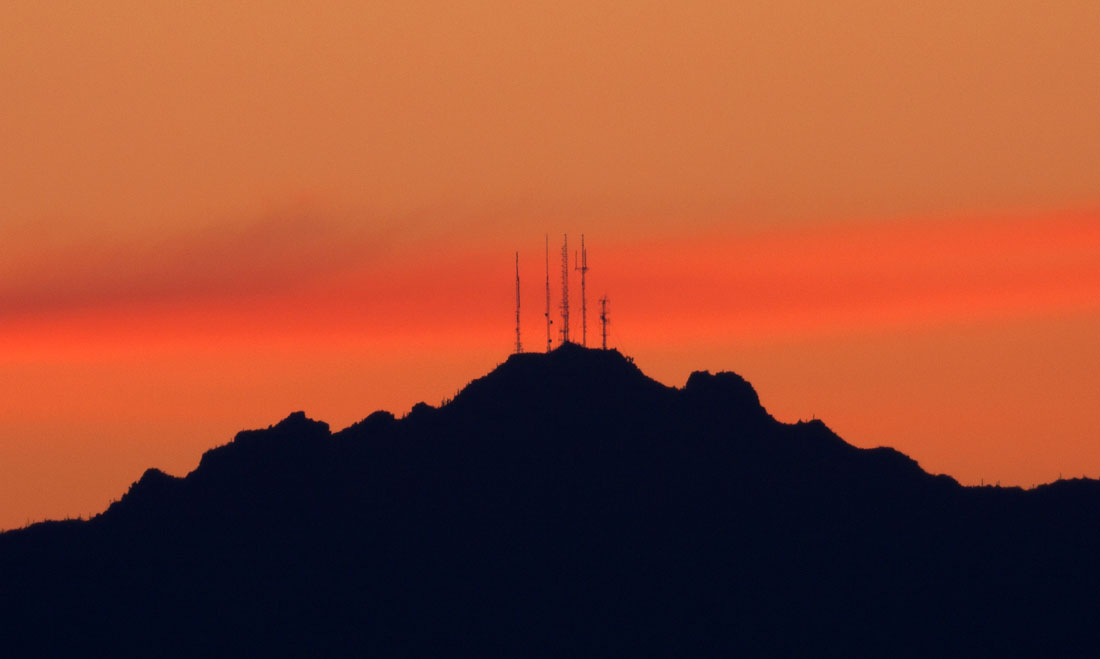
A couple other targets seen in daylight... There are many mountaintop observatories seen in and around Southern Arizona. Among them are Kitt Peak, Mount Hopkins, several atop Mount Lemmon and Mount Bigelow and of course, Mount Graham. Few know about the one south of the border near Cananea, Sonora. The Guillermo Haro Astrophysical Observatory is located about 20 miles south of the US border and 8 miles NE of Cananea, a copper-mining town in Sonora. I took a series of images of likely mountaintops with the TEC140, waiting till I got home to find the correct one after goosing contrast in Photoshop. Shown at left, it is about 100 miles distant from Geology Vista... Mentioned above, Mount Bigelow is home to some UA scopes, hidden among the trees, but from my vantage point, a nice array of TV transmitters for Tucson was visible from about 3.25 miles distance. It makes a nice resolution target - here cropped slightly from the Meade 80mm F/6 (480mm focal length).

Finally, as the sun set and it started darkening, I swung down towards the fairgrounds and took a few frames of the county fair midway. No great shakes with 25 miles of air between us, but the stripes of the big U.S. flag flying over the midway are easily resolved - still fun stuff nonetheless.

By the way, whenever I shoot through a telescope with this long of a focal length, there are a couple tricks to follow. Since vibration during even a short exposure can blur the image, I tend to always make sure "mirror lockup" on the camera is enabled, along with a 2-second (or more!) delay. That way, the vibration caused by the moving mass of the DSLR mirror has passed before the much lighter shutter vanes makes the exposure. This always helps get the sharpest images when shooting with focal lengths of 1,000mm or more.

It is always fun to spend time with telescope and camera, especially from a high location, just to see what you can see. Generally more than you think you can!

Wednesday, December 23, 2015

Five Sunsets!

We've just passed the Winter Solstice, and for those that know me, it's the season for imaging the setting sun past the silhouette of Kitt Peak National Observatory. Like the ancients gathered around Stonehenge for celestial alignments, I've been drawn to this one for well over 20 years, first recording the sunset behind the Observatory in 1988! Those days was with my 12" Newtonian telescope and film (!) camera pointed out of my old van! It is much easier now with portable refractors and digital cameras. I can park and be set up in minutes these days. At left is a GIF file I put together on the "optimum" date of 17 December - click for a larger version. At right is shown my current setup - TEC 140 triplet apochromatic telescope and the venerable Canon XSi camera. Note the home-built solar filter that we made in the TAAA filter workshop about a month ago - it has gotten lots of use lately!

The GIF image at left is quite remarkable. While it shows a few circular artifacts that I didn't see in the original files, what is amazing are the layers in the atmosphere. Formed from air at different temperature profiles, you can see their effect on the image both at the suns edge, and also in the appearance and spacing of the two sunspots. It looks like watching an image at the bottom of a wavy pool!

Why the "Five Sunset" title? Well it hit me that I really didn't know how the image correlated to Kitt Peak very exactly. I knew if you were at "the spot" a few days before and after solstice, you could catch the alignment. I wanted to learn a little more about the situation. About the time I decided to do this, it was 10 days before solstice, so went up alternate days 5 times. It really was an amazing experience! Every sunset was different. Most were clear, one had some clouds during sunset, the last night it completely clouded up 30 minutes after sunset.

The end result is shown here at left.  I started on the 13th, when the sun was still moving southward more than a fifth of its diameter every 2 days. Of course, its southward motion slowed and stopped on solstice day on the 21st, taken just a few hours before the start of Winter. While the casual observer might think the sun wouldn't cover the observatory on most of those dates from this image, note the suns sweeping left-to-right motion for us here in the Northern Hemisphere. Because of the horizontal motion, I caught the full Observatory silhouette on 3 of the 5 evenings, all observations from the exact same spot. As you can see at right, after the first alignment happens about the 17th, the sun continues to move southward, appearing to lower from day to day as it sweeps past the Observatory. On solstice day, it BARELY covers the full silhouette - it helps to move northward as far as you can along the curve to help you catch more solar disk.

But the silhouette wasn't the only thing to see! Like I said above, every one was different - the first day it was very hazy - at least the inversion layer was above the observed level of Kitt Peak and it appeared very hazy. The result was that when the sun dropped below the observatory profile, the peaks projected their shadows into the hazy air, shown at left. Similarly, the next trip up on the 15th, I was shooting the disk (Meade 80mm F/6) as it dropped below the mountain and I caught a bit of blue/green flash between a crack in the mountain, and at the same time, caught more rays being cast upwards and outwards from the suns position, shown at right.


It often paid to not to hurry home. On the evenings when there were clouds, there were spectacular sunsets. At left is a nice example - a 3-frame panorama taken with a 300mm lens plus a 1.4X tele-converter. On another night, I had planned to pause at "Bad Dog" (actually Babad Do'ag) overlook near the lower slopes of the Catalinas to shoot Kitt Peak silhouetted not by the setting sun, but with late twilight glow with the city lights in the foreground. At right is a 5 frame panorama taken with the Meade 80mm F/6 (480mm focal length) and 10 second exposures. I love catching the contrast of the dark-sky observatory within view of the urban lights of Tucson. Besides the lights of Tucson's downtown skyline, the bright lights are from the UA football practice field, where the team was practicing for their upcoming bowl game.

I've got some more items of interest here, but will have to wait for a subsequent post.

Saturday, March 21, 2015

Look to the West!

The multi-planet alignments in the western sky at sunset are slowly coming to an end. Mars and Venus, so close a month ago, are now widely separated, and Uranus, visible next to Mars just 10 days ago, is nowhere to be seen as it appears to move too close to the sun from our perspective. Tonight, however, the moon, fresh from its solar eclipse Friday morning in far northwestern Europe, appeared tonight (Saturday) adjacent to Mars. I drove up to "Bad Dog" overlook on the Mount Lemmon Highway to improve my western horizon. I arrived minutes before sunset, and was able to barely capture the moment of sunset behind the Tucson Mountains about 24 miles away, and the saguaro cacti on the slopes of the Catalinas considerably closer. I enjoyed the view of city lights coming up as the Moon/Mars conjunction became visible.


I wasn't sure how close Mars and the Moon would appear - I was hoping to use the William Optics 11cm, F/7 refractor used for the sunset above, but once Mars popped out, it wouldn't quite fit with the 770mm focal length. Fortunately, I was prepared and brought my smaller Meade 80mm F/6 for 480mm of focal length for the view shown at left. Mars is in the lower left, and if you click the image to load the full-size view, you can also spot a couple of 6th magnitude stars in Pisces. Of course, the "dark side" of the Moon is visible because with the skinny crescent phase, from the Moon's surface, there is a nearly full Earth illuminating it. Called "Earthshine", it is easily seen during the crescent moon phase.


A little later as it got darker, I finally broke out the kit lens for the Canon XSi to take a wide-angle shot. Visible at left is the Moon/Mars pair, and also brilliant Venus above it. I went looking for the much dimmer planet Uranus, visible near these planets the last few weeks, but it has appeared to have dropped too close to the sun to spot.

There is still good reason to watch the west, though... Tomorrow (Sunday), the moon continues its path away from the sun and is adjacent to the brighter planet Venus - be on the lookout if your skies are agreeable!

Wednesday, January 1, 2014

Chasing Skinny Crescents!

Earlier in the week, Sky and Telescope magazine told us of a New Year's Day observing challenge - from the western US, it was possible to spot a very young moon, well under 24 hours after new moon.  It favored us as this time of the year, the ecliptic (path the moon, sun and planets follow), is nearly vertical in the western sky, the moon is near perigee so it appears to move faster, and the timing was right since new moon was at 4:14am Mountain Standard time earlier in the day.  The difficult part was picking it out of the bright twilight shortly after sunset, so a mountain location for clearest skies were perhaps called for...  Hey, it was a holiday, and it was a beautiful New Year's Day, so why not go for a little drive and go for it!

In addition to the skinny crescent of the moon, Venus is nose-diving towards inferior conjunction in a few days (11 January), and would be less than 8 degrees from the moon.  Trying to image the small crescent like we did in Rocky Point last week would be tough because of its low elevation, so again, with the day off, I went after it as the planet transited high in the sky! According to the planet information in Heavens-Above, it would pass due south about 40 degrees high at 1330, so set up the William Optics 11cm APO to try to find it. Binoculars helped to sweep it up, but it was tougher than I thought, since it was only 15 degrees from the sun. I never saw it visually, but once in the scope it was easy. It was still bright enough that I had to use 1/2000 second exposure (a single exposure shown here), and it still might have been overexposed. That is why the sky looks pretty dark, but it is a good shot of the skinny crescent as it passes between us and the sun. The crescent was also easily seen in binoculars, but you only have another couple days to spot it!

About an hour before sunset, Melinda and I
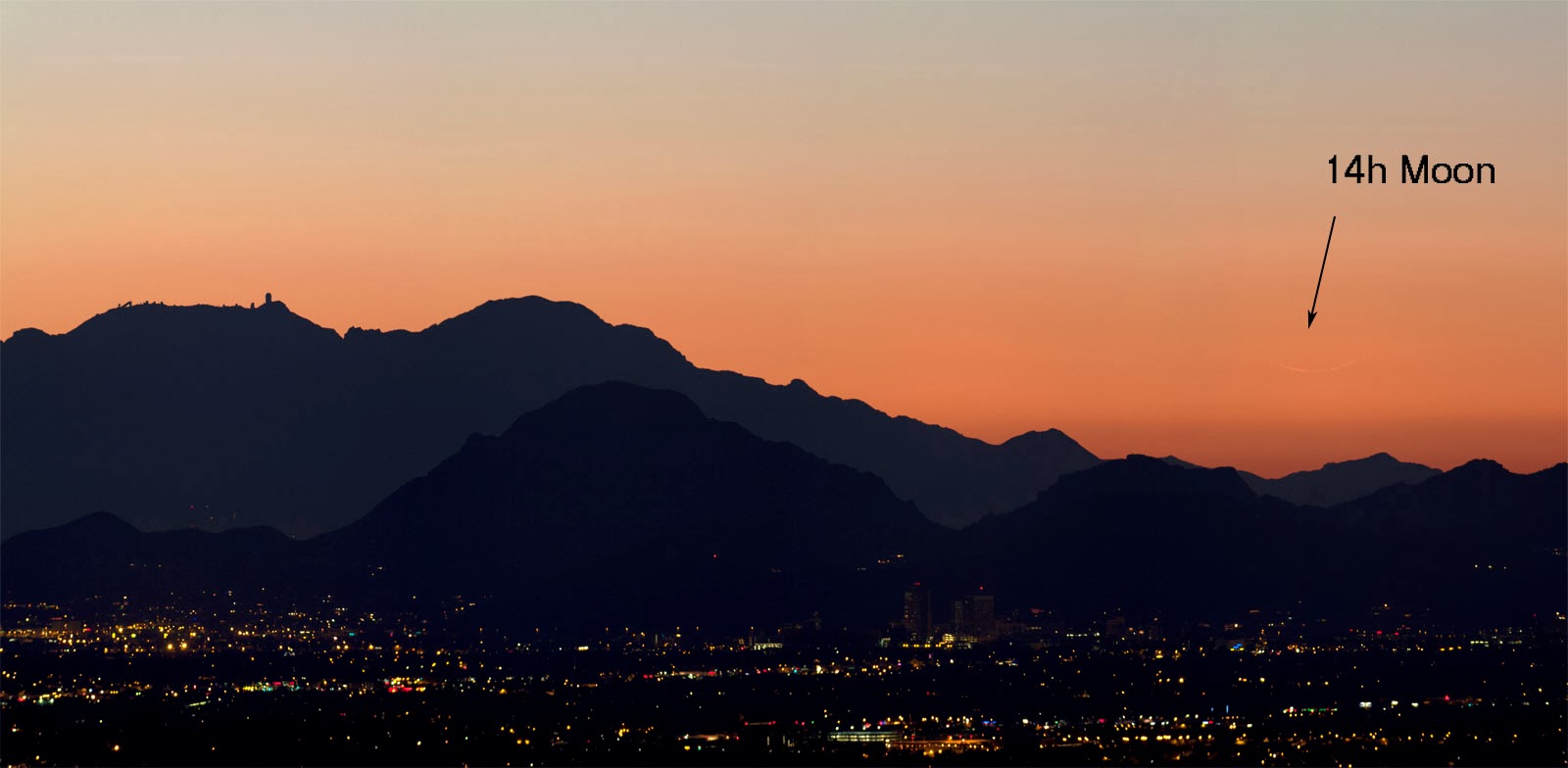
jumped in the van with a couple scopes and cameras and headed to the Mount Lemmon Highway, to the Babad Do'ag (Bad Dog to its sacrilegious friends) lookout.  From this vantage point the sun would set just south of Kitt Peak National Observatory across the Tucson valley, and with any luck, the moon would also be near the silhouette of the Observatory!  I set up a sturdy tripod and  used a little Meade 80mm F/6 (480mm focal length) for some shooting, as well as the 70-200 zoom.  Melinda spotted Venus before sunset, but as the minutes ticked away, I was worried we wouldn't spot the little lunar crescent in the still-bright sky...  Finally, with minutes left before I figured we might as well pack up, I spotted it in 10X44 binoculars!  It was just to the right of Kitt Peak, and barely as high as the top of the mountain!  After I pointed it out to her, Melinda swept it up too and I spent the next few minutes shooting a little mosaic with the Meade, and also catching it with the zoom with Venus in the frame (1/4 second, F/6.3 @90mm focal length, ISO 200).  It was tough to spot, I don't think there was a chance to see it naked eye, but the little elevation we got off the first 3 miles of the Mount Lemmon Highway likely helped.  Looking at it in Photoshop, it was even tough to see in the wide frame without zooming in, so I inserted a magnified, enhanced sub frame to show it better.  It is much easier to see in the 4-frame Meade mosaic with longer exposure (1 second, F/6, ISO 200) and slightly darker sky.  It is visible way on the right edge of the frame, so make sure it is on your screen if you load the full-size image...

In the end, looking at the time stamp, corrected to proper time, we spotted the moon at 1806 local time when the moon was 13h52m old (after new).  Likely a new record for me, though I'm not sure I've ever gone out looking for young moons before.  It was fun - any excuse to get under a clear sky!